2026 Doctrine and Covenants Revisions Announced by Mormon Church represent the first major scriptural update since 2013, driven by 20+ years of historical scholarship through the Joseph Smith Papers Project. The Church made 25 section introduction adjustments based on newly documented historical evidence, reshaping how members understand the origins of foundational Mormon doctrine.
Quick Overview — What You Need to Know
- 📖 25 Doctrine and Covenants section introductions were revised in late 2025, with changes announced formally by the Church early 2026.
- 📖 15 revisions corrected factual errors (dates, locations, minor inaccuracies); 10 added historical context based on Joseph Smith Papers research.
- 📖 Section 132 (on eternal marriage and polygamy) saw a key change: the phrase “as early as 1831” was removed, altering historical precision around the revelation’s dating.
- 📖 Emma Smith’s role was acknowledged in the Word of Wisdom section, crediting her influence alongside the Prophet Joseph Smith.
- 📖 Changes are available digitally now on ChurchofJesusChrist.org and the Gospel Library app; printed scriptures will reflect updates in coming months.
2026 Doctrine and Covenants Revisions Announced by Mormon Church: The Core Story
Here’s what actually happened. The Church of Jesus Christ of Latter-day Saints quietly released a series of adjustments to the Doctrine and Covenants — one of the faith’s four canonized scripture volumes — based on 20+ years of rigorous historical scholarship.
This is not new doctrine. This is not a theological rewrite. This is something narrower and, in some ways, more significant: the Church is saying, “We’ve studied the original documents more carefully, and we now understand the historical context differently.”
Elder Kyle S. McKay, the Church Historian and Recorder, framed it this way: “These adjustments bring the section introductions in line with what we have learned from more than twenty years of careful study of Joseph Smith’s documents. The minor changes to dates and places reflect the careful attention with which we believe this remarkable legacy of divine revelation ought to be treated.”
That’s the whole thing, right there. It’s not revolutionary. It’s scholarly. And it matters because the Doctrine and Covenants is the textual foundation of Mormon belief.
The Revisions at a Glance
| Section | Type of Change | What Changed | Why It Matters |
|---|---|---|---|
| Section 2 | Location correction | “House of the Prophet’s father” → “Smiths’ log home at Palmyra” | More precise historical documentation |
| Section 78 | Wording correction | “Mercantile and publishing” → “Literary and mercantile” | Reflects original wording more accurately |
| Section 89 | Historical acknowledgment | Added Emma Smith’s role in the Word of Wisdom inquiry | Recognizes women’s influence on doctrine |
| Section 94 | Contextual clarity | Added explanation about Kirtland as a stake of Zion | Helps readers understand settlement patterns |
| Section 96 | Major revision | Clarified Church name as “The Church of Jesus Christ of Latter-day Saints” and mentioned Far West as gathering place | Addresses naming and geographic context |
| Section 132 | Dating precision | Removed “as early as 1831” phrase | Reflects uncertainty about exact dating |
| Chronological order | Multiple sections | Updated dates from specific months to “May or June” or “Late winter or spring” | Acknowledges historical imprecision |
Sources: Church Newsroom, Joseph Smith Papers Project, Gospel Library[1][2][3]
The Section 132 Change — Why People Are Paying Attention
If you want to understand why these revisions matter, focus on Section 132. It’s the most discussed change, and for good reason.
Section 132 is the revelation on eternal marriage. It’s also the theological foundation for 19th-century polygamy in the faith. For decades, the section introduction stated the revelation was given “as early as 1831.” That specific dating gave a precise timeline for when Joseph Smith received what Mormons believe is direct revelation from God.
In the 2026 revision, that phrase was removed. The introduction now simply says “earlier,” a single word replacing a specific historical claim.
What does that mean? It means the Church is saying, “We can’t pin down the exact date with the precision we previously claimed.” And that matters because it acknowledges the limits of historical evidence. The Joseph Smith Papers Project, which has exhaustively examined the Prophet’s original documents over two decades, found that the dating was less certain than the Church’s traditional account suggested.
This is not a reversal of doctrine. Polygamy is still part of Mormon history. But it’s a recalibration of historical specificity. And that recalibration signals something important: the Church is willing to update its narratives when scholarship demands it.
Emma Smith and the Word of Wisdom — A Woman’s Voice Emerges
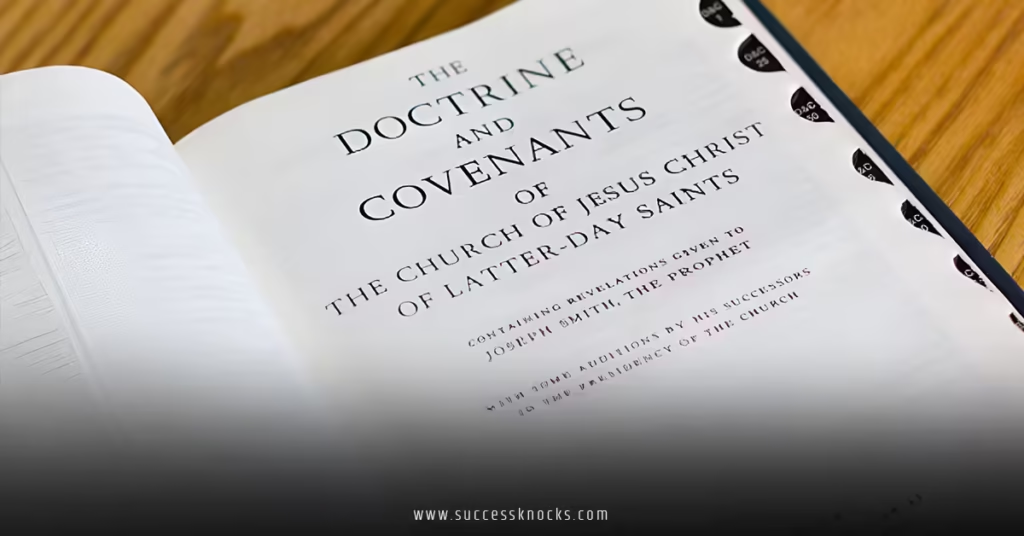
2026 Doctrine and Covenants Revisions Announced by Mormon Church Here’s a quieter but equally significant shift. Section 89 is the Word of Wisdom, the revelation forbidding tobacco, alcohol, and hot drinks (coffee and tea).
The old introduction said: “As a consequence of the early brethren using tobacco in their meetings, the Prophet was led to ponder upon the matter; consequently, he inquired…”
The new introduction says: “As a consequence of the early brethren using tobacco in their meetings, and how that concerned his wife, Emma Smith, the Prophet inquired.”
One phrase. One name. Emma Smith is now explicitly credited as part of the inquiry process.
Why does that matter? Because for 150+ years, the Word of Wisdom was framed as Joseph Smith’s solitary response to a problem. The new wording acknowledges that his wife — a woman with agency and concern — was part of that process. It’s not a doctrinal change. It’s a historical correction that repositions women’s agency in Mormon founding narratives.
This pattern appears elsewhere in the revisions too. The Church is not rewriting its past. It’s saying, “When we look more carefully at the documents, we see contributions and context we previously missed.”
The Bigger Picture: Why 2025–26 Revisions Happened Now
2026 Doctrine and Covenants Revisions Announced by Mormon Church The timing is not random. The Joseph Smith Papers Project, a massive multi-decade scholarly endeavor to document and analyze Joseph Smith’s original texts, reached a conclusion in 2025. With that academic work complete, the Church undertook a comprehensive review of its Doctrine and Covenants section introductions to align them with whatever new understandings emerged from 20+ years of rigorous scholarship.
In a real sense, the Church is saying: “Here’s what we know now that we didn’t know before, or know with more clarity.”
This is distinct from doctrinal revelation. It’s historical housekeeping. But it’s significant housekeeping because it shows the Church’s willingness to update its foundational texts when evidence demands it. That kind of intellectual honesty is rare in religious institutions and noteworthy when it happens.
2026 Doctrine and Covenants Revisions Announced by Mormon Church: Beginner’s Action Plan
If you’re new to Mormon culture or scripture, here’s how to think about this.
Step 1: Understand the difference between doctrine and history.
The Doctrine and Covenants is scripture — the Church treats it as divine revelation. But the introductions to sections are not scripture; they’re scholarly context. This update is to the context, not the revelation itself.
Step 2: Know where to find the revisions.
They’re live now on ChurchofJesusChrist.org and the Gospel Library mobile app for most languages. Printed copies will follow in coming months. You don’t need to buy new scriptures.
Step 3: Pay attention to date changes.
Many of the 25 revisions shift specific dates to more general timeframes — “May” becomes “May or June”; “April” becomes “Late winter or spring.” That’s the Church acknowledging historical uncertainty.
Step 4: Look for context additions.
Beyond corrections, the Church added historical context to help readers understand why revelations were given and how they fit into Joseph Smith’s broader experience.
Step 5: Treat this as ongoing scholarship.
The Joseph Smith Papers Project is now complete, but scholarship on early Mormonism will continue. Future revisions are likely.
Common Mistakes in Interpreting These Changes
Mistake 1: Assuming this changes Mormon doctrine
The revisions update historical introductions, not the revelations themselves. Section 132 still says what it always said; the introduction is more cautious about dating. Fix it by separating scriptural text from explanatory headings.
Mistake 2: Thinking the Church is hiding something
The Church publicly announced these changes through official channels and provided detailed documentation. Fix it by checking the Church’s own newsroom and scriptural pages instead of relying on secondhand commentary.
Mistake 3: Overlooking the Emma Smith acknowledgment
The addition of Emma Smith’s role in the Word of Wisdom is historically significant, signaling a recalibration of women’s agency in Mormon narratives. Fix it by reading the specific section 89 change carefully instead of treating all revisions as trivial.
Mistake 4: Confusing section introductions with scripture itself
Section introductions are study helps written by scholars. The revelation text itself is what Mormons believe is divine. Fix it by understanding that updating a heading is different from changing doctrine.
Mistake 5: Assuming all 25 changes are equally important
15 revisions correct factual errors; 10 add context. The Section 132 and Emma Smith changes are the most substantive. Fix it by reading the detailed summary document from the Church instead of treating all adjustments as equivalent.
What the Church Historian Said — And Why That Framing Matters
2026 Doctrine and Covenants Revisions Announced by Mormon Church Elder McKay’s public comments are worth taking seriously. He said the adjustments “bring the section introductions in line with what we have learned from more than twenty years of careful study of Joseph Smith’s documents.”
That language does something important. It frames scholarship as a path to better understanding, not as a challenge to faith. The Church is saying, “Our commitment to truth-seeking includes being willing to update our historical narratives when evidence suggests we should.”
That’s not a small signal in a religious context. Many faiths treat historical claims as sacrosanct. The LDS Church is signaling that it treats history differently — as something that clarifies and improves with scholarship.
Key Takeaways
- 25 Doctrine and Covenants section introductions were revised in late 2025, based on 20+ years of Joseph Smith Papers scholarship.
- 15 revisions corrected factual errors (dates, locations); 10 added historical context.
- Section 132’s dating became less specific, acknowledging historical uncertainty around the eternal marriage revelation.
- Emma Smith was credited in the Word of Wisdom section, repositioning women’s agency in Mormon founding narratives.
- Changes are live digitally now on the Church’s official platforms; printed scriptures will reflect updates in coming months.
- This is scholarly update, not doctrinal change — section introductions are study helps, not scripture itself.
- The Church is signaling willingness to update its historical narratives when scholarship demands it, a notable intellectual move in religious contexts.
The 2026 Doctrine and Covenants Revisions Announced by Mormon Church are technically minor — a few words here, a date clarification there. But they reflect something larger: a religious institution attempting to align its historical claims with what rigorous scholarship suggests. That’s rare. That’s worth paying attention to. And for Mormon members and scholars of early American religion alike, these revisions are worth reading in full, not just in summary.
Frequently Asked Questions (FAQs)
Q: What are the main 2026 Doctrine and Covenants Revisions Announced by Mormon Church?
The Church made 25 adjustments to section introductions in late 2025–early 2026, based on Joseph Smith Papers scholarship. Changes included date corrections, historical clarifications, and added context — 15 factual corrections and 10 contextual additions.
Q: Does the 2026 Doctrine and Covenants revision change Mormon doctrine?
No. The revisions update the introductions to sections, which are historical study helps, not scripture itself. The actual revealed text remains unchanged. This is historical clarification, not doctrinal revision.
Q: Why was Section 132’s dating changed in the 2026 Doctrine and Covenants Revisions Announced by Mormon Church?
The phrase “as early as 1831” was removed because Joseph Smith Papers research suggests the exact dating of the revelation is less certain than previously claimed. Changing “as early as 1831” to simply “earlier” acknowledges that historical imprecision.
Read Also:successknocks.com