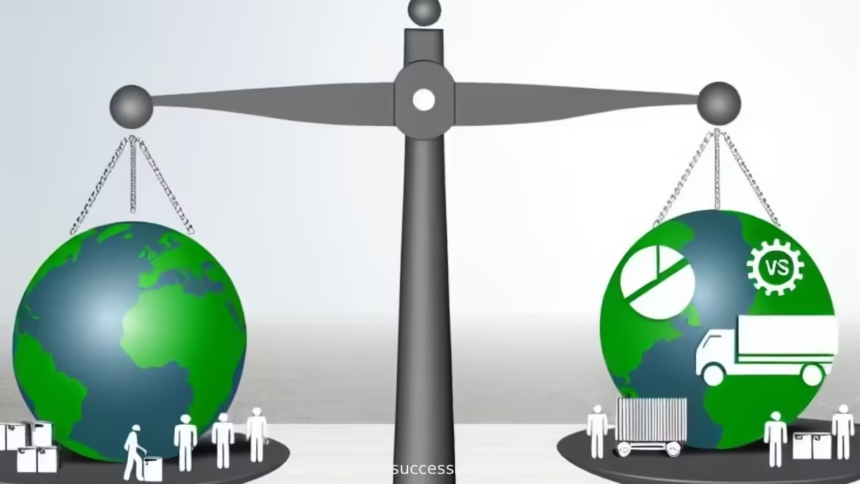
3PL vs in-house logistics comparison decisions used to be simple: big companies built their own warehouses, small ones didn’t have a choice. That’s not how it works anymore. In 2026, a scrappy DTC brand can ship like an enterprise, and a mid-size manufacturer can still get crushed by bad fulfillment math. The line between “outsource it” and “own it” has gotten blurry, and picking wrong is expensive.
Here’s the quick-hit version before we go deep:
- 3PL (third-party logistics) means you pay an outside company to handle warehousing, fulfillment, and shipping.
- In-house logistics means your team owns the warehouse, the labor, the trucks, and the tech stack.
- 3PLs usually win on speed-to-market and lower upfront cost; in-house usually wins on control and long-term unit economics at scale.
- The “right” answer depends on order volume, SKU complexity, and how fast you’re growing — not on which model sounds more impressive.
This piece is one slice of a bigger conversation. If you want the full lay of the land on outsourcing trends, margins, and where the industry’s heading, I laid it all out in the broader 3PL outsourcing trends guide, and it’s worth a read before you commit to either path.
What “3PL” and “In-House” Actually Mean
A 3PL is a hired gun. You send them inventory, they store it, pick it, pack it, and ship it — usually with their own warehouse space, software, and staff. You’re renting logistics capability instead of building it.
In-house logistics is the opposite. You lease or buy the warehouse. You hire the pickers, the forklift drivers, the ops manager who yells at everyone nicely. You own the whole machine, gears and grease included.
Neither is inherently “better.” They’re just different bets on where you want to spend money and energy.
The 3PL vs In-House Logistics Comparison, By The Numbers
Numbers make this real fast. Here’s how the two models typically stack up across the factors that actually move the needle.
| Factor | 3PL | In-House Logistics |
|---|---|---|
| Upfront Investment | Low — no warehouse, no equipment purchase | High — real estate, racking, tech, staffing |
| Cost Structure | Variable, pay-per-order/per-pallet | Mostly fixed, regardless of volume swings |
| Speed to Launch | Days to weeks | Months, sometimes longer |
| Control Over Process | Limited — you follow their SOPs | Total — you set every rule |
| Scalability for Peaks | Flexible — they absorb spikes | Rigid — you plan and staff for it yourself |
| Best Fit | Growing brands, seasonal spikes, limited capital | High-volume, predictable, brand-critical operations |
Cost is where most people get tripped up, because a 3PL’s per-order fee looks scary next to an in-house team’s “fixed” payroll — until you actually run the full math on labor, software, insurance, and downtime. I broke down every line item, fee type, and hidden cost in the full 2026 cost breakdown, and it’ll save you from comparing apples to spreadsheets.
The U.S. Bureau of Labor Statistics tracks warehousing and storage employment trends that show just how labor-intensive in-house fulfillment really is — staffing isn’t a side cost, it’s the whole ballgame. You can dig into the raw data on the Bureau of Labor Statistics warehousing industry page if you want the receipts.
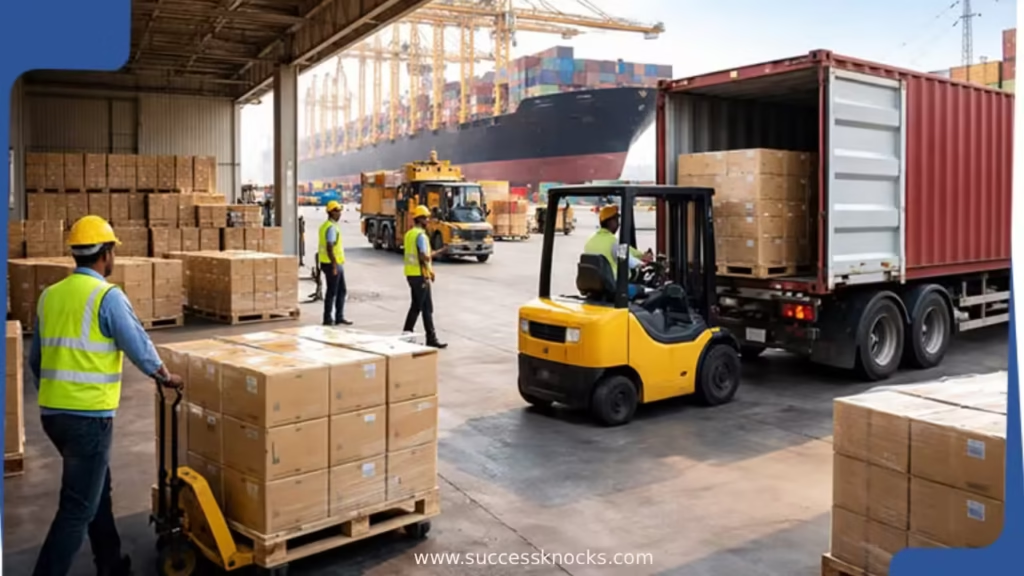
When the 3PL vs In-House Logistics Comparison Tips Toward Outsourcing
In my experience, 3PLs win when speed and flexibility matter more than granular control. If your order volume swings wildly by season, building a warehouse for your December peak means paying for empty space in July. That’s dead money.
A 3PL also wins when you’re testing a new market or SKU line. Why sign a five-year lease before you know the product sells? Let someone else absorb that risk while you validate demand.
When In-House Still Wins This 3PL vs In-House Logistics Comparison
In-house pulls ahead once you hit real volume — think thousands of orders a day, not dozens. At that scale, the fixed costs of your own operation start beating a 3PL’s per-order fees, and the math flips in your favor.
It also wins when your product needs specialized handling — think temperature-controlled goods, high-value electronics, or anything requiring custom kitting that a general 3PL just won’t do well. Control over quality becomes the whole point.
Here’s the thing though: in-house isn’t “safer” by default. Running your own fulfillment is like building your own kitchen instead of ordering takeout — total control, sure, but you’re also the one stuck doing dishes at 2 a.m. when a truck breaks down or a picker calls in sick.
Step-by-Step: How to Run Your Own 3PL vs In-House Logistics Comparison
You don’t need a consultant to figure this out. Walk through these steps, in order, and you’ll land on the right answer faster than most companies twice your size.
- Map your order volume for the last 12 months, including seasonal peaks and valleys.
- Calculate your true in-house cost — labor, rent, software, insurance, equipment, and turnover.
- Get quotes from at least three 3PLs and compare their per-order fees against your in-house math.
- Weigh control needs — does your product require custom handling that a general warehouse can’t offer?
- Stress-test for growth — will this decision still make sense at double your current volume?
- Pilot before you commit — test a 3PL with a portion of SKUs, or run in-house alongside outsourcing for a season.
That last step matters more than people admit. Ever tried scaling a warehouse team overnight during a Q4 rush? It’s brutal. A pilot period lets you feel the pain before it’s permanent.
Common Mistakes & How to Fix Them
Most companies don’t lose money because they picked the “wrong” model. They lose money because they picked without doing the homework. Here’s what usually goes sideways.
| Mistake | The Fix |
|---|---|
| Comparing only per-order 3PL fees to in-house payroll | Include every hidden in-house cost: software, insurance, turnover, downtime |
| Building in-house before volume justifies it | Wait until order volume is consistent and predictable, not a hopeful projection |
| Signing a 3PL contract without checking integration capability | Confirm their software talks to your storefront and inventory tools before signing |
| Ignoring peak-season capacity limits | Ask any 3PL directly how they handle volume spikes — get it in writing |
| Treating the decision as permanent | Revisit the model every 12–18 months as volume and product mix change |
The businesses I’ve watched get this right treat the decision as reversible. The ones that get burned treat it like a marriage vow.
Key Takeaways
- 3PL vs in-house logistics comparison ultimately comes down to volume, capital, and how much control you actually need.
- 3PLs offer lower upfront risk, faster launch, and better flexibility for seasonal swings.
- In-house logistics wins at scale, when fixed costs start beating variable per-order fees.
- Hidden costs — labor, software, insurance, turnover — are where in-house math usually falls apart if ignored.
- A pilot period, testing one model without fully committing, beats guessing every time.
- Revisit this decision periodically; the right call at $1M in revenue isn’t the right call at $10M.
- Neither model is “safer” — each just trades one kind of risk for another.
The Bottom Line
Look, there’s no universal winner in the 3PL vs in-house debate — anyone who tells you otherwise is selling something. What matters is matching the model to where your business actually stands today, not where you hope it’ll be in three years.
Run the real numbers, pilot before you commit, and revisit the call as you grow. That’s the whole game. If you’re leaning toward outsourcing and want to vet providers properly, the U.S. Small Business Administration has solid general guidance on vetting outside vendors and contracts on the SBA’s business management resource hub, which applies just as well to logistics partners as anything else.
FAQs
Is a 3PL cheaper than in-house logistics for a small business?
Usually, yes — at low-to-moderate order volume, a 3PL’s variable pricing beats the fixed costs of leasing warehouse space and hiring a full team. That flips once you hit high, consistent volume.
How do I know when to switch from a 3PL to in-house logistics?
Watch your per-order 3PL fees against your projected fixed in-house costs. Once your volume is high and predictable enough that owning the operation would cost less per unit, it’s time to run the numbers seriously.
Can a business use both 3PL and in-house logistics at the same time?
Absolutely, and plenty do. A hybrid setup — in-house for core, high-volume SKUs and a 3PL for overflow or seasonal spikes — is one of the smartest middle grounds in this whole 3PL vs in-house logistics comparison.