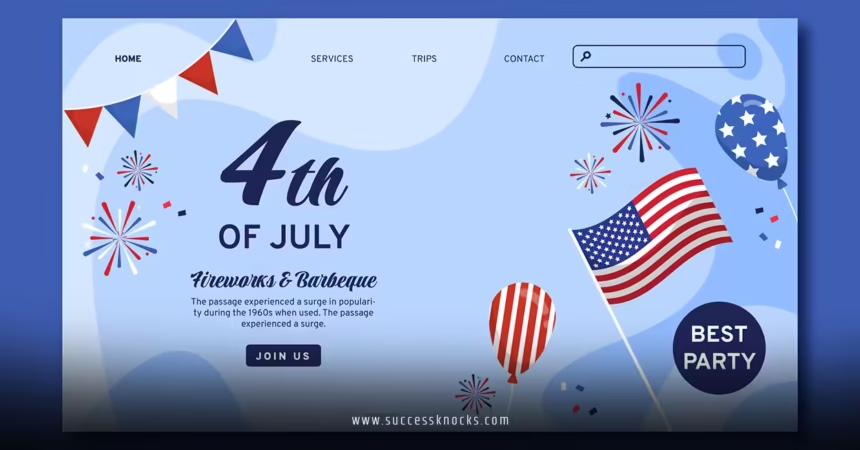
4th of july email marketing templates for ecommerce are your shortcut to launching high-converting, on-brand Independence Day campaigns without starting from a blank screen every time. Think of them as pre-wired sequences and layouts you can customize quickly so you spend more time making money and less time fiddling with design.
- Done-for-you structures for promos, flash sales, and last-chance offers you can plug into your ESP.
- Pre-written copy angles optimized for urgency, patriotism, and summer vibes (without getting cringe or controversial).
- Strategically timed sequences for the full holiday window: warm-up, launch, reminder, and post-holiday follow-up.
- Built to work with popular ecommerce platforms and ESPs, and align with best practices on deliverability and accessibility.
- Ideal for beginners who need guardrails and intermediates who want to move faster and test more.
Why 4th of july email marketing templates for ecommerce matter more than ever
4th of july email marketing templates for ecommerce give you an unfair advantage in a crowded promo week where everyone is yelling “SALE!” but only a few are actually being heard.
Here’s the big picture:
- Americans spend heavily around Independence Day on everything from apparel and home goods to outdoor gear and party essentials.
- Email is still one of the highest ROI channels for ecommerce, with multiple industry benchmarks (like those published by Shopify and Mailchimp) repeatedly showing it driving strong revenue per send.
- The brands that win aren’t just sending one promo email. They’re running orchestrated sequences that warm up, launch, remind, and follow up.
In my experience, the teams that prepare tight templates before the rush are the ones that actually ship on time, stay consistent with their branding, and squeeze the most revenue out of a short window.
Fast reference: types of 4th of july email marketing templates for ecommerce
Here’s a quick comparison so you know what to build first.
| Template Type | Primary Goal | Best Send Time | Who It’s For | Key Elements |
|---|---|---|---|---|
| Teaser / Warm-Up | Build anticipation, grow intent | 5–10 days before July 4th | All subscribers, especially engaged | Curiosity subject line, hint at discount, CTA to stay tuned / join VIP list |
| Main Launch Promo | Drive peak sales | July 1–3 | All promotional subscribers | Clear offer, bold headline, hero product, urgency, social proof |
| Last-Chance Reminder | Capture fence-sitters | July 4 | Non-buyers & non-openers from previous sends | Hard urgency, countdown, concise copy, simple CTA |
| VIP / Early Access | Reward loyal customers | 1–2 days before public launch | High-LTV / loyalty segment | Exclusive access, extra perk, personal tone |
| Post-Holiday Follow-Up | Increase AOV & retention | July 5–7 | Recent buyers | Thank you message, product care tips, cross-sell, review request |
Core strategy: how to think about 4th of july email marketing templates for ecommerce
Before writing a single subject line, zoom out.
What usually happens is this: brands slap flags on their graphics, toss in a discount, send one email, and call it done. Then they wonder where the revenue is.
Better approach:
- Treat July 4th like a mini-cyber-week, not a one-off send.
- Plan a sequence that follows a customer journey: awareness → consideration → decision → loyalty.
- Build reusable templates around that journey, not random one-and-done designs.
Here’s the thing: your “template” isn’t just the layout. It’s the combo of:
- Email type (teaser, launch, reminder, follow-up)
- Offer structure (percent off, bundle, tiered discount, free shipping)
- Messaging angle (patriotic, summer fun, budget-friendly, family-focused)
- Visual style (bold colors, subtle accents, or minimal with a hint of red, white, and blue)
Get those pieces right, and you can reuse 70–80% of the structure next year with minor tweaks.
Plug-and-play 4th of july email marketing templates for ecommerce (copy you can adapt today)
1. Teaser / warm-up template
Subject line ideas:
- “Something big is lighting up your July 🎆”
- “Our Independence Day deals are almost here…”
- “4th of July is coming. Your cart’s about to be happy.”
Email skeleton:
- Preheader: “Early access. Limited-time offers. Keep an eye on your inbox.”
- Hero headline: “4th of July is about to get a whole lot brighter.”
- Subhead: “Exclusive offers are launching soon. Want first dibs?”
- Body copy (short):
- One sentence on what’s coming (sitewide sale, bestsellers, bundles).
- One sentence on why they should care (save $$, limited stock, new drops).
- Primary CTA: “Join the early access list” or “Get notified first” (link to SMS list, early-access segment, or app download).
- Secondary content: Small preview of categories (e.g., “Backyard essentials,” “Red, white & new arrivals”).
Use this email to build a VIP or early-access segment you’ll hammer during the main window.
2. Main launch promo template
Subject line ideas:
- “4th of July Sale: Up to 30% off starts NOW 🇺🇸”
- “It’s live: Independence Day deals you can’t ignore”
- “This is your sign to stock up for summer”
Structure:
- Preheader: “4th of July savings on [product category]: ends July 4 at midnight.”
- Hero headline: “Our 4th of July Sale is officially ON.”
- Offer block:
- Clear statement: “Save 25% sitewide” or “Buy 2, get 1 50% off.”
- Fine print in smaller text (minimums, exclusions, end date).
- Featured products:
- 3–6 product cards with images, short benefits-driven description, and price.
- Highlight items relevant to summer, outdoors, gatherings.
- Urgency bar: “Ends July 4 • Limited stock • Free shipping over $X.”
- Primary CTA: “Shop the 4th of July Sale.”
- Secondary CTA: “Shop bestsellers” or “Shop under $50.”
This is your main moneymaker. Keep it scannable. Big buttons. Minimal fluff.
3. Last-chance reminder template
Subject line ideas:
- “Last hours to save for the 4th 🎇”
- “Final call: 4th of July deals end tonight”
- “You’ve got one more shot at these savings”
Structure:
- Preheader: “Your 4th of July discount expires at midnight.”
- Hero headline: “Last chance before the fireworks fade.”
- Timer graphic or text countdown:
- “Only [X] hours left to save up to 30%.”
- Body copy (keep it tight):
- One line: remind of offer.
- One line: what they’ll regret missing (outdoor must-haves, party gear, etc.).
- Primary CTA: “Grab your 4th of July deal.”
- Secondary CTA (optional): “Shop bestsellers before they’re gone.”
This email should be shorter than your main promo. Less talking, more nudging.
4. VIP / early access template
Subject line ideas:
- “You’re first in line for our 4th of July sale”
- “VIP only: 4th of July deals start early”
- “Because you’re one of our favorites…”
Structure:
- Tone: More personal, “we handpicked this for you” vibe.
- Hero headline: “Early access just for you.”
- Offer copy:
- “Start shopping our 4th of July Sale 24 hours before everyone else.”
- Extra perk: “Plus, get an additional 10% off with code VIPFIREWORKS.”
- CTA: “Unlock early access.”
- Fine print: Keep it clear so VIPs don’t get confused later when the public sale starts.
Used well, this template boosts retention and makes your best customers feel like insiders.
5. Post-holiday follow-up template
Subject line ideas:
- “Thanks for celebrating with us 🇺🇸”
- “Your 4th of July haul: how to get the most from it”
- “One small thank-you for a big 4th”
Structure:
- Hero headline: “You made our 4th of July.”
- Body:
- Short thank-you message.
- Helpful tips: care instructions, styling ideas, recipes, or how-to content related to what they bought.
- Cross-sell / related products:
- “You might also like” section with complementary items.
- Soft CTA: “Explore what’s next for summer.”
- Optional: Invite reviews or UGC (“Share your 4th with us on Instagram using #[yourbrand]4th”).
This is where you shift from pure selling to relationship-building and long-term AOV.
Step-by-step action plan: from zero to live 4th of july email marketing templates for ecommerce
For beginners and intermediate marketers, here’s the practical sequence to get this done without spinning your wheels.
Step 1: Clarify your offer and constraints
- Decide your primary offer: percent off, dollar off, bundles, free shipping, or tiered discounts.
- Check margin and inventory so you’re not discounting items you can’t afford or don’t have.
- Make sure your legal terms and conditions are set (refunds, exclusions, dates).
If you need help framing discounts profitably, checking platforms like Shopify’s ecommerce blog for promo strategy is worth it.
Step 2: Map your email sequence
At minimum, line up these sends:
- Teaser / warm-up
- Main launch promo
- Last-chance reminder
- Optional: VIP early access
- Optional: Post-holiday follow-up
Assign target dates and times. For U.S. audiences, late morning or early afternoon local time often performs well, but test against your historical data in your ESP.
Step 3: Draft copy using the templates
- Start with subject lines and preview text—these drive opens.
- Plug in your offer, product categories, and brand voice into the skeletons above.
- Keep paragraphs short and bullet lists frequent for scannability.
In my experience, writing in a doc first, then pasting into your ESP, prevents “design-first” bloat and keeps the message sharp.
Step 4: Design once, reuse smartly
- Set up one core design in your email service provider (e.g., Klaviyo, Mailchimp, Omnisend).
- Lock your logo, footer, typography, and brand colors.
- Make swappable content blocks (hero, product grid, testimonial, timer).
Design accessibility matters: use proper contrast, minimum 14–16px body text, and descriptive alt text. Accessibility guides from reputable organizations like the Web Accessibility Initiative are helpful references.
Step 5: Segment your audience
Even beginner-level segmentation helps:
- Engaged subscribers (opened/clicked in last 30–90 days)
- Customers vs. non-customers
- High-value / VIP segment (top 10–20% by spend)
- Location if relevant (U.S.-only promo? Filter accordingly.)
Send every 4th of july email marketing template for ecommerce to the segment that makes sense, not your entire list blindly.
Step 6: Set up tracking and testing
- Add UTM parameters to your CTAs for clear attribution in analytics tools.
- A/B test at least one variable: subject line, hero headline, or offer framing.
- Monitor open rate, click rate, revenue per recipient, and unsubscribe rate.
Authoritative analytics resources like Google Analytics documentation can help you interpret those metrics correctly.
Step 7: QA everything before you hit send
Run a checklist:
- Links working?
- Discount codes accurate?
- Dates and times correct for the holiday?
- Mobile preview looks clean?
- Alt text present and understandable?
Send test emails to yourself and at least one teammate on both desktop and mobile. Fix what feels even slightly off.
Common mistakes with 4th of july email marketing templates for ecommerce (and how to fix them)
Mistake 1: Overdoing the patriotic visuals
Problem: Over-the-top flags and fireworks make the email look like a clip-art project, not a brand you trust with payment info.
Fix:
- Use a subtle palette: hints of red, white, and blue, not a full explosion.
- Keep product photography front and center; holiday accents should support, not dominate.
- Use clean, modern typography instead of novelty fonts.
Mistake 2: Only sending one email
Problem: One send = leaving money on the table. People miss emails. People procrastinate. Life happens.
Fix:
- Use a minimum 3-email sequence: teaser, launch, last chance.
- Resend to non-openers with a tweaked subject line.
- Scale up for bigger lists with VIP and post-holiday follow-ups.
Mistake 3: Generic, “could-be-any-brand” copy
Problem: The email sounds like everyone else. No brand voice. No specificity. Forgettable.
Fix:
- Bake in brand personality: phrases, jokes, or phrasing you use year-round.
- Reference specific product benefits: “spill-resistant,” “UV-protective,” “kid-proof,” not just “perfect for July 4th.”
- Write like you talk to a smart friend, not like you’re filling a brochure.
Mistake 4: Ignoring mobile experience
Problem: Long walls of text, tiny buttons, and cramped layouts crush conversions on phones.
Fix:
- Single-column layouts. Big buttons. 1–2 lines per paragraph.
- Put the main offer and CTA above the fold.
- Test on multiple devices and email clients if your ESP supports it.
Mistake 5: Weak list hygiene and deliverability
Problem: You send your best 4th of july email marketing templates for ecommerce… and they land in spam or promotions tabs where no one sees them.
Fix:
- Regularly clean your list by suppressing unengaged subscribers after a reasonable window.
- Authenticate your domain (SPF, DKIM, DMARC) following guidance from your ESP and email standards bodies.
- Avoid spammy phrasing and excessive images with no supporting text.
Advanced angles: stand out from the discount noise
If you’re beyond the basics, here’s what I’d test.
1. Mission-aligned messaging
Not every audience loves overt patriotism. Some respond better to community, family, or shared experiences.
You can angle your templates around:
- “Summer memories with people you love.”
- “Long-weekend comfort and convenience.”
- “Hosting without stress.”
You still reference the 4th, but your focus is the customer’s life, not the flag.
2. Bundles and curated collections
Instead of random discounting:
- Create “4th of July party packs,” “BBQ starter kits,” or “Red, White & New wardrobe bundles.”
- Feature those bundles prominently in your templates with one-click add-to-cart.
That reduces decision fatigue and increases AOV.
3. Evergreen template reusability
Design your 4th of july email marketing templates for ecommerce so you can tweak and reuse them for Labor Day, Memorial Day, and other seasonal events:
- Swap color accents and imagery.
- Update copy references from “4th of July” to the next holiday.
- Keep the same structural blocks and automation flows.
It’s like building a reusable stage and changing the backdrop, not rebuilding the theater every time.
Key Takeaways
- 4th of july email marketing templates for ecommerce save time, boost consistency, and give you a proven framework to plug your offers into.
- Think in sequences, not single sends: teaser, launch, reminder, VIP, and follow-up win more revenue than a lone promo blast.
- Keep designs accessible, mobile-first, and brand-consistent, with subtle holiday accents instead of overwhelming patriotic clichés.
- Use segmentation and basic testing to send each template to the right audience and refine subject lines, offers, and CTAs.
- Common pitfalls—like generic copy, bad list hygiene, and ignoring mobile—are fixable with a simple checklist before you launch.
- Reusable structures let you adapt your 4th of July templates to other holidays, compounding your effort across the calendar.
- The brands that prep early and systematize their 4th of july email marketing templates for ecommerce walk into the holiday confident—and walk out with better numbers.
FAQs about 4th of july email marketing templates for ecommerce
1. How early should I start using 4th of july email marketing templates for ecommerce in my planning?
Ideally, start building and customizing your 4th of july email marketing templates for ecommerce 3–4 weeks before the holiday so you have time to finalize offers, design, and segmentation without rushing.
2. Can I reuse my 4th of july email marketing templates for ecommerce for other holidays?
Yes, if you build them with modular sections and neutral layouts, you can easily adapt your 4th of july email marketing templates for ecommerce to Labor Day, Memorial Day, or Black Friday by swapping copy, colors, and images.
3. What’s the minimum sequence I need for 4th of july email marketing templates for ecommerce if my team is small?
If you’re lean on resources, create a simple three-part sequence with your 4th of july email marketing templates for ecommerce: one teaser, one main launch email, and one last-chance reminder to cover the key decision points.