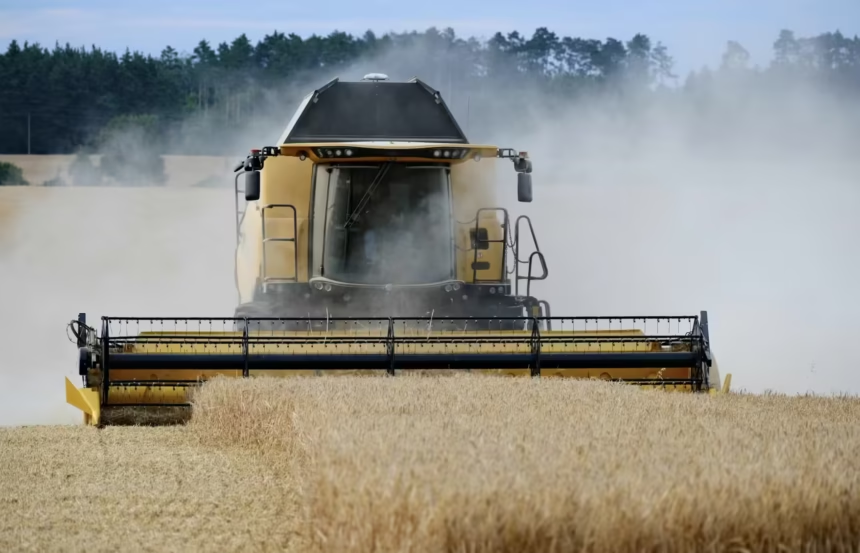
Running a farm efficiently comes down to more than what happens in the field. What you do with your harvest after it’s been gathered — how you store it, protect it, and move it to market — shapes your bottom line just as much as the growing season itself.
For many farmers, on-farm grain storage has shifted from a convenience to a competitive necessity. Managing your own inventory gives you control over timing, quality, and price in ways that simply aren’t possible when you’re dependent entirely on commercial elevators or tight post-harvest windows. Here’s a practical look at six ways grain bins deliver real value across the farm operation.
1. Storage Timing Becomes Your Decision
Harvest season is one of the most logistically compressed periods in farming. When everyone is bringing grain to market at the same time, elevator lines grow long, trucking costs spike, and prices drop as supply floods local markets simultaneously.
On-farm storage breaks that bottleneck entirely. With your own bins, you can harvest at the right agronomic time without being pressured to deliver before you’re ready. You move grain when roads are accessible, trucks are available, and your operation has the capacity to handle it — not when the calendar forces your hand.
That flexibility alone can translate into meaningful savings on transportation and drying costs during peak periods.
2. You Gain Pricing Power
Grain markets fluctuate constantly. Selling everything immediately after harvest often means accepting whatever price the market offers at that moment — which isn’t always a strong one. Stored grain gives you options.
Farmers who invest in the right grain bin infrastructure for their operation can hold inventory and sell into stronger market windows across the year, rather than accepting harvest-time lows as their only option.
Companies like Farm and Ranch Depot. offers a range of hopper bottom storage solutions sized to match different operation scales, making it easier to match storage capacity to realistic marketing goals.
3. Post-Harvest Losses Drop Significantly
Grain that isn’t stored correctly doesn’t just lose quality — it loses value. Moisture, temperature fluctuations, pests, and poor aeration can degrade a crop that was perfectly fine coming off the combine. That degradation costs money, and it’s largely preventable.
According to the U.S. Department of Agriculture, on-farm storage directly reduces post-harvest losses by giving producers effective, safe, and accessible storage — keeping grain in marketable condition far longer than field stockpiling or inadequate facilities can manage.
Modern grain bins with aeration systems, temperature monitoring, and moisture control take that protection further — giving farmers the ability to actively manage stored grain condition rather than simply hoping it holds.
4. Inventory Visibility Improves
When grain sits across multiple off-farm locations or is managed through external elevators, keeping accurate inventory records takes real effort. Knowing exactly how much you have, where it is, and in what condition it’s sitting becomes harder the more fragmented your storage picture is.
On-farm bins centralise that picture. A well-managed bin system, especially one equipped with modern monitoring technology, gives you:
- Real-time volume estimates based on fill levels
- Temperature and moisture data tracked over time
- Accurate records for insurance, financing, and sale decisions
- Easier reconciliation at tax time and year-end reporting
That clarity makes planning — for both the current season and the next — considerably more straightforward.
5. Feed Management Gets Simpler
For operations that raise livestock, grain storage has a second layer of value: it supports consistent, cost-effective feed management. Buying and storing feed grain in bulk when prices are low — rather than purchasing in smaller quantities throughout the year at varying prices — reduces feed costs meaningfully over time.
Hopper-bottom bins are particularly well-suited to this use case. Their funnel-shaped base allows grain to flow cleanly from the bottom without manual scooping or augering out residual product, reducing labour and ensuring older grain gets used before new inventory is added. That first-in, first-out flow matters for feed quality and reduces waste.
For diversified operations balancing grain production with livestock feeding, on-farm storage creates a direct link between the two sides of the business.
6. The Investment Pays Back Over Time
Grain bins aren’t a small purchase, but the return on investment case is well established. The ability to reduce post-harvest losses, capture better pricing windows, lower commercial storage fees, and cut transport costs during peak periods all contribute to a payback that most farmers see within a reasonable number of years.
There are also structural factors worth noting. As of late 2025, U.S. total grain storage capacity growth had stagnated while production continued to rise — meaning commercial storage is increasingly tight, and farmers with on-farm capacity have a genuine strategic advantage. When commercial elevators face overflow and charge premium rates, the cost comparison shifts further in favour of owning your storage.
Beyond economics, owning your storage also reduces dependency on third-party infrastructure — an important consideration when transportation disruptions, weather events, or market volatility create pressure on the supply chain.
Final Thoughts
Grain storage is one of those infrastructure investments that affects almost every other operational decision on the farm — when you sell, what you can afford to hold, how well you manage feed costs, and how accurately you track inventory. Getting the right storage in place changes the rhythm of the whole operation, not just the harvest period.
For farmers evaluating whether on-farm storage makes sense, the question usually isn’t whether it adds value — it’s which configuration matches the scale, crop mix, and marketing approach of their specific operation.