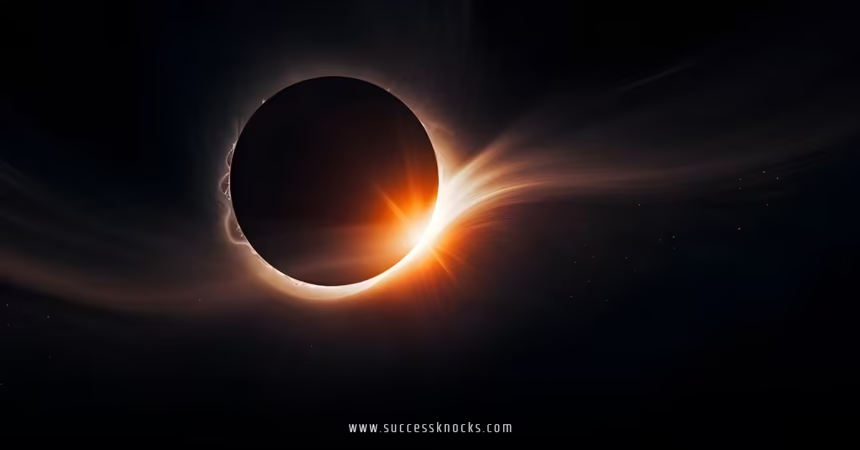
Solar eclipse myths and scientific facts explained – if you’ve ever felt a chill down your spine watching the moon swallow the sun, you’re not alone. For thousands of years, humanity has stared at the sky in awe, fear, and wonder when day suddenly turns to night. Some cultures thought dragons were eating the sun, others believed demons were attacking. Today we know better… or do we? Let’s dive deep into the most persistent solar eclipse myths and scientific facts explained in plain, exciting English so you can impress your friends at the next eclipse party.
What Actually Happens During a Solar Eclipse? (The Science First)
Before we bust any myths, let’s get the facts straight.
A solar eclipse happens when the Moon passes directly between Earth and the Sun, temporarily blocking sunlight. There are four types:
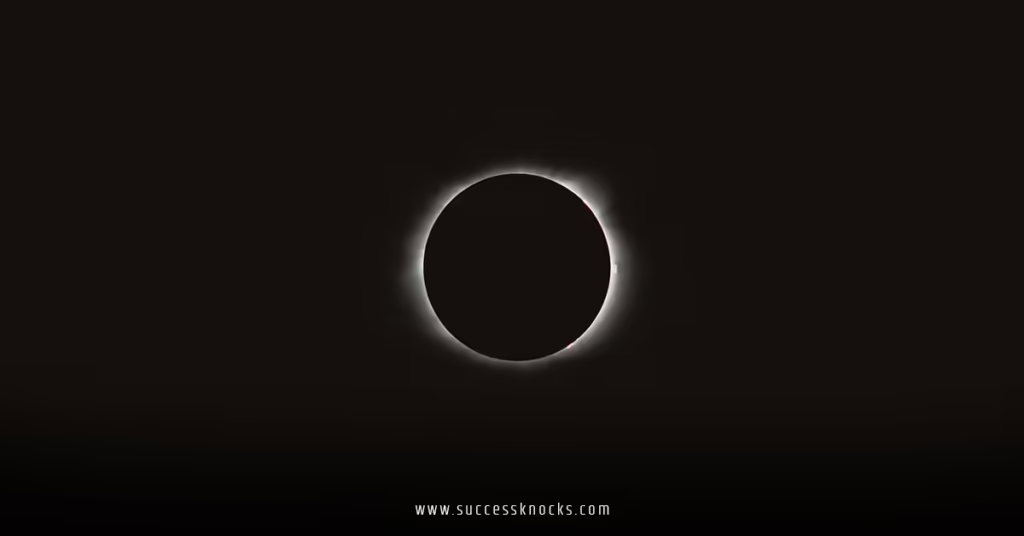
- Total solar eclipse – the Moon completely covers the Sun; day becomes dark, stars appear, temperature drops.
- Annular solar eclipse – the Moon is a bit farther away, leaving a glowing “ring of fire” around its edges.
- Partial solar eclipse – only part of the Sun is obscured, looks like a bite was taken out of it.
- Hybrid – shifts between total and annular along its path (rare and super cool).
The path of totality – where you see the full show – is usually only 100–200 km wide, but the partial phase can be seen across thousands of kilometers. The longest totality possible? About 7 minutes and 31 seconds. That’s it. Blink and you’ll miss the best part.
Top 10 Persistent Solar Eclipse Myths and Scientific Facts Explained
Myth 1: A Solar Eclipse Is Dangerous for Pregnant Women and Their Babies
This is probably the most widespread myth worldwide. In India, Mexico, parts of Africa, and many Asian countries, pregnant women are told to stay indoors, not eat, not sleep, not use knives, and sometimes even lie completely still during an eclipse.
Scientific fact explained: There is zero credible evidence that a solar eclipse harms unborn babies. No increase in birth defects, miscarriages, or cleft palates has ever been linked to eclipses in any large-scale medical study. The myth likely started because eclipses are rare and dramatic – perfect for superstition to fill the gap.
Myth 2: You Shouldn’t Eat or Drink During an Eclipse
Many cultures fast during an eclipse, believing food cooked or consumed then becomes “poisoned.”
Reality check: Food does not suddenly become radioactive or toxic because the Moon blocks the Sun for a few minutes. Eat your eclipse-watching picnic without worry (just don’t stare at the Sun while munching).
Myth 3: Eclipses Cause Earthquakes, Tsunamis, or Natural Disasters
Social media explodes with this one every single eclipse.
Science says: The gravitational pull during an eclipse is actually weaker than during a normal new moon because the Sun, Moon, and Earth are perfectly aligned – the forces partially cancel each other out. No measurable increase in seismic or volcanic activity has ever been tied to solar eclipses.
Myth 4: Looking at an Eclipse Will Instantly Blind You
This one has a grain of truth but is wildly exaggerated.
The real deal: Staring at the uneclipsed or partially eclipsed Sun without proper protection can cause solar retinopathy – permanent damage to your retina. However, during the brief moments of totality (when the Sun is 100% covered), it is perfectly safe to look with the naked eye. That’s the magic moment everyone waits for!
Myth 5: Ancient People Predicted Eclipses Perfectly – Modern Science Just Caught Up
We love romanticizing the Maya, Babylonians, or Stonehenge builders.
Truth: Ancient astronomers were brilliant at spotting patterns (the Saros cycle of 18 years 11 days was known to Babylonians), but they couldn’t predict the exact path of totality across Earth’s surface. Modern computing and NASA’s algorithms are orders of magnitude more precise.
Myth 6: Solar Eclipses Are Extremely Rare
Actually, solar eclipses happen 2–5 times every year somewhere on Earth. The catch? The path of totality is narrow, so any specific location only gets a total eclipse every 360–410 years on average.
Myth 7: Animals Go Crazy and Plants Die During Eclipses
You’ll see videos of chickens roosting at noon or cows lying down.
Explanation: Many animals have circadian rhythms tied to light levels of light. When the sky darkens dramatically, their bodies think it’s night. Plants don’t “die” – they just pause photosynthesis for a few minutes. Everything goes back to normal afterward.
Myth 8: Eclipses Are a Bad Omen or Signal the End of the World
From the Vikings banging pots to scare away sky wolves to modern doomsday preachers, eclipses have always attracted apocalyptic predictions.
Fact: Over 5,000 solar eclipses have been recorded in human history. The world is still here.
Myth 9: You Can Safely Watch an Eclipse Through Sunglasses, Phone Cameras, or X-Rays
Please don’t.
Only ISO 12312-2 certified eclipse glasses, #14 welder’s glass, or proper solar telescopes are safe for the partial phases. Regular sunglasses block maybe 50–70% of light – nowhere near enough.
Myth 10: The Corona You See During Totality Is the Sun’s Atmosphere on Fire
The glowing white crown around the Moon is jaw-droppingly beautiful, but it’s not fire.
Science: The corona is the Sun’s outer atmosphere – superheated plasma reaching millions of degrees but extremely thin, so it doesn’t fry us. It’s always there; we just can’t normally see it because the Sun’s surface is 10,000 times brighter.
Why Do Solar Eclipse Myths Persist in the 21st Century?
Even with smartphones and NASA livestreams, myths refuse to die. Here are three big reasons:
- Cultural inertia – traditions passed down for centuries feel sacred.
- Fear of the unknown – the sky going dark in the middle of the day is primal and unsettling.
- Viral misinformation – WhatsApp forwards and TikTok videos spread faster than fact-checks.
The good news? Education works. Countries that run strong public outreach (like the U.S. during the 2017 and 2024 eclipses) see huge increases in safe viewing practices and drops in superstitious behavior.
How to Safely Watch the Next Solar Eclipse (Step-by-Step)
- Check the date and path – websites like timeanddate.com or NASA’s eclipse site are gold.
- Get ISO-certified eclipse glasses early (they sell out!).
- If you’re in the path of totality, travel there – it’s a bucket-list experience.
- During partial phases: glasses on, always.
- During totality: glasses off, stare in awe, cry a little (it’s normal).
- Use a pinhole projector or colander for fun indirect viewing with kids.
The Emotional Power of a Total Solar Eclipse – Beyond Science and Myths
Solar Eclipse Myths and Scientific Facts Explained:Here’s something science can’t fully quantify: the feeling when the sky turns twilight purple, Venus and Jupiter pop out in daytime, the temperature drops 10–20 °F in minutes, and the Sun’s corona flares around a pitch-black Moon.
People scream, cry, propose marriage, and feel suddenly tiny in the universe. Even hardcore astronomers who’ve seen dozens get emotional. That raw, shared wonder is the real magic that no myth can touch.
Upcoming Solar Eclipses You Can Actually See (2025–2030)
- August 12, 2026 – Total eclipse across Iceland, Greenland, and Spain (perfect for Europeans!).
- August 2, 2027 – Total across Morocco, Egypt, Saudi Arabia – Luxor at sunset? Unreal.
- July 22, 2028 – Total across Australia and New Zealand.
- November 25, 2030 – Total across Southern Africa, including Namibia and Botswana.
Start planning now – flights and hotels book years in advance.
Conclusion: Embrace the Wonder, Ditch the Fear
Solar eclipse myths and scientific facts explained side by side show us something beautiful about being human: we are meaning-making creatures who look at a shadow on the Sun and see dragons, gods, omens – or pure cosmic mechanics. Both responses are valid in their own way. The myths remind us how awe-inspiring eclipses are; the science lets us enjoy them safely and deeply.
Next time the Moon photobombs the Sun, step outside (with proper eye protection!), feel the temperature drop, watch the birds go quiet, and remember: you’re witnessing one of nature’s most spectacular coincidences. No demons required.
Frequently Asked Questions About Solar Eclipse Myths and Scientific Facts Explained
Q1: Is it really safe to look at a total solar eclipse without glasses during totality?
Yes – but only during the exact minutes of 100% totality when the Sun’s disk is completely covered. The moment any sliver of Sun reappears (called the “diamond ring”), glasses go back on immediately.
Q2: Why do some cultures still tell pregnant women to stay indoors during an eclipse?
The belief stems from ancient fears that “harmful rays” during the eclipse could cause birth defects. Modern medicine has found no evidence whatsoever, but cultural traditions change slowly.
Q3: Can animals really predict a solar eclipse?
No. They simply react to the sudden drop in light levels, just like they would during a heavy storm or at dusk.
Q4: Will staring at a partial eclipse for just a few seconds blind me?
Even a few seconds without protection can cause permanent retinal damage. There’s no “safe” duration – always use proper solar filters for partial phases.
Q5: Where can I find the most accurate solar eclipse maps and timings?
The gold standards are NASA’s Eclipse Website, TimeAndDate.com, and Xavier Jubier’s interactive Google Maps at eclipse.gsfc.nasa.gov/SEgoogle/SEgoogle2001/SE2024Apr08Tgoogle.html.
Read More:successknocks.com