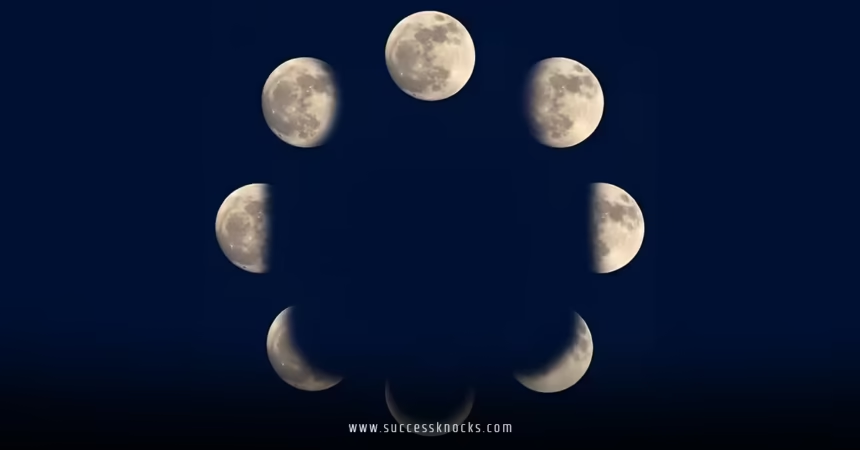
Have you ever looked up and wondered why the moon sometimes looks like a glowing cookie with a bite taken out, and other nights it’s a perfect silver coin? You’re not alone. Understanding lunar phases for beginners is one of the most rewarding first steps in astronomy because it’s beautiful, free, and happens every single month—no telescope required.
Think of the moon as Earth’s loyal dance partner. As the two waltz around the sun together, sunlight hits the moon from different angles, and we only ever see the part that’s lit up from our viewpoint. That’s it. That’s the entire secret behind every crescent, quarter, and full moon you’ve ever seen.
In this beginner-friendly guide, I’ll walk you through all eight lunar phases in plain English, show you exactly why they happen, and even sneak in a real-world example—like the stunning waning gibbous moon you can spot right now next to Jupiter and Orion (more on that in a moment).
Why Do Lunar Phases Even Exist? (The Super-Simple Explanation)
Imagine you’re sitting in a dark room with a friend holding a basketball (the moon) and a lamp (the sun) in the middle of the room. You (Earth) stay in one spot while your friend slowly walks in a circle around you.
- When the basketball is between you and the lamp → you see nothing (new moon).
- When the basketball is off to the side → you see half of it lit (first quarter).
- When the basketball is on the opposite side of the lamp → you see the whole thing glowing (full moon).
That’s literally all that’s happening in space—except the “walk” takes about 29.5 days. That’s one complete lunar cycle, also called a synodic month.
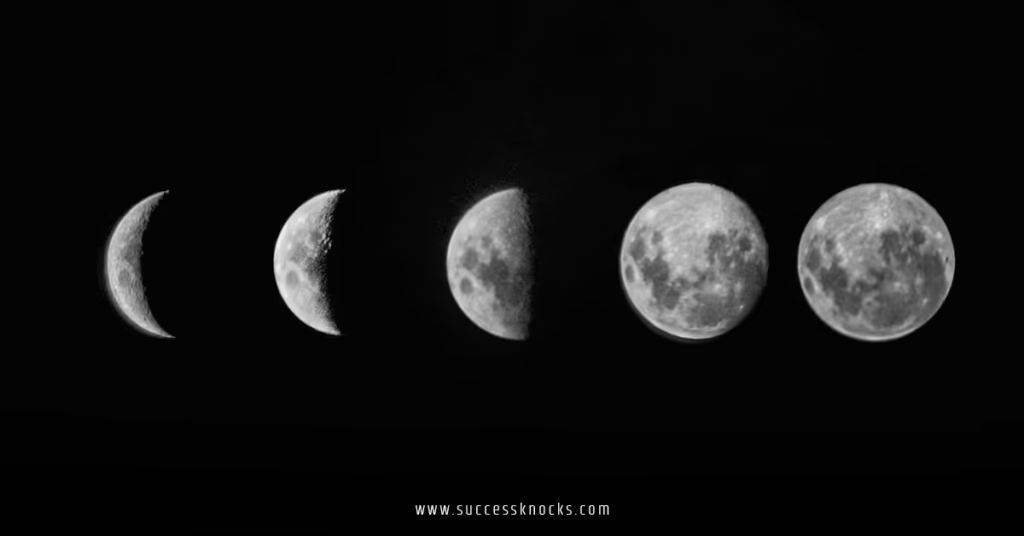
The 8 Lunar Phases Explained (With Easy Memory Tricks)
Here they are in order, starting from the invisible new moon:
- New Moon
The moon is between Earth and the sun. We see zero light. Perfect time for stargazing because the sky stays dark all night. - Waxing Crescent
A tiny silver fingernail appears on the right side (in the Northern Hemisphere). “Waxing” = growing. - First Quarter (also called Waxing Half Moon)
Exactly half the moon is lit—looks like a perfect D shape. Easy memory trick: it happens about one week after new moon. - Waxing Gibbous
More than half lit, but not quite full. “Gibbous” just means “humped” or “bulging.” Think of a cookie that someone took one small bite from. - Full Moon
The entire face glows. The moon is now opposite the sun in the sky—rises at sunset, sets at sunrise. Wolves howl, tides go wild, and your phone camera tries its best. - Waning Gibbous
The moon starts shrinking again. Now the left side darkens first. This is the exact phase you’ll see on the night of December 5, 2025, hanging out super close to bright Jupiter with Orion nearby. Want step-by-step directions? Check out this complete guide on how to see waning gibbous moon near Jupiter and Orion tonight December 2025. - Last Quarter (Waning Half Moon)
Half lit again, but now it’s a backward C shape. Rises around midnight, perfect for late-night stargazers. - Waning Crescent
Just a shrinking silver smile on the left before the cycle restarts with the next new moon.
Pro tip for beginners: In the Northern Hemisphere, the lit side always tells you if it’s waxing or waning. Right side lit = waxing (growing). Left side lit = waning (shrinking). Easy!
How Long Does Each Phase Last?
Technically, each exact moment (like “first quarter”) lasts only an instant, but we see each “look” for roughly 3–4 days because the moon moves about 13° per day across the sky. That’s why a waxing gibbous feels like it lingers for almost a week.
Why Understanding Lunar Phases Makes Every Night Sky Better
Once you get the rhythm, the moon stops being random and becomes a cosmic calendar:
- Planning a stargazing party? Pick new moon week.
- Want gorgeous moonlit hikes? Full moon nights.
- Hoping to see meteors? Avoid bright moon phases.
- Chasing planets like Jupiter? Use a bright waning gibbous as your pointer (exactly what’s happening tonight in December 2025!).
Common Beginner Questions About Lunar Phases
Why do we always see the same side of the moon?
The moon is tidally locked—it spins on its axis at the same speed it orbits Earth. Sneaky, right?
Does the moon actually change shape?
Nope! It’s always a perfect sphere. We just see different amounts of its sunlit half.
What’s a supermoon or micromoon?
When a full (or new) moon happens at the moon’s closest point to Earth (perigee), it looks 14% bigger and 30% brighter. December 4, 2025, just gave us the Cold Supermoon—tonight’s waning gibbous is still riding that extra-large glory.
Can I see lunar phases from the Southern Hemisphere?
Yes, but everything flips! The illuminated side reverses, and the moon appears “upside down” compared to northern views.
Quick Cheat Sheet to Impress Your Friends
- Right side lit + growing → waxing phases
- Left side lit + shrinking → waning phases
- Gibbous = more than half but not full
- Crescent = less than half
- Quarter = exactly half
Print it, stick it on your fridge, and you’ll sound like a pro in no time.
Final Thought: The Moon Is Your Forever Sky Buddy
Understanding lunar phases for beginners isn’t about memorizing names—it’s about finally seeing the pattern in something you’ve looked at your whole life. Once you do, every night feels different. Tonight, that knowledge pays off instantly: step outside, spot the bright waning gibbous moon glowing next to dazzling Jupiter, and let Orion’s belt guide your eyes across the winter sky. You’ve got this.
Ready to put your new knowledge to work right now? Don’t miss the incredible view waiting for you—here’s your complete guide on how to see waning gibbous moon near Jupiter and Orion tonight December 2025.