

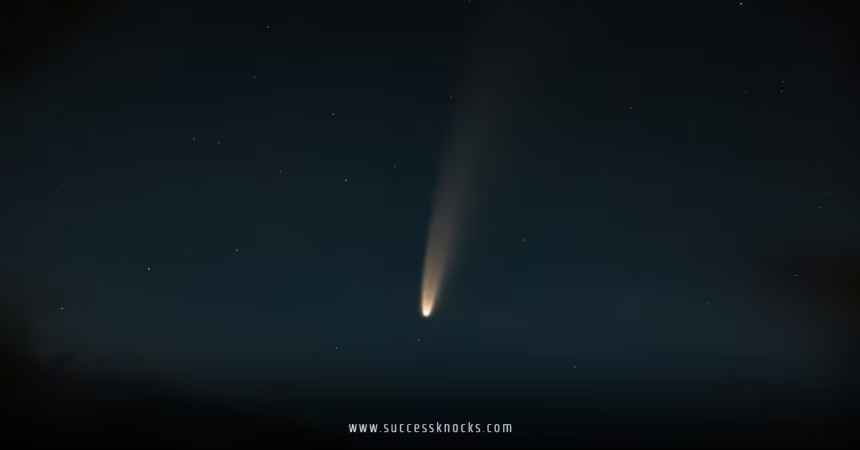
Interstellar comet 3I/ATLAS closest approach to Earth December 19 2025 marks one of the most thrilling celestial events of the year. Imagine a frozen wanderer from another star system zipping through our cosmic neighborhood—doesn’t that spark your curiosity? This rare visitor, only the third confirmed interstellar object we’ve ever spotted, is set to swing by our planet at a safe but exciting distance, offering us a unique glimpse into the depths of the galaxy.
What Is Comet 3I/ATLAS?
Let’s start with the basics: Comet 3I/ATLAS is an interstellar comet, meaning it didn’t originate in our solar system. Unlike the comets we’re used to, which loop around the Sun on predictable paths, this one hails from the vast space between stars. Discovered on July 1, 2025, by the NASA-funded ATLAS telescope in Chile, it earned its name quickly—the “3I” stands for the third interstellar object (after 1I/’Oumuamua and 2I/Borisov), and “ATLAS” honors the survey that found it.
Think of it like a postcard from a distant galaxy. This comet has likely been traveling through the Milky Way for billions of years, ejected from its home system long ago. Its nucleus, estimated to be between 0.4 and 5.6 kilometers wide, is wrapped in a fuzzy coma of gas and dust, with hints of a tail forming as it reacts to our Sun’s warmth.
Why Is It Called Interstellar?
What sets interstellar objects apart? They follow hyperbolic orbits—open paths that fling them into and out of our solar system without getting captured by the Sun’s gravity. Comet 3I/ATLAS boasts an eccentricity far greater than 1, screaming “outsider!” as it races at speeds over 200,000 km/h. Rhetorical question: How many more of these cosmic hitchhikers are out there, unseen?
The Journey of Interstellar Comet 3I/ATLAS Closest Approach to Earth December 19 2025
The interstellar comet 3I/ATLAS closest approach to Earth December 19 2025 is the highlight of its whirlwind tour. But its path has been epic. Entering from the direction of Sagittarius, it reached perihelion—its closest point to the Sun—around late October 2025, at about 1.4 AU (roughly 210 million kilometers).
Post-perihelion, it swung outward, passing close to Mars in early October and even getting snapped by spacecraft there. Now, heading away, it peaks in proximity to us on December 19, at approximately 1.8 AU—or about 270 million kilometers. That’s nearly twice the Earth-Sun distance, so no worries about impacts; it’s safer than rushing holiday traffic!
Timeline of Key Events
- Discovery: July 1, 2025
- Perihelion: Late October 2025
- Closest to Earth: December 19, 2025 (interstellar comet 3I/ATLAS closest approach to Earth December 19 2025)
- Departure: Heading out by the 2030s, never to return
This flyby is like a brief hello from an old friend passing through town—you wave, snap a photo, and cherish the moment.
Why the Interstellar Comet 3I/ATLAS Closest Approach to Earth December 19 2025 Matters to Scientists
Why all the buzz? The interstellar comet 3I/ATLAS closest approach to Earth December 19 2025 gives astronomers their best shot at studying an alien world’s building blocks up close. Telescopes like Hubble have already captured its glowing coma and activity, revealing a composition rich in carbon dioxide, with traces of water ice, carbon monoxide, and even cyanide gas—similar yet distinct from our local comets.
This close pass allows for detailed spectroscopy, probing its chemistry. Is it packed with organics that could hint at life elsewhere? Or unusual ices formed around a far-off star? Observations from missions like JUICE and ground-based scopes are pouring in data, painting a picture of planet formation in other systems.
Analogy time: Studying this comet is like tasting a recipe from a chef in another country—it shows how ingredients mix differently under alien conditions.
Scientific Insights Gained So Far
Hubble images show a teardrop-shaped dust envelope, while other telescopes detect a greenish hue from sublimating gases. Post-perihelion, it’s brightened, sporting tails of dust and plasma. Some even spotted X-ray emissions from solar wind interactions—a first for an interstellar object.
Experts note its high speed and unbound orbit confirm its extrasolar origins, possibly from the Milky Way’s thick disk, making it potentially older than our solar system.

How to Observe the Interstellar Comet 3I/ATLAS Closest Approach to Earth December 19 2025
Excited to spot it yourself? During the interstellar comet 3I/ATLAS closest approach to Earth December 19 2025, it’ll be visible with a decent telescope or strong binoculars under dark skies. Look in the constellation Leo in the pre-dawn hours—it’s faint, around magnitude 10-12, so light pollution is your enemy.
Apps like Sky Tonight or Stellarium can guide you. Pro tip: Join a virtual livestream from observatories for guaranteed views without freezing outside!
Viewing Tips for Beginners
- Find a dark site away from cities.
- Use at least a 30cm aperture telescope for best results.
- The new moon around this date means darker skies—perfect timing!
Will you catch a glimpse of this galactic traveler? It’s a once-in-a-lifetime chance.
Comparing 3I/ATLAS to Previous Interstellar Visitors
How does our star guest stack up?
- 1I/’Oumuamua (2017): Rocky, no coma, cigar-shaped—mysterious and inactive.
- 2I/Borisov (2019): Classic comet with a big tail, rich in carbon monoxide.
- 3I/ATLAS: Larger nucleus, active coma, greenish glow, and cryovolcanic hints.
The interstellar comet 3I/ATLAS closest approach to Earth December 19 2025 outshines them in observability, thanks to its timing and brightness.
What Makes Interstellar Objects Rare?
We’ve only spotted three in history because they’re fast and faint. But with better surveys, more are coming—exciting times ahead!
Safety and Myths Surrounding the Event
Rest easy: The interstellar comet 3I/ATLAS closest approach to Earth December 19 2025 is completely safe. At 1.8 AU away, it’s farther than Mars ever gets. No collision risk, no apocalyptic scenarios.
Some online chatter speculates wild theories—like alien probes—but evidence points firmly to a natural comet. NASA and ESA confirm: It’s icy, active, and poses zero threat.
The Future After the Closest Approach
After December 19, 3I/ATLAS will fade as it races toward Jupiter (closer pass in 2026) and eventually interstellar space by the 2030s. Observations continue into 2026, but it’ll dim quickly.
This event reminds us how connected we are to the cosmos—tiny specks on a pale blue dot, visited by wanderers from the stars.
In wrapping up, the interstellar comet 3I/ATLAS closest approach to Earth December 19 2025 is a reminder of the universe’s vast wonders. From its ancient origins to the scientific treasures it carries, this visitor has captivated us all. Step outside, look up, and feel that connection—it’s moments like these that inspire awe and push humanity to explore further. Don’t miss your chance to witness history in the skies!
Frequently Asked Questions
1. When exactly is the interstellar comet 3I/ATLAS closest approach to Earth December 19 2025?
The peak closeness occurs on December 19, 2025, at about 1.8 AU from Earth—a safe and distant pass.
2. Is the interstellar comet 3I/ATLAS closest approach to Earth December 19 2025 dangerous?
No, it’s entirely safe. The distance is nearly twice that of the Sun, with no risk of impact.
3. Can I see the interstellar comet 3I/ATLAS closest approach to Earth December 19 2025 with the naked eye?
Unlikely—it’s too faint. You’ll need a telescope or binoculars under dark skies for a good view.
4. What makes comet 3I/ATLAS different during its interstellar comet 3I/ATLAS closest approach to Earth December 19 2025?
Its interstellar origin and active coma provide unique insights into alien planetary systems.
5. Will the interstellar comet 3I/ATLAS closest approach to Earth December 19 2025 return?
No, its hyperbolic orbit means it’s a one-time visitor, heading back to deep space forever.


