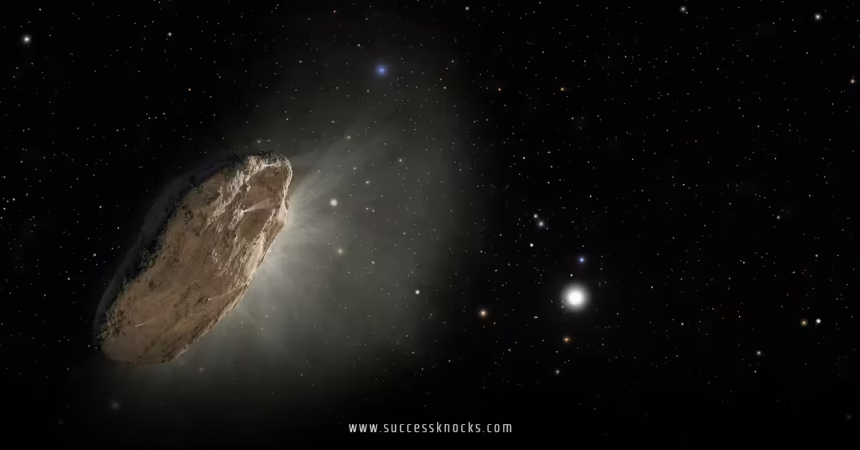
Interstellar object ‘Oumuamua burst onto the scene in 2017, captivating astronomers and the public alike as the first confirmed visitor from outside our solar system. Picture this: a reddish, cigar-shaped wanderer hurtling through space at breakneck speeds, defying expectations and sparking endless debates. What makes this interstellar object ‘Oumuamua so intriguing? Its bizarre shape, unexpected acceleration, and origins in a distant star system challenge everything we thought we knew about cosmic travelers.
Discovery of Interstellar Object ‘Oumuamua
Back in October 2017, the Pan-STARRS1 telescope in Hawaii spotted something odd—a faint point of light moving way too fast for a typical asteroid or comet. Initially dubbed A/2017 U1, it quickly earned the name ‘Oumuamua, Hawaiian for “scout” or “messenger from afar arriving first.” Why the rush? Its hyperbolic trajectory screamed interstellar: no bound orbit around the Sun, just a quick slingshot visit before heading back to the void.
Rhetorical question: How often do we get postcards from other stars? This was the first, but it paved the way for more, including the recent interstellar comet 3I/ATLAS closest approach to Earth December 19 2025, another exciting flyby worth watching.
What Makes Interstellar Object ‘Oumuamua Unique?
Interstellar object ‘Oumuamua wasn’t your average space rock. Estimated at 100-400 meters long but incredibly elongated—up to 10 times longer than wide—it tumbled chaotically, varying in brightness dramatically every 7.3 hours. No coma, no tail like a comet, yet it accelerated away from the Sun without visible outgassing. Analogy: It’s like spotting a sleek, silent sports car speeding through your neighborhood—no exhaust, no noise, just pure mystery.
Its reddish hue suggested long exposure to cosmic rays, and composition? Rocky or metallic, possibly with ices hidden beneath a hardened crust. Traveling at over 26 km/s relative to the Sun, it came from the direction of Vega but had been journeying for hundreds of millions of years.
Trajectory and Path Through Our Solar System
The path of interstellar object ‘Oumuamua was a steep dive: entering from above the planetary plane, whipping around the Sun at perihelion on September 9, 2017 (just 0.25 AU away), and exiting toward Pegasus. No capture by gravity—pure one-way ticket out.
Theories Behind the Strange Acceleration of Interstellar Object ‘Oumuamua
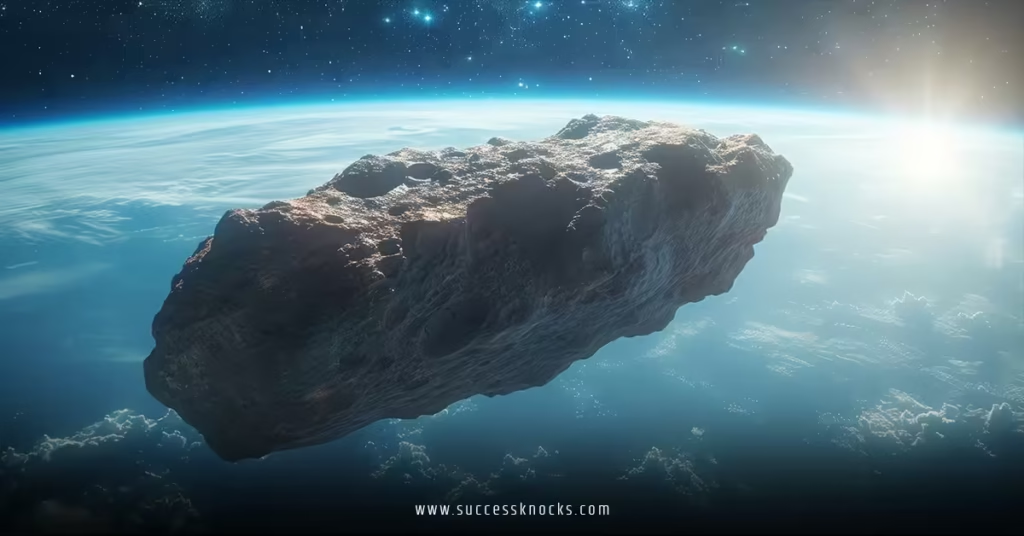
Here’s where things get wild. Interstellar object ‘Oumuamua showed non-gravitational acceleration—speeding up as it left the Sun, like a gentle push. No visible jets, so what gives?
Leading natural explanations:
- Hydrogen outgassing: Cosmic rays turned water ice into trapped hydrogen, which sublimated invisibly (2023 study).
- Nitrogen ice fragment: A chunk off an exo-Pluto, explaining shape and push without dust (2021 theory).
But Harvard’s Avi Loeb stirred the pot, suggesting it could be artificial—an alien lightsail probe. Thin, reflective, accelerated by solar radiation pressure. While most experts lean natural, Loeb argues we shouldn’t dismiss extraterrestrial tech.
Why the Alien Probe Idea Persists
Loeb’s book Extraterrestrial highlights anomalies: extreme shape (no known natural object matches), high speed near local standard of rest, and that puzzling boost. Is it a defunct sail from another civilization? Unlikely, say critics, but it forces us to consider: In a vast universe, why assume we’re alone?
Comparing Interstellar Object ‘Oumuamua to Later Visitors
Interstellar object ‘Oumuamua set the stage. Next came 2I/Borisov in 2019—a classic comet with coma and tail, rich in CO. Then 3I/ATLAS in 2025, active and cometary. ‘Oumuamua stands out as asteroid-like yet accelerating like a comet— a “dark comet” perhaps?
These visitors hint at common ejections from other systems, offering samples of alien planet-building.
Scientific Impact and Legacy of Interstellar Object ‘Oumuamua
Interstellar object ‘Oumuamua revolutionized astronomy. It confirmed interstellar objects exist and pass through regularly—estimates suggest thousands in our system at any time. Upcoming surveys like Vera C. Rubin Observatory (operational 2025) will spot more.
Lessons? Better preparedness for future flybys, like the ongoing observations of the [interstellar comet 3I/ATLAS closest approach to Earth December 19 2025], a safer but brighter chance to study an outsider.
Could We Ever Catch Up to Interstellar Object ‘Oumuamua?
Too late—it’s fading into the distance. But concepts like Comet Interceptor or lightsail probes dream of chasing future ones.
In the end, interstellar object ‘Oumuamua reminds us how much mystery lingers in the cosmos. From its silent acceleration to debated origins, it sparked curiosity, debate, and discovery. As more visitors arrive—like the current buzz around the [interstellar comet 3I/ATLAS closest approach to Earth December 19 2025]—we’re better equipped to unravel their stories. Keep looking up; the next messenger might change everything.
Frequently Asked Questions
1. What exactly is the interstellar object ‘Oumuamua?
It’s the first confirmed visitor from outside our solar system, a reddish, elongated body discovered in 2017 with a hyperbolic orbit.
2. Why did interstellar object ‘Oumuamua accelerate strangely?
Natural theories point to invisible outgassing of hydrogen or nitrogen; some speculate solar radiation on an artificial structure.
3. Is interstellar object ‘Oumuamua an alien spacecraft?
Most scientists say no—it’s likely natural—but the idea highlights the need for open-minded exploration.
4. How does interstellar object ‘Oumuamua compare to recent visitors?
Unlike cometary 2I/Borisov and 3I/ATLAS, it lacked a visible tail, making it more asteroid-like yet mysteriously active.
5. Will we see more objects like interstellar object ‘Oumuamua?
Yes! New telescopes promise detections yearly, building on lessons from ‘Oumuamua.