Mars solar wind interaction is one of the most fascinating dynamics in our solar system. Picture this: a relentless stream of charged particles blasting from the Sun at millions of miles per hour, slamming into Mars like an invisible cosmic hurricane. Without a strong global magnetic shield like Earth’s, Mars takes the full brunt, leading to dramatic effects on its thin atmosphere. Have you ever wondered why Mars is a cold, dry desert today when evidence suggests it once had rivers and oceans? The answer lies heavily in this ongoing Mars solar wind interaction, which has been stripping away the planet’s air for billions of years.
Let’s unpack this intriguing process. It’s not just about loss—it’s a complex dance of plasma, magnetic fields, and energy transfer that reveals clues about planetary evolution. And with missions like NASA’s ongoing studies building on this, we’re getting clearer pictures than ever.
Understanding Mars Solar Wind Interaction Basics
At its heart, Mars solar wind interaction happens because the Red Planet lacks a dynamo-generated global magnetic field. Earth has one, courtesy of its molten core, deflecting solar wind like a giant bubble. Mars? Not so much. Instead, the solar wind—mostly protons and electrons—directly hits the upper atmosphere, ionizing it and creating an induced magnetosphere.
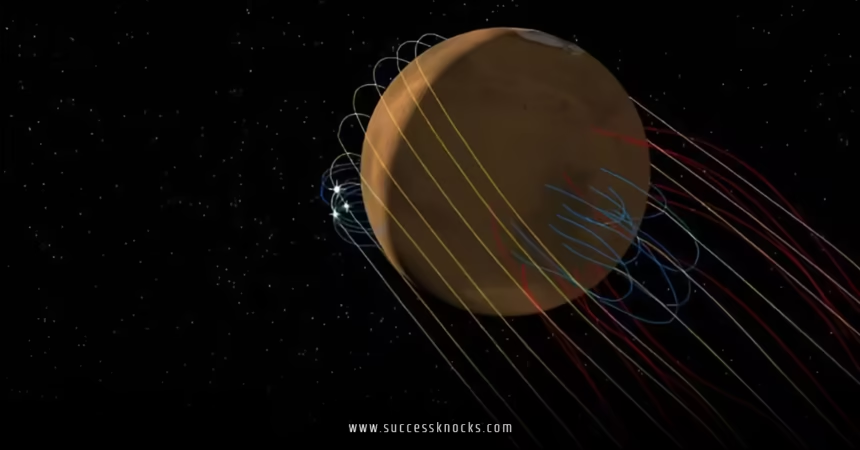
Think of it as a makeshift shield: the solar wind’s own magnetic field drapes around Mars, piling up and forming boundaries like the bow shock (where solar wind slows abruptly) and the magnetic pile-up boundary closer in. This hybrid setup—mixing weak crustal remnants from ancient fields with induced ones—makes Mars solar wind interaction uniquely chaotic.
Rhetorical question: What if Earth lost its magnetic field? We’d face similar erosion, highlighting why studying Mars solar wind interaction matters for understanding habitability across planets.
This schematic illustrates the induced magnetosphere and how solar wind drapes around Mars.
The Hybrid Magnetosphere in Mars Solar Wind Interaction
Mars isn’t completely defenseless. Ancient crustal fields, strong in the southern hemisphere, create mini-magnetospheres that poke through the induced one. This “hybrid” nature complicates Mars solar wind interaction—solar wind flows smoothly in some areas but gets tangled in others, leading to magnetic reconnection events where energy explodes and particles accelerate.
During calm periods, the interaction is steady, but solar storms amp it up. Coronal mass ejections can compress the magnetosphere, boosting atmospheric escape rates dramatically.
Analogy: It’s like wind hitting a leaky house—steady breeze causes slow drips, but a gale rips off shingles. In Mars solar wind interaction, those “gales” have contributed to losing much of the original thick atmosphere.
Here’s an illustration of Mars’ hybrid magnetosphere, showing the mix of crustal and induced fields.
Mechanisms of Atmospheric Escape Through Mars Solar Wind Interaction
How does Mars lose its air? Several processes tie directly to Mars solar wind interaction:
- Ion pickup: Solar wind grabs ionized atmospheric particles and sweeps them away.
- Sputtering: High-energy particles knock atoms out.
- Jeans escape: Thermal evaporation, enhanced by solar energy.
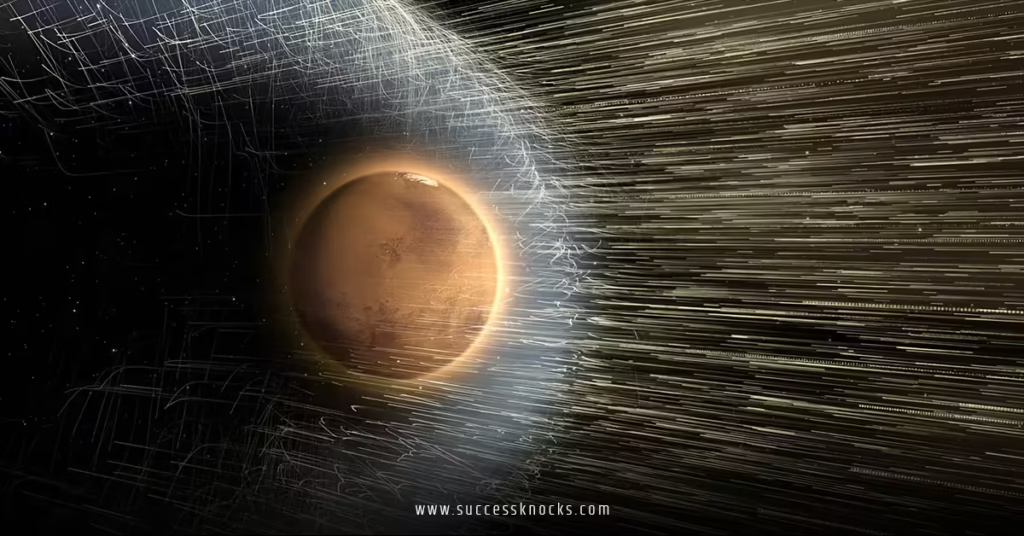
But the big player? Bulk escape during storms, where Mars solar wind interaction funnels energy into accelerating ions tailward.
Observations from MAVEN show escape rates varying by orders of magnitude—calm days lose little, stormy ones a lot. Interestingly, some studies suggest the induced magnetosphere protects more than expected, with EUV radiation playing a bigger role in heating and expanding the atmosphere for escape.
This image depicts solar wind stripping ions from Mars’ atmosphere during a storm.
Rare Events: When Mars Solar Wind Interaction Changes Dramatically
One standout moment? December 2022, when solar wind nearly vanished at Mars. A fast stream overtook a slow one, creating a void. Suddenly, without pressure, Mars’ magnetosphere ballooned thousands of kilometers, and the atmosphere puffed up like a balloon released from a squeeze.
This rare Mars solar wind interaction “off” switch showed how dependent the system is on constant solar input—and thrilled scientists with unique data on expansion dynamics.
Implications for Mars’ Past and Future Habitability
Over billions of years, Mars solar wind interaction likely stripped away enough atmosphere to end the warm, wet era. Models suggest up to a third or more lost this way, cooling the planet and sublimating water into space or underground.
For future human exploration, understanding Mars solar wind interaction is crucial—radiation hazards, ionosphere effects on comms, all tie in.
And excitingly, the recently launched NASA ESCAPADE mission Mars atmosphere 2025 will dive deeper with twin orbiters, providing real-time, multi-point views of these processes.
Visualization of a disappearing solar wind event impacting Mars.
Ongoing Research and Missions Studying Mars Solar Wind Interaction
Missions like MAVEN (since 2014) have revolutionized our view, quantifying escape and revealing protections. Mars Express contributed early insights into boundaries.
Now, with ESCAPADE en route (arriving 2027), we’ll get stereo observations—separating spatial from temporal changes in Mars solar wind interaction for the first time.
In summary, Mars solar wind interaction isn’t just erosion—it’s a dynamic plasma ballet shaping a world’s fate. From hybrid magnetospheres to rare voids, it explains Mars’ transformation and warns of vulnerabilities elsewhere. As we probe deeper, especially with innovations like the NASA ESCAPADE mission Mars atmosphere 2025, we’re not only decoding the Red Planet’s history but preparing for our own footsteps there. What surprises will the next solar storm reveal? The Sun and Mars have more stories to tell—stay curious!
FAQs
What causes the Mars solar wind interaction to strip away atmosphere?
The primary driver in Mars solar wind interaction is the lack of a global magnetic field, allowing charged particles to directly energize and accelerate atmospheric ions into space through processes like pickup and sputtering.
How does Mars’ hybrid magnetosphere affect solar wind interaction?
Mars’ hybrid magnetosphere, combining crustal remnants and induced fields, creates uneven barriers during Mars solar wind interaction, leading to localized protections and enhanced escape in weak-field regions.
What happened during the 2022 solar wind disappearance at Mars?
In a rare Mars solar wind interaction event, low-density solar wind caused the magnetosphere to expand massively, temporarily halting typical erosion and allowing the atmosphere to swell.
Why is studying Mars solar wind interaction important for habitability?
Understanding Mars solar wind interaction reveals how planets lose atmospheres over time, informing why Mars became uninhabitable and aiding searches for life-friendly exoplanets.
How will future missions improve our knowledge of Mars solar wind interaction?
Missions like the NASA ESCAPADE mission Mars atmosphere 2025 will use dual spacecraft for simultaneous observations, capturing real-time dynamics in Mars solar wind interaction that single orbiters miss.