

Venezuela US military operation 2026 stunned everyone when it unfolded in the early hours of January 3. Imagine waking up to news that U.S. special forces had raided Caracas, captured a sitting president, and essentially flipped a nation’s leadership overnight. That’s exactly what happened with Operation Absolute Resolve—a high-stakes gamble that blended law enforcement, military precision, and geopolitical ambition. But why now, and what does it mean moving forward? Let’s unpack this dramatic chapter in U.S.-Venezuela relations, where oil, drugs, and power collided in spectacular fashion.
What Happened During the Venezuela US Military Operation 2026
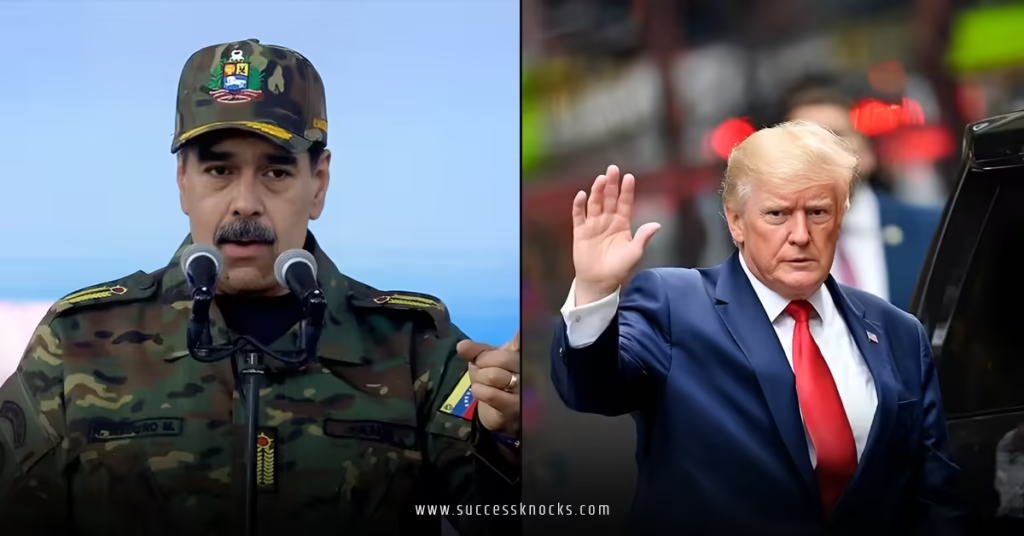
Picture this: It’s around 2 a.m. in Caracas on January 3, 2026. Explosions light up the sky as U.S. forces suppress air defenses. Delta Force commandos storm a fortified compound, apprehending Nicolás Maduro and his wife, Cilia Flores. No American lives lost— a tactical masterpiece, as President Trump called it.
The operation didn’t come out of nowhere. Months of buildup included seizing oil tankers, striking alleged drug-running boats (killing over 100 in prior actions), and positioning warships like the USS Gerald R. Ford in the Caribbean. Trump framed it as justice for long-standing narco-terrorism charges against Maduro, with a $15 million bounty finally claimed.
Maduro and Flores were whisked to New York, pleading not guilty in federal court on January 5. Trump announced the U.S. would temporarily “run” Venezuela, focusing on stability and reclaiming oil assets. It’s like a real-life action movie, but with real-world fallout—power outages in Caracas, over 100 reported deaths (including Cuban personnel), and a tense calm settling over the streets.
Timeline of the Venezuela US Military Operation 2026
To make sense of the chaos, here’s a quick rundown:
- Late 2025: U.S. escalates with tanker seizures and boat strikes.
- January 2-3, 2026: Final approvals; over 150 aircraft involved.
- January 3: Raid executes; Maduro captured.
- January 5: Arraignment in Manhattan; Delcy Rodríguez sworn in as acting president.
- Ongoing: U.S. maintains naval presence; talks of oil concessions emerge.
This swift action echoes past interventions, like the 1989 Panama invasion for Noriega, but on a larger scale.
Why the Venezuela US Military Operation 2026 Took Place
Ever wonder what pushes a president to greenlight such a risky move? Trump cited Maduro’s indictment for flooding America with drugs via cartels labeled terrorists. But dig deeper, and oil looms large—Venezuela sits on the world’s biggest reserves, degraded but tantalizing.
The administration sold it as counter-narcotics with law enforcement flair, backed by “inherent constitutional authority.” Critics? They see imperialism reborn, especially with Trump’s boasts about refurbishing oil infrastructure for U.S. companies.
Rhetorical question: Is this about justice, security, or securing energy dominance? Probably a mix, like throwing a grenade into a stagnant pond to see what surfaces.
Key Motivations Behind Venezuela US Military Operation 2026
- Drug Trafficking: Ties to gangs and cocaine routes.
- Oil Access: Potential billions in reserves for U.S. firms.
- Regional Influence: Weakening allies like Cuba (32 reported Cuban deaths).
Trump’s team, including Marco Rubio and Pete Hegseth, monitored from Mar-a-Lago—personal touch adding to the drama.
International Reactions to Venezuela US Military Operation 2026
The world didn’t stay silent. Allies like France decried sovereignty violations at the U.N. Latin American nations—Brazil, Mexico, Colombia—issued joint condemnations. China demanded Maduro’s release; Cuba mourned losses.
Some quiet support emerged, like from opposition figures hoping for democracy. But overall? A chorus questioning legality, with fears of precedent—could bigger powers justify similar grabs elsewhere?
It’s akin to dropping a boulder in a lake: Ripples hit everyone, from refugee fears on borders to stock surges for oil companies like ExxonMobil.
Domestic Impact and the Link to Trump Approval Rating After Maduro Capture January 2026
Back home, reactions split sharply. Supporters cheered a strongman takedown; critics worried about overreach. Early polls showed a bump in Trump’s numbers, tying directly to discussions around trump approval rating after maduro capture january 2026—a perceived win injecting momentum amid domestic challenges.
For more on how this bold stroke influenced public opinion, check out the detailed analysis of trump approval rating after maduro capture january 2026.
Legal and Ethical Questions Surrounding Venezuela US Military Operation 2026
Was this legal? Experts debate fiercely. Trump claims executive power for extraterritorial arrests, like bin Laden’s raid. But invading a sovereign nation without U.N. backing? Many say no—violating the Charter’s non-intervention principle.
Precedents like Panama held up in U.S. courts, but internationally? Condemnation rained down. Ethical angle: Civilian casualties, power vacuums—will stability follow, or chaos?
Potential Long-Term Consequences of Venezuela US Military Operation 2026
- Power Vacuum: Acting President Rodríguez offers dialogue, but resistance lingers.
- Oil Boom?: Concessions talked, but rebuilding takes years.
- Geopolitical Shifts: Emboldens hawks; strains alliances.
Think of it as opening Pandora’s box—exciting short-term, unpredictable long-term.
Historical Context: US Interventions and Venezuela US Military Operation 2026
This isn’t America’s first rodeo in Latin America. From Grenada to Panama, quick strikes often boost leaders initially. Here, the Venezuela US military operation 2026 fits that mold—tactical brilliance, strategic fog.
Compared to Obama’s bin Laden success or Bush’s Iraq quagmire, this feels more like the former: Precise, leader-focused. Yet without clear endgame, risks mount.
Comparing Venezuela US Military Operation 2026 to Past Actions
- Panama 1989: Similar capture, drug charges.
- Grenada 1983: Quick win, polling boost.
- Difference: Oil stakes higher; polarization deeper.
What’s Next After Venezuela US Military Operation 2026
As of January 8, 2026, Venezuela hums with uncertainty. Rodríguez signals energy cooperation; Trump pushes control. U.S. forces loom offshore—no boots yet, but threats linger.
Opposition leader María Corina Machado eyes return. Trials loom for Maduro. Globally, eyes watch: Will this stabilize or spiral?
One thing’s clear—this operation redefined bold. Stay informed; history’s writing itself.
Conclusion
The Venezuela US military operation 2026 was a thunderclap—decisive, controversial, and game-changing. From capturing Maduro to eyeing oil riches, it showcased U.S. might while sparking fierce debate on legality and legacy. Short-term triumph? Likely. Long-term peace? That’s the million-barrel question.
This event ripples far: Boosting perceptions of strength (see trump approval rating after maduro capture january 2026 for polling insights), reshaping energy markets, and testing international norms. Whether it leads to prosperity or prolonged tension, one truth stands: Actions like these echo for decades. What do you think—masterstroke or misstep? The story’s far from over.
FAQs
1. What was the codename for the Venezuela US military operation 2026?
It was Operation Absolute Resolve, involving elite forces and massive air support to capture Maduro.
2. Why did the US launch the Venezuela US military operation 2026?
Primarily to apprehend Maduro on narco-terrorism charges, with underlying goals of disrupting drugs and accessing oil reserves.
3. How many casualties resulted from the Venezuela US military operation 2026?
Reports vary: Over 100 deaths, including Venezuelan forces, civilians, and Cuban personnel; seven U.S. troops injured.
4. What is the current status in Venezuela after the US military operation 2026?
Delcy Rodríguez acts as president, offering dialogue; U.S. influences policy, especially energy, amid calm but uncertainty.
5. How has the Venezuela US military operation 2026 affected US politics?
It sparked partisan divides, with potential impacts on leadership approval—explore more in analyses of trump approval rating after maduro capture january 2026.


