

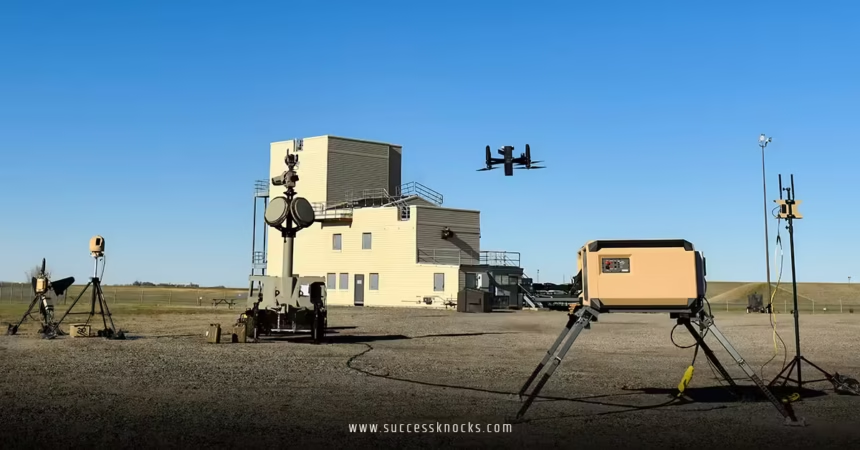
USNORTHCOM counter-small UAS fly-away kit certification marks a pivotal advancement in protecting U.S. military installations from the rising threat of drone incursions. Imagine a scenario where unauthorized drones hover over a strategic air base, potentially spying, disrupting operations, or worse—delivering payloads. In today’s fast-evolving security landscape, this isn’t science fiction; it’s a real concern for homeland defense. That’s why the recent USNORTHCOM counter-small UAS fly-away kit certification stands out as a critical step forward, equipping forces with rapid, deployable tools to detect, track, and neutralize these threats effectively.
What Is USNORTHCOM Counter-Small UAS Fly-Away Kit Certification All About?
Let’s break it down simply. The USNORTHCOM counter-small UAS fly-away kit certification refers to the official validation of a mobile, transportable counter-drone system designed specifically for U.S. Northern Command (USNORTHCOM). This kit allows a specialized team to quickly deploy to any military base within the continental United States or Alaska when drone threats emerge.
Achieved in late October 2025, this certification came after a rigorous week-long evaluation at Minot Air Force Base in North Dakota. An 11-person team—drawn from diverse backgrounds across USNORTHCOM and partner units—successfully engaged over 100 simulated drone targets. They proved the kit’s reliability in harsh, real-world conditions like cold, wind, and rain. Think of it as giving homeland defenders a “ready-to-go” toolbox for drone defense, shifting from advisory roles to active protection.
Why does this matter? Drone technology is proliferating rapidly. Small UAS (unmanned aerial systems) are cheap, easy to obtain, and increasingly sophisticated. From hobbyists to adversaries, the risk of incursions over sensitive sites is growing. USNORTHCOM counter-small UAS fly-away kit certification ensures a standardized, proven response capability that’s fast and flexible.
The Background: Why Counter-Small UAS Capabilities Are Essential
The drone threat didn’t appear overnight. Over the past decade, we’ve seen drones used in conflicts worldwide, from reconnaissance to targeted strikes. Domestically, unauthorized flights near military installations have raised alarms about espionage, smuggling, or even terrorism.
In response, the Department of Defense designated USNORTHCOM as the lead synchronizer for homeland counter-small UAS (HC-sUAS) operations in late 2024. This role focuses on coordinating defenses across the continental U.S. and Alaska. Before this, installation commanders relied heavily on passive measures or limited local tools. Now, with USNORTHCOM counter-small UAS fly-away kit certification, there’s a dedicated rapid-response option that bridges critical gaps.
Have you ever wondered how a base commander handles a sudden drone swarm? The certification process tests exactly that—deployment speed, system setup, threat engagement, and safe teardown.
Key Milestones Leading to USNORTHCOM Counter-Small UAS Fly-Away Kit Certification
The journey to certification wasn’t quick. It began with earlier exercises like Desert Peak in March 2025, which tested authorization and deployment processes at Davis-Monthan Air Force Base.
Then came Falcon Peak 25.2 in September 2025 at Eglin Air Force Base, Florida. This is where the team first got hands-on with the kit, learning setup, threat mitigation, and teardown. Delivered by manufacturer Anduril, the system integrates advanced technologies into a portable package.
The culmination? The October 21-27, 2025, deployment to Minot AFB. Here, the team not only countered threats but also assisted in updating the base’s 130i defense plan—a legal framework under 10 U.S.C. 130i that authorizes counter-UAS actions while coordinating with the FAA and DOT.
This USNORTHCOM counter-small UAS fly-away kit certification validated the full lifecycle: from alert to redeployment back to Colorado Springs.
Components of the Fly-Away Kit: What Makes It So Effective?
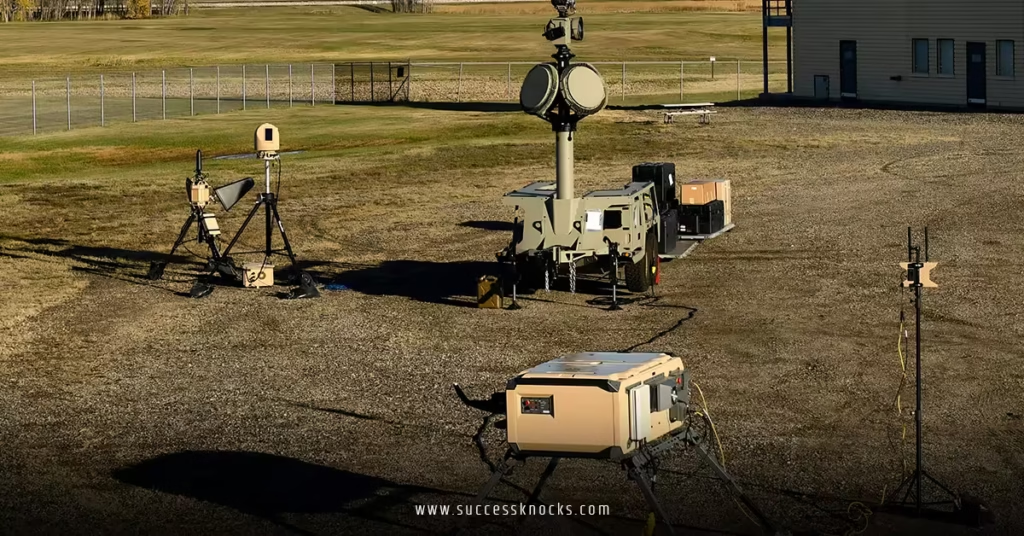
The USNORTHCOM counter-small UAS fly-away kit certification highlights a sophisticated, layered system. It’s not just one gadget—it’s an integrated suite:
- Heimdal mobile sensor trailer — Provides 360-degree radar and thermal optics for autonomous target acquisition.
- Anvil drone interceptors — Autonomous, self-guided units that ram or (in armed variants) use explosives to neutralize threats with low collateral damage.
- Pulsar electromagnetic warfare effector — Detects, classifies, tracks, and denies drones using radio frequency jamming.
- Wisp wide-area infrared system — AI-enabled, 360-degree sensor for precise visuals in various conditions.
All this ties into Lattice, the command-and-control software that fuses data for operators. The kit’s portability allows transport via military aircraft like the C-130 Hercules, making it truly “fly-away” ready.
The Certification Process: How USNORTHCOM Counter-Small UAS Fly-Away Kit Certification Was Achieved
Certification involved high-pressure testing. The team—many with no prior drone experience—adapted quickly. From loading equipment to engaging targets under adverse weather, every step was scrutinized.
Maj. Austin Fairbairn, who led on the ground, noted the steep learning curve but praised the team’s transformation into professionals. Chief Warrant Officer 3 Joey Frey emphasized exceeding expectations in just 30 days from first touch.
Gen. Gregory Guillot, USNORTHCOM commander, called it a major step beyond advisory roles, providing active detection and low-collateral defeat options.
This process ensures reliability, safety, and compliance with domestic laws—key for operations on U.S. soil.
Why USNORTHCOM Counter-Small UAS Fly-Away Kit Certification Matters for the Future
With USNORTHCOM counter-small UAS fly-away kit certification, the U.S. gains a proactive edge. It supports installation commanders facing incursions, enables rapid response, and integrates with broader defense plans.
As threats evolve, this capability sets a foundation for scaling. It demonstrates innovation, teamwork across services, and adaptation in a changing battlespace.
Conclusion: Looking Ahead with Enhanced Homeland Protection
In summary, USNORTHCOM counter-small UAS fly-away kit certification represents a leap in defending against drone threats to U.S. military sites. From rapid deployment to layered countermeasures and legal coordination, it equips forces to respond decisively. As drones become more common, this certified capability offers reassurance that homeland defenses are adapting swiftly. Stay informed and engaged—because in security, preparation today prevents crises tomorrow. The future of homeland defense looks stronger thanks to this milestone.
Ready to dive deeper? Here are some frequently asked questions:
For more details, check these high-authority sources:
- U.S. Northern Command Official News
- DVIDS Coverage on the Certification
- Defense News on the Rapid Anti-Drone Team
FAQ :
FAQ 1: What exactly does USNORTHCOM counter-small UAS fly-away kit certification mean?
It means the official operational validation of a mobile counter-drone system and its team, proven through real-world exercises to detect, track, and mitigate small UAS threats at U.S. installations.
FAQ 2: When and where was the USNORTHCOM counter-small UAS fly-away kit certification achieved?
The certification was attained during a deployment from October 21-27, 2025, at Minot Air Force Base, North Dakota, following prior testing in Florida.
FAQ 3: Who manufactures the technology in the USNORTHCOM counter-small UAS fly-away kit?
The kit was delivered by Anduril, incorporating components like Anvil interceptors, Pulsar effectors, and Heimdal sensors.
FAQ 4: How does USNORTHCOM counter-small UAS fly-away kit certification comply with U.S. laws?
It aligns with 10 U.S.C. 130i, which authorizes defense against drone incursions while requiring coordination with the FAA and DOT to ensure safe, legal operations.
FAQ 5: Why is the USNORTHCOM counter-small UAS fly-away kit certification important for military bases?
It provides installation commanders with a rapid, deployable solution to counter drone threats, moving from advisory support to active mitigation and enhancing overall homeland security.


