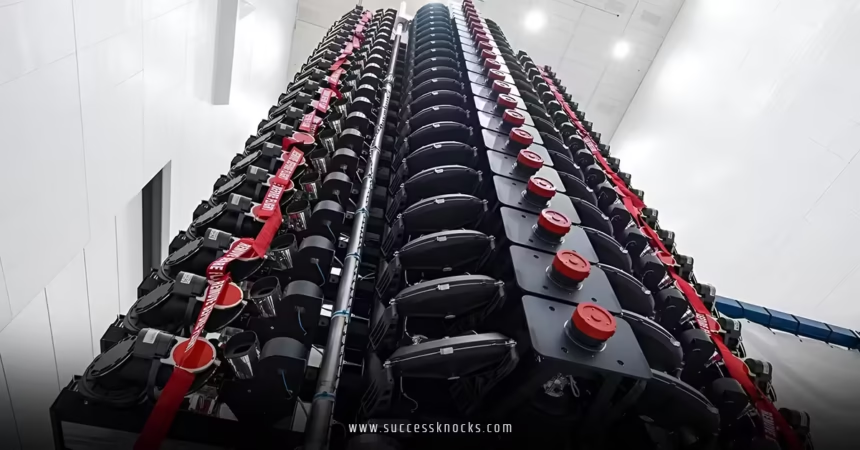
If you’ve been following SpaceX’s relentless push to connect the entire planet, you’ve probably heard about Starlink V2 Mini satellites. These aren’t just incremental tweaks—they represent a massive leap in satellite technology that’s helping Starlink deliver faster, more reliable internet to millions of users worldwide. Launched in batches like the notable SpaceX Starlink 17-30 launch Vandenberg January 22 2026, these satellites are the backbone of the constellation’s second-generation capabilities.
Picture this: older satellites were like reliable but basic cell towers in space. The Starlink V2 Mini satellites? They’re like upgrading to 5G towers on steroids—bigger, smarter, and packing way more punch per unit. In this article, we’ll break down what makes them special, how they differ from previous versions, their technical specs, and why they’re crucial for the future of connectivity.
What Exactly Are Starlink V2 Mini Satellites?
Starlink V2 Mini satellites are the compact yet powerful version of SpaceX’s second-generation (Gen2) Starlink spacecraft. Introduced as a bridge between the first-generation satellites (V1 and V1.5) and the full-sized V2 models designed for Starship, the “Mini” label might sound diminutive, but don’t be fooled. SpaceX itself emphasizes that a single V2 Mini delivers up to four times the user-serving capacity compared to earlier counterparts.
These satellites operate in low Earth orbit (LEO), typically around 550 km altitude in various inclinations (like 53° for many groups). They’re built to handle massive data throughput while keeping costs and launch constraints in check. By early 2026, thousands of these had already been deployed, with missions like the SpaceX Starlink 17-30 launch Vandenberg January 22 2026 adding 25 more to the growing mesh network.
Key Technical Specifications of Starlink V2 Mini Satellites
Let’s dive into the numbers that make these satellites stand out.
- Mass: Early versions weighed around 730-800 kg at launch, with later optimized designs dropping to about 525-575 kg. This lighter mass allows Falcon 9 to carry more per flight—up to 29 in some configurations.
- Size and Solar Arrays: Each features massive dual solar arrays spanning roughly 30 meters (about 100 feet) when deployed, with a total surface area exceeding 116 square meters—over four times that of V1.5 models. This powers the beefier payloads efficiently.
- Propulsion: They use argon-fueled Hall-effect thrusters, delivering 2.4x higher thrust and 1.5x better impulse than previous ion systems. This means quicker maneuvers for collision avoidance and orbit maintenance.
- Communications Payload: Ku-band, Ka-band, and crucially E-band for backhaul. More powerful phased-array antennas enable tighter beams and higher throughput.
- Inter-Satellite Links: Equipped with optical lasers (typically three per satellite) capable of 200 Gbps per link, forming a global mesh that routes data through space instead of relying heavily on ground stations.
- Capacity: Roughly 4x more per satellite than V1.5—translating to around 96 Gbps downlink and 6.7 Gbps uplink in some estimates, though real-world figures vary by load and location.
These specs make Starlink V2 Mini satellites far more efficient at serving users in dense or remote areas alike.
How Starlink V2 Mini Satellites Compare to Previous Generations
The jump from V1/V1.5 to Starlink V2 Mini satellites is dramatic.
First-gen satellites (V1.0/V1.5) were lighter (around 260-306 kg), had smaller antennas, and relied more on Ku/Ka bands without E-band. They delivered solid service but hit capacity limits in high-demand regions.
Starlink V2 Mini satellites flip the script:
- Capacity boost — 4x more user bandwidth per satellite, meaning fewer units needed for the same coverage (though overall constellation size keeps growing).
- Efficiency — Better power management, stronger thrusters, and laser links reduce latency and improve global routing.
- Launch economics — While fewer fit per Falcon 9 (21-29 vs 50-60 earlier), the added capacity per launch is higher—often equivalent to 50% more bandwidth overall.
- Future-proofing — They incorporate tech like E-band backhaul and advanced beamforming, paving the way for direct-to-cell services in later variants.
Think of it like upgrading from a fleet of compact cars to mid-size SUVs: each new vehicle hauls more passengers farther with better fuel efficiency.

The Role of Starlink V2 Mini Satellites in Recent Launches
A prime example is the SpaceX Starlink 17-30 launch Vandenberg January 22 2026. This mission sent 25 Starlink V2 Mini satellites into polar orbit from Vandenberg’s SLC-4E pad using a veteran Falcon 9 booster on its 10th flight. The deployment added significant capacity to polar and high-latitude regions, where coverage is vital for users in places like Alaska, Canada, or maritime operations.
Missions like this one highlight how Starlink V2 Mini satellites are deployed in targeted groups to fill coverage gaps. Each batch contributes terabits-per-second of aggregate capacity—estimates suggest a typical V2 Mini launch adds around 2.7 Tbps to the network. That’s enough to stream ultra-HD video to thousands simultaneously or support critical operations in disaster zones.
Benefits and Real-World Impact of Starlink V2 Mini Satellites
So, what does this mean for everyday people?
- Faster Speeds and Lower Latency — Users report noticeable improvements in download/upload rates and reduced buffering, especially in congested areas.
- Broader Coverage — Enhanced laser links mean better service in oceans, mountains, and poles where ground stations are sparse.
- Reliability — More capacity per satellite reduces overload during peak hours.
- Scalability — SpaceX manufactures these at scale (six per day reported in earlier years), enabling rapid constellation growth.
For rural communities, remote workers, or even ships and planes, Starlink V2 Mini satellites are closing the digital divide faster than ever.
Challenges and Future Outlook
No tech is perfect. Astronomers raise concerns about satellite brightness and orbital congestion, though SpaceX has mitigated reflectivity in newer designs. Environmental impacts from launches and deorbiting are monitored closely.
Looking ahead, Starlink V2 Mini satellites serve as a stepping stone. The full V2 (non-Mini) and upcoming V3 versions promise even greater leaps—think 10x downlink and 24x uplink compared to current Minis, with masses around 1,900 kg and capacities hitting 1 Tbps per satellite. Until Starship is fully operational, the Minis remain the workhorse.
Conclusion
Starlink V2 Mini satellites are quietly revolutionizing satellite internet. With superior capacity, advanced propulsion, powerful antennas, and seamless laser networking, they’re the key to Starlink’s dominance in global broadband. Missions such as the SpaceX Starlink 17-30 launch Vandenberg January 22 2026 continue injecting these powerhouses into orbit, bringing high-speed connectivity closer to everyone, everywhere. As the constellation matures, expect even more transformative changes—whether you’re in a bustling city or the middle of nowhere, the sky is no longer the limit.
Here are three high-authority external links for more details:
- Starlink Official Technology Page
- SpaceX Launches – Starlink Missions
- Gunter’s Space Page – Starlink V2 Mini
FAQs
What makes Starlink V2 Mini satellites different from older versions?
Starlink V2 Mini satellites offer up to 4x the capacity of V1.5 models thanks to larger solar arrays, E-band backhaul, stronger phased-array antennas, and argon Hall thrusters.
How many Starlink V2 Mini satellites were launched in the SpaceX Starlink 17-30 launch Vandenberg January 22 2026?
The SpaceX Starlink 17-30 launch Vandenberg January 22 2026 deployed 25 Starlink V2 Mini satellites to enhance polar and global coverage.
What is the approximate weight of a Starlink V2 Mini satellite?
Starlink V2 Mini satellites weigh between 525 kg (optimized versions) and 800 kg, allowing Falcon 9 to launch more per mission efficiently.
Do Starlink V2 Mini satellites have laser links?
Yes, Starlink V2 Mini satellites feature optical inter-satellite lasers operating at up to 200 Gbps, creating a space-based internet mesh for lower latency worldwide.
How do Starlink V2 Mini satellites improve internet service?
By providing 4x more capacity per unit, Starlink V2 Mini satellites boost speeds, reduce congestion, and extend reliable coverage to remote, maritime, and aviation users.