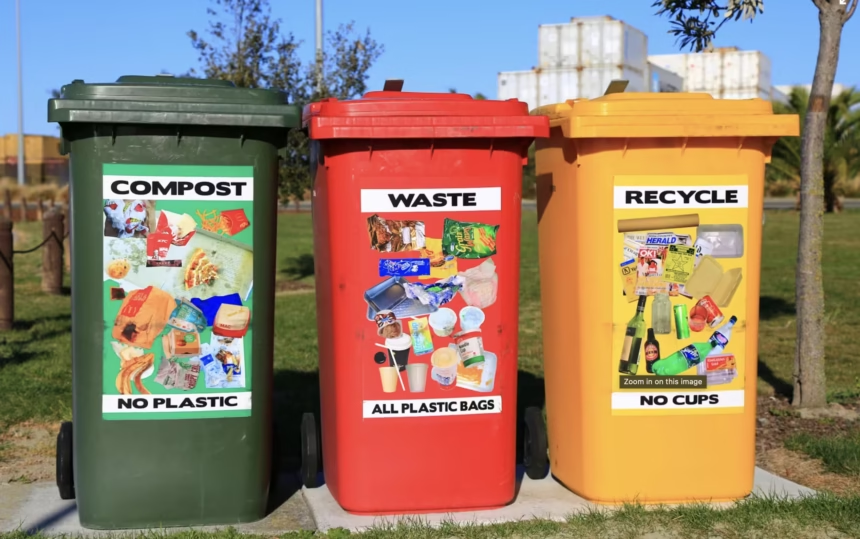
Sustainability is a priority in the business world for a variety of reasons. Customers and investors both value sustainable processes and strategies, giving priority to green businesses.
For businesses, this means being smart about their processes and policies, from introducing recycling habits in-house to securing contracts with green suppliers. As the focus on recycling in business grows, the business of recycling also develops into a profitable sector, currently valued at $410 million. In fact, for new entrepreneurs searching for the best opportunity, recycling may well be where they need to build their presence.
Plastic Recycling
Plastic recycling is one of the most tech-heavy areas of modern waste management.
The process usually starts with sorting systems that separate plastics by type through a variety of techniques, including air classifiers and optical scanners. Once sorted, materials are shredded, washed, and fed through special machines like a plastic film granulator, which chops plastic film and flexible plastics into uniform granules that can be used all over again.
The plastic recycling industry has a lot of equipment, which includes pelletizers, extruders, and melt filtration systems.
Recyclable plastic is often used in packaging, construction materials, car parts, textiles, and all sorts of consumer goods.
Paper and Cardboard Recycling
Paper and cardboard recycling relies on industrial processes to keep the quality of the fibres as high as possible. The material is sent to pulping. That’s where the paper is mixed with water and mechanically broken down to a raw form. Screening and cleaning systems then kick in to get rid of staples and adhesives, while flotation systems help remove the ink.
You need special equipment like drum pulpers, centrifugal cleaners, and refiners to keep the fibre strength up.
Recycled paper and cardboard reappear in packaging, office paper, tissues and insulation materials.
Metal Recycling
Metal recycling is a technologically mature domain that is highly effective. It separates ferrous and non-ferrous metals using magnetic systems, eddy current separators, and sensors before shredding and baling the metals for smelting. This ensures metals can be purified and reshaped.
Recycled metals are commonly used in construction, manufacturing, electronics, and transport.
Recycling Electronics
Electronic waste is more complex and requires higher precision. Here, the recycling process starts with dismantling items, either by hand or automatically. This allows for the separation of different components, so they can be shredded to recover plastics, metals, and rare materials. There are even specialized systems that are designed to safely extract copper, precious metals, and lithium.
The materials recovered can get used again in new electronics, batteries, wiring, and all sorts of industrial applications.
The recycling technology has evolved a lot in the last few decades, and there is no denying that it is constantly evolving. The discovery that Ideonella sakaiensis bacteria have evolved to produce enzymes that can eat plastic also brings a twist to the plastic recycling industry. In the near future, we can expect the recycling industry to transform itself, becoming more sustainable and environmentally-friendly as we learn to reuse materials better and in a safer way. Who knows whether in 20 or 30 years’ time, the complex equipment the recycling sector relies on may be replaced by inexpensive and common bacteria and enzymes?