
Hey there, fellow investor! If you’ve been keeping an eye on Microsoft MSFT stock price after Q2 2026 earnings, you’re not alone. This massive tech giant just dropped its fiscal second-quarter results for 2026 (covering October to December 2025), and the market’s reaction has been anything but straightforward. One minute it’s beating expectations, the next it’s dipping in after-hours trading. What’s really going on with Microsoft MSFT stock price after Q2 2026 earnings? Let’s break it down in a way that’s easy to follow, whether you’re a seasoned trader or just dipping your toes into stocks.
Picture Microsoft as that reliable friend who’s always overdelivering on promises—but sometimes the crowd expects even more fireworks. That’s exactly what happened here. The company reported solid numbers, yet the stock took a hit. Curious why? Stick around as we dive deep into the details, the numbers, the reasons behind the move, and what it might mean for your portfolio.
What Happened: Microsoft Q2 FY2026 Earnings Overview
Microsoft released its Q2 FY2026 earnings on January 28, 2026, after the market closed. The headline figures looked impressive at first glance. Revenue came in at around $81.3 billion, marking a healthy 17% jump year-over-year. That’s no small feat in a world where growth can slow down fast.
Adjusted earnings per share (EPS) hit $4.14, comfortably beating Wall Street’s consensus estimate, which hovered around $3.86 to $3.97 depending on the source. Think of it like acing a test you studied hard for—yet the reaction wasn’t pure cheers.
The star of the show? Microsoft’s cloud business, particularly Azure. Intelligent Cloud revenue surged, with Azure and other cloud services growing strongly—some reports pegged Azure at 39% growth. Commercial cloud revenue crossed a big milestone, topping $50 billion for the quarter. AI integrations continued to fuel demand, with Microsoft highlighting how its tools are powering everything from enterprise productivity to advanced AI workloads.
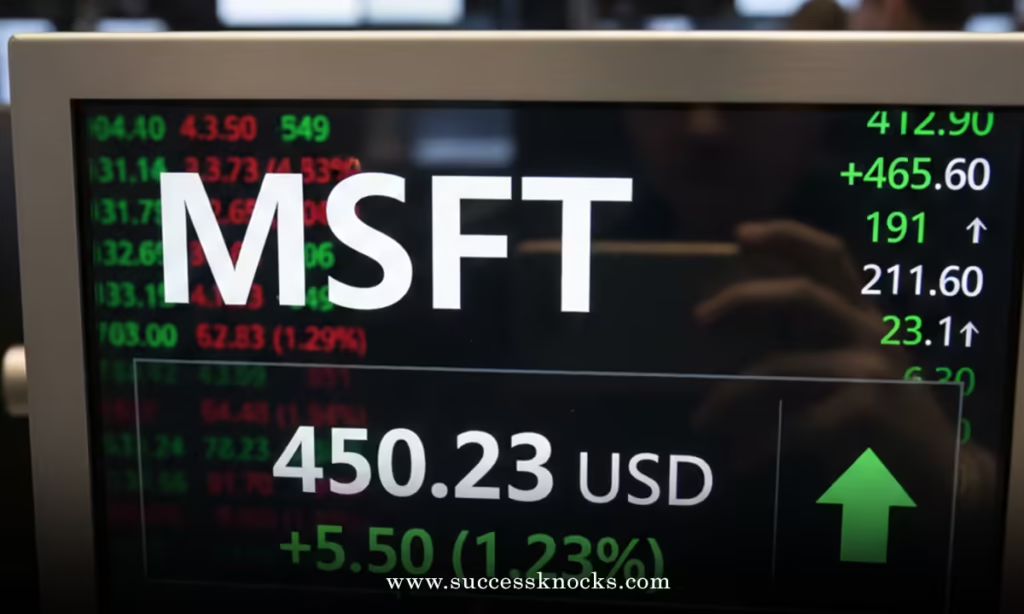
But here’s where it gets interesting. Despite the beat, the stock didn’t soar. Instead, Microsoft MSFT stock price after Q2 2026 earnings dropped significantly in after-hours trading—falling as much as 7% at one point, bringing it down from the closing price around $481-483 to levels in the mid-450s in some extended sessions.
Why the sell-off on good news? Investors zeroed in on a few cautionary notes from the report.
Key Drivers Behind the Stock Movement
Let’s unpack the main factors influencing Microsoft MSFT stock price after Q2 2026 earnings.
First, cloud growth moderation. While still robust, some saw signs of slowing momentum in certain areas. Azure’s growth was strong, but guidance for the next quarter (around 37-38% constant currency) met expectations without blowing them out of the water. In a market obsessed with explosive AI-driven expansion, “solid but not spectacular” can feel like a letdown.
Second, margin pressures and capital expenditures. Microsoft is pouring massive amounts into AI infrastructure—think data centers, GPUs, and talent. Capex has been ramping up aggressively, and while it’s fueling long-term growth, it squeezes near-term margins. Operating margin guidance came in a bit lighter than hoped, sparking worries about profitability in the face of huge investments.
It’s like building a bigger house to host more guests: the foundation gets stronger, but the immediate costs make your bank account look thinner. Investors fretted over whether the returns from these AI bets would come fast enough.
Third, segment nuances. Productivity and Business Processes (think Microsoft 365) grew nicely, around 16-17%. More Personal Computing (Windows, Xbox, Surface) had mixed results—gaming and hardware showed some softness amid broader market trends.
Overall, the earnings showed Microsoft executing well on its AI and cloud strategy, but the market priced in risks like capacity constraints, competition from rivals like AWS and Google Cloud, and the sheer scale of spending needed to keep up with AI demand.
Historical Context: How MSFT Has Reacted to Past Earnings
To understand Microsoft MSFT stock price after Q2 2026 earnings, it’s helpful to look back. Microsoft has a track record of beating estimates consistently, thanks to its diversified empire—from Office subscriptions to Azure dominance.
In recent years, post-earnings moves have varied. Strong AI narratives often sent shares higher, but when guidance disappointed or capex spiked too much, dips followed. This Q2 reaction echoes some past episodes where “beat but guidance meh” led to short-term pullbacks.
Yet Microsoft has bounced back time and again. The stock’s long-term trajectory remains upward, driven by secular trends like digital transformation and AI adoption. If history is any guide, this dip could be a buying opportunity for patient investors.
Analyst Views and Future Outlook
Wall Street largely remains bullish on Microsoft. Many analysts maintain “Buy” or “Overweight” ratings, with price targets often in the $600+ range—implying significant upside from current levels.
The consensus sees AI as Microsoft’s biggest growth engine. Partnerships (like the deep tie-up with OpenAI) and tools like Copilot are embedding AI across products, creating sticky revenue streams. Remaining performance obligations (future contracted revenue) are sky-high, signaling strong demand visibility.
That said, risks exist. Macroeconomic headwinds, regulatory scrutiny on big tech, and execution challenges in scaling AI infrastructure could weigh on sentiment. But Microsoft’s moat—its enterprise relationships, vast data, and integrated ecosystem—gives it an edge few can match.
Looking ahead, the next earnings (Q3 FY2026, expected around April 2026) will be key. If Microsoft shows continued AI momentum and better margin control, Microsoft MSFT stock price after Q2 2026 earnings could prove to be a temporary blip.
Should You Buy, Hold, or Sell MSFT Now?
Here’s the million-dollar question: What does Microsoft MSFT stock price after Q2 2026 earnings mean for your next move?
If you’re a long-term believer in AI and cloud computing, this pullback might feel like a discount on one of the market’s strongest compounders. Microsoft’s fundamentals remain rock-solid—recurring revenue, massive cash flow, and a dividend that’s grown steadily.
Short-term traders might wait for stabilization, as volatility could linger. Beginners? Focus on the big picture: Microsoft isn’t going anywhere. It’s adapting to the AI era better than most.
Whatever your style, do your due diligence. Markets can be emotional, but facts win out over time.
Conclusion
Wrapping this up, Microsoft MSFT stock price after Q2 2026 earnings tells a tale of strong execution met with cautious investor nerves. The company delivered a revenue beat, EPS surprise, and continued cloud/AI momentum, yet concerns over spending and moderated growth guidance triggered a sharp after-hours drop. It’s a classic case of “great results, but the bar was sky-high.”
Microsoft’s story is far from over—it’s investing aggressively in the future, and that could pay huge dividends down the line. If you’re in it for the long haul, dips like this often become footnotes in a bigger upward journey. Stay informed, keep perspective, and who knows? This could be one of those moments you look back on and say, “I’m glad I didn’t panic.”
For more details, check these high-authority sources:
- Microsoft’s official Investor Relations page: Microsoft Investor Relations
- Yahoo Finance for historical data: Yahoo Finance MSFT
- CNBC coverage of the earnings: CNBC Microsoft Earnings
FAQs
What was the immediate impact on Microsoft MSFT stock price after Q2 2026 earnings?
Microsoft MSFT stock price after Q2 2026 earnings saw a notable decline, dropping up to 7% in after-hours trading despite beating estimates, mainly due to concerns over cloud growth moderation and higher capex.
Did Microsoft beat earnings expectations in Q2 2026?
Yes, Microsoft reported adjusted EPS of $4.14 (versus estimates around $3.86-$3.97) and revenue of $81.3 billion (above forecasts), marking a clear beat for Microsoft MSFT stock price after Q2 2026 earnings reactions.
Why did the stock fall despite strong Q2 results?
The dip in Microsoft MSFT stock price after Q2 2026 earnings stemmed from lighter margin guidance, ongoing heavy AI infrastructure spending, and slightly tempered cloud growth expectations, even as core metrics exceeded forecasts.
What role did AI play in Microsoft’s Q2 2026 performance?
AI was a major driver, boosting Azure and cloud services significantly. However, capacity constraints and investment needs tempered enthusiasm around Microsoft MSFT stock price after Q2 2026 earnings.
Is Microsoft stock a good long-term investment after this earnings reaction?
Many analysts think so—strong fundamentals, AI leadership, and recurring revenue make it compelling, though short-term volatility around Microsoft MSFT stock price after Q2 2026 earnings could persist.