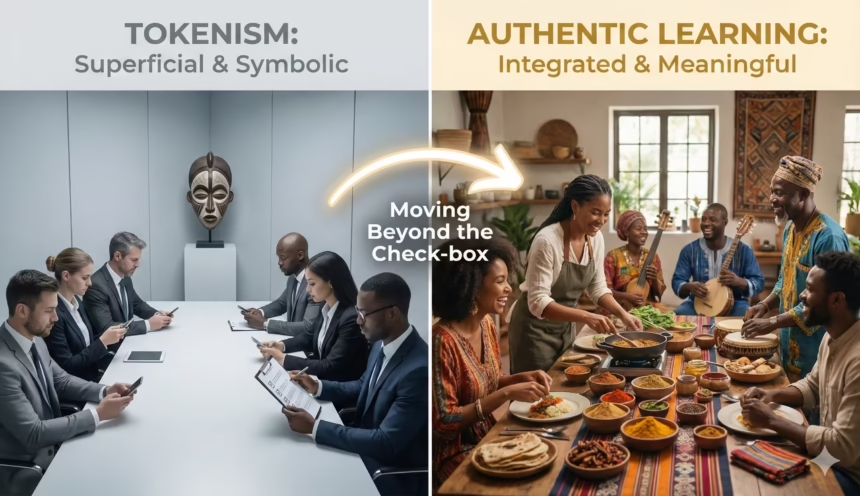
In recent years, many Australian organisations have made significant strides in their efforts to engage with Aboriginal and Torres Strait Islander communities. From launching Reconciliation Action Plans (RAPs) to hosting NAIDOC Week events, the intent to foster inclusion is evident. However, without deeper structural commitment, well-meaning gestures risk becoming superficial. Avoiding tokenism in cultural learning requires more than symbolic acknowledgements—it demands meaningful, ongoing engagement and systemic change.
Embed Cultural Learning Within Long-Term Strategy
The most effective way to avoid tokenism is to treat cultural learning not as a standalone activity, but as a strategic priority. One-off workshops or awareness days can have value, but they must be part of a longer journey that informs organisational policy, hiring practices, procurement, and governance. This involves identifying gaps, setting clear objectives, and integrating accountability measures.
For instance, government agencies and large corporates are increasingly turning to Aboriginal and Torres Strait Islander cultural awareness training for workplaces to establish a deeper understanding across departments. These programmes, when tailored to organisational goals, foster internal alignment and create space for sustained learning—not just momentary recognition. Programmes must also address both historical context and contemporary realities, allowing staff to understand the broader social, political, and economic dynamics that shape Indigenous experiences.
Centre First Nations Voices in Program Design
One of the core indicators of tokenistic practice is the absence of authentic Indigenous participation. For cultural learning initiatives to be credible, they must be informed, led, or co-created by Aboriginal and Torres Strait Islander peoples. This ensures that content is not only accurate but also reflects lived experiences, diverse perspectives, and evolving priorities within Indigenous communities.
Inviting Elders, community leaders, and Indigenous educators to contribute meaningfully to program design promotes cultural safety and builds trust. Moreover, engaging with regionally specific voices avoids homogenising Aboriginal and Torres Strait Islander cultures—acknowledging instead the diversity of language groups, traditions, and local contexts across Australia.
Focus on Internal Capability and Accountability
Tokenism often emerges when responsibility for cultural engagement is externalised—outsourced to consultants without investing in internal structures that can carry the work forward. Organisations should cultivate internal champions and cross-functional RAP committees empowered to make decisions, monitor progress, and foster inclusive leadership across levels.
This includes embedding cultural competency into job descriptions, performance indicators, and induction pathways. When staff understand that cultural learning is part of their professional development, rather than a box-ticking exercise, it shifts attitudes and normalises respectful engagement. Monitoring and evaluation also matter: collecting qualitative and quantitative data on learning outcomes, staff confidence, and behaviour change helps refine the approach and guard against performative gestures.
Align Cultural Learning with Broader Inclusion Goals
Avoiding tokenism means treating cultural learning not as an isolated compliance requirement, but as a component of broader diversity, equity and inclusion (DEI) strategies. When cultural understanding is aligned with efforts to reduce structural disadvantage, such as improving recruitment pipelines, engaging Indigenous suppliers, or reforming leadership representation, it contributes to measurable systemic change.
Educational institutions, for example, may pair cultural awareness with inclusive curriculum design and Indigenous student support. Likewise, corporates may integrate cultural learning into supplier diversity initiatives, strengthening economic empowerment alongside cultural respect. The more these efforts are interconnected, the less likely they are to be dismissed as symbolic or cosmetic.
Create Safe Spaces for Reflection and Growth
Tokenism can sometimes result from fear—fear of saying the wrong thing, of being called out, or of opening uncomfortable conversations. Organisations must therefore create safe, respectful environments where staff can reflect, ask questions, and explore complex topics without judgement. This requires experienced facilitators, clear ground rules, and a non-punitive learning culture.
Critically, this includes recognising that mistakes will happen and offering constructive ways to address them. Cultural learning should not be reduced to etiquette; it should support emotional intelligence, active listening, and the ability to navigate cultural humility. When learning is framed as a continuous process, rather than a test to pass, organisational culture becomes more open, honest, and inclusive.
Conclusion: From Intent to Integrity
Tokenism arises when cultural learning becomes symbolic rather than structural. To avoid this, organisations must embed long-term strategies, centre Indigenous leadership, build internal capability, and align efforts with broader inclusion goals. It is not enough to intend respect—integrity requires action, consistency, and accountability. By investing in genuine, context-aware engagement, organisations not only strengthen their cultural competency but also contribute meaningfully to reconciliation.