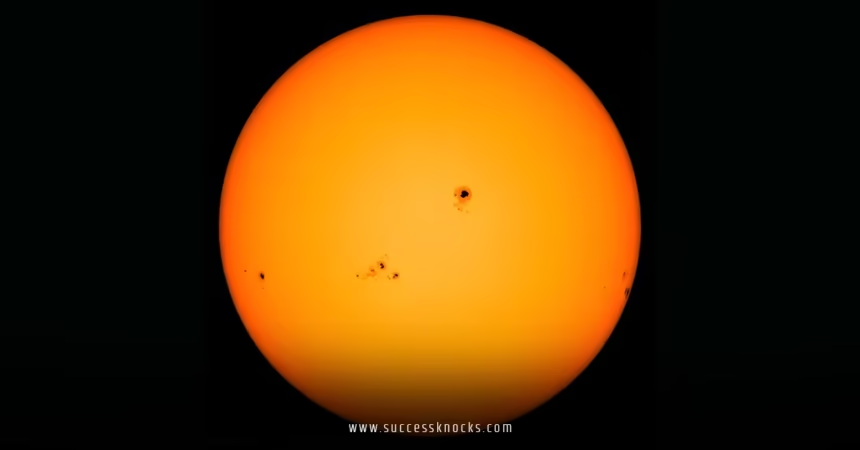
Solar Cycle 25 peak activity 2026 continues to deliver surprises even as the Sun’s wildest phase begins to wind down. We’ve entered February 2026, and the Sun is still firing off powerful X-class flares—like the recent barrage from active region AR4366—including an X8.1 eruption that ranks among the strongest in recent years. If you’re tracking space weather, you know this ties directly into ongoing NASA solar storm warnings and space weather alerts spring 2026, where intense solar outbursts keep triggering geomagnetic watches, radio blackouts, and chances for stunning auroras. The peak wasn’t a single tidy moment; it’s more like a drawn-out fireworks show that’s refusing to end quietly.
What Exactly Is Solar Cycle 25?
Every 11 years or so, the Sun goes through a cycle of rising and falling magnetic activity. Solar Cycle 25 kicked off in December 2019 after a deep minimum, and it’s now well into its maximum phase. Scientists track this primarily through the smoothed sunspot number—a 13-month average that smooths out daily ups and downs.
Early predictions from the NOAA/NASA/ISES Solar Cycle Prediction Panel in 2019 called for a modest peak around July 2025 with a smoothed sunspot number of about 115—similar to the relatively quiet Cycle 24. But reality proved more exciting. Activity surged beyond expectations, hitting a smoothed maximum around 161 in October 2024 according to sources like SILSO and Wikipedia summaries of observations.
Even so, the decline isn’t sharp. Solar maximum isn’t a single day—it’s a period that can stretch over a year or more, with lingering high activity. Into 2026, we’re seeing exactly that: persistent strong flares, complex sunspot groups, and occasional spikes that keep space weather forecasters on their toes.
Why Solar Cycle 25 Peak Activity 2026 Feels So Prolonged
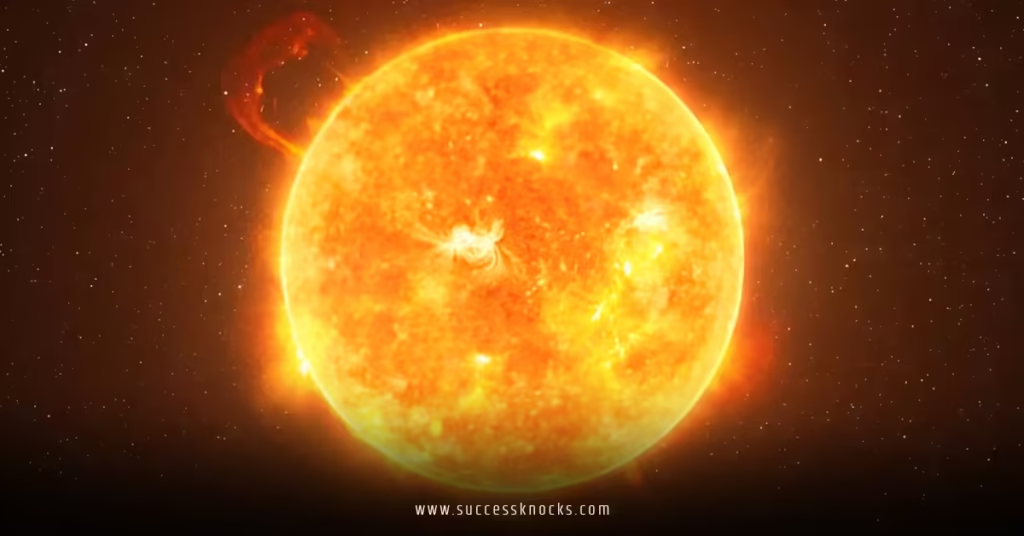
Think of the Sun’s magnetic field like a twisted rubber band. During maximum, it snaps and releases energy in flares and coronal mass ejections (CMEs). The 2019 panel expected a straightforward peak, but Cycle 25 has shown hints of double-peaked behavior—common in some cycles where activity plateaus or rebounds.
NASA and NOAA announced in late 2024 that solar maximum had arrived, but emphasized it could continue for another year or so. By early 2026, we’re in the declining phase, yet events like the February 1-2, 2026, sequence of four X-class flares (including X8.1, X2.8, and others) from one sunspot region remind us the Sun isn’t done yet.
Experts note that the largest historical events sometimes occur during the decline—think roller-coaster surges even as the overall trend heads downward. This explains why NASA solar storm warnings and space weather alerts spring 2026 remain frequent: models predict continued chances for M- and X-class activity, potential G1-G2 geomagnetic storms, and aurora displays pushing farther from the poles.
Key Indicators of Ongoing Peak Activity in 2026
Sunspot numbers tell part of the story, but flares and CMEs steal the show. In early February 2026, monster sunspot AR4366 erupted repeatedly, launching over 20 flares in 24 hours at one point. NASA’s Solar Dynamics Observatory captured these in vivid detail—bright flashes of plasma hotter than the Sun’s surface.
NOAA’s Space Weather Prediction Center issues scales for impacts:
- R-scale for radio blackouts from flares
- S-scale for solar radiation storms
- G-scale for geomagnetic storms from CMEs
Recent activity has pushed R3+ blackouts and G1 watches, with potential for higher if Earth-directed CMEs arrive. F10.7 radio flux (another activity proxy) has stayed elevated, supporting the idea that we’re not fully past the peak turbulence.
New satellites and tools enhance monitoring. Real-time data from L1 points helps predict arrivals better than ever.
Impacts of Solar Cycle 25 Peak Activity 2026 on Earth and Technology
The fun part? Auroras. Strong geomagnetic storms light up skies at mid-latitudes—green curtains, red glows, even purple hues. In 2026’s lingering high activity, northern (and sometimes southern) hemisphere viewers get treats, especially around equinoxes when Earth’s magnetic field aligns favorably.
The flip side hits harder. Power grids risk induced currents leading to outages. Satellites face increased drag or radiation damage. GPS signals degrade during ionospheric storms, affecting navigation. Airlines reroute polar flights to dodge radiation spikes, and astronauts on the ISS receive shelter warnings.
These risks keep NASA solar storm warnings and space weather alerts spring 2026 critical. Operators put assets in safe modes, grids tweak voltages, and forecasters provide hours-to-days notice.
How Scientists Track and Predict Solar Cycle 25 in 2026
NASA’s Solar Dynamics Observatory, ACE, and SOHO provide constant eyes on the Sun. NOAA’s SWPC combines this with models for forecasts. Monthly updates to solar cycle progression graphs show the smoothed curve declining slowly after the 2024 peak, but with wide uncertainty bands.
Community sites like SpaceWeather.com aggregate alerts and citizen observations. As Cycle 25 fades toward minimum around 2030, expect fewer big events—but 2026 could still surprise with occasional monsters.
What to Expect Next in Solar Cycle 25 Peak Activity 2026 and Beyond
The Sun’s activity won’t drop off a cliff. Declining phases often feature sporadic strong outbursts, potentially into 2027. Auroras might remain frequent through late 2026, though less intense than 2024-2025 peaks.
For skywatchers, check forecasts around new/dark moons. For tech users, awareness of alerts helps—apps notify of incoming storms.
This cycle has exceeded expectations, teaching us more about the Sun’s dynamo. It underscores why continuous monitoring matters in our space-dependent world.
Conclusion
Solar Cycle 25 peak activity 2026 proves the Sun’s maximum is a marathon, not a sprint. With smoothed peaks in 2024 but powerful flares and CMEs persisting into early 2026, we’re witnessing a cycle stronger than predicted. This fuels ongoing NASA solar storm warnings and space weather alerts spring 2026, blending breathtaking auroras with real infrastructure safeguards. Stay tuned to reliable sources, appreciate the cosmic show, and remember: our star’s moods affect life here more than we often realize. Whether chasing lights or protecting tech, understanding this cycle empowers us all.
FAQs
When did Solar Cycle 25 actually peak, and why is activity still high in 2026?
The smoothed sunspot maximum occurred around October 2024 at about 161, higher than the 115 predicted. Solar Cycle 25 peak activity 2026 reflects the extended maximum phase, where strong flares continue during the slow decline.
How does Solar Cycle 25 peak activity 2026 relate to aurora visibility?
Elevated activity means more CMEs hitting Earth, triggering geomagnetic storms that push auroras equatorward. In spring 2026, this links to vivid displays tied to NASA solar storm warnings and space weather alerts spring 2026.
Are there risks from Solar Cycle 25 peak activity 2026 to modern technology?
Yes—flares cause radio blackouts, CMEs induce grid currents, and radiation affects satellites/GPS. Warnings help mitigate, but 2026’s lingering surges keep risks relevant.
What tools track Solar Cycle 25 peak activity 2026 updates?
NASA’s Solar Dynamics Observatory images, NOAA SWPC forecasts, and sites like SpaceWeather.com provide real-time data on sunspots, flares, and alerts.
Will Solar Cycle 25 peak activity 2026 lead to more intense events later?
Possibly—declining phases can produce big storms (e.g., historical examples years after peak). Expect occasional surprises through 2026-2027 before quiet returns.