
Giant phantom jellyfish behavior and feeding methods explained in detail reveal one of the ocean’s most mysterious creatures. This elusive deep-sea dweller, known scientifically as Stygiomedusa gigantea, drifts through the dark like a ghostly apparition, captivating scientists and ocean lovers alike. Have you ever wondered how something so massive survives in the crushing depths without stinging tentacles? Let’s dive into the fascinating world of this rare jelly and uncover its secrets.
Discovering the Giant Phantom Jellyfish: A Rare Deep-Sea Enigma
The giant phantom jellyfish earns its name for good reason. First described in the late 1800s, it has been spotted fewer than 130 times in over a century. That’s rarer than spotting a shooting star on a cloudy night! Researchers at places like the Monterey Bay Aquarium Research Institute (MBARI) have captured most sightings using remote-operated vehicles (ROVs).
Why so elusive? It lives in the midnight zone of the ocean, where sunlight never reaches. Imagine a creature larger than a human, floating silently thousands of feet below the surface. Giant phantom jellyfish behavior and feeding methods explained often come from brief video encounters, making every observation precious.
Physical Features That Make It Unique
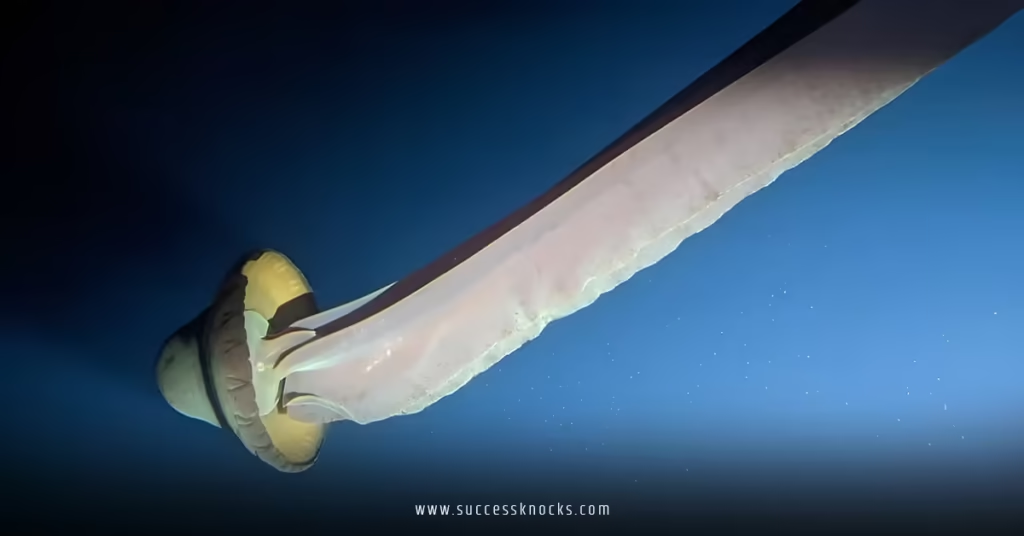
Picture a massive umbrella-shaped bell over three feet wide—that’s the giant phantom jellyfish’s body. Trailing behind are four ribbon-like oral arms that stretch up to 33 feet long. These aren’t typical tentacles. Unlike most jellies that sting prey into submission, this one lacks stinging cells on tentacles entirely.
Instead, those oral arms act like flowing scarves in the current—wide, paddle-shaped, and incredibly efficient. The bell appears reddish-orange under lights, helping it blend into the faint red light that filters down in deep waters. It’s camouflage at its finest. When you think about giant phantom jellyfish behavior and feeding methods explained, these physical traits are key to survival.
The Role of the Bell in Movement
The bell isn’t just for show. It pulsates gently to propel the jelly forward. Think of it as a slow, rhythmic heartbeat pushing water out for propulsion. This movement is energy-efficient, perfect for a life of drifting.
Oral Arms: More Than Meets the Eye
Those long arms are the stars of the show. They undulate lazily, creating a massive net in the water column. Giant phantom jellyfish behavior and feeding methods explained hinge on these arms—they’re both locomotion tools and hunting weapons.
Habitat and Distribution: Where Does It Live?
The giant phantom jellyfish calls all major oceans home, except the Arctic. You’ll find it from the Antarctic waters to the Gulf of California, but almost always deep down—typically between 2,000 and 22,000 feet.
In polar regions, it sometimes ventures shallower, even to a few hundred feet. Why? Possibly to rid itself of parasites under faint sunlight or to find richer feeding grounds. Giant phantom jellyfish behavior and feeding methods explained vary slightly by depth, as prey availability changes.
It thrives near hydrothermal vents or areas with upwelling currents that bring nutrients—and plankton—to the depths. It’s not picky about location, as long as it’s dark, cold, and quiet.
Giant Phantom Jellyfish Behavior Explained: Graceful Drifter of the Deep
How does something so large move so gracefully? Giant phantom jellyfish behavior and feeding methods explained start with its slow, deliberate style. It doesn’t chase prey like a shark. Instead, it drifts with ocean currents, conserving energy in a food-scarce environment.
Pulsating for Propulsion
Watch footage of one, and you’ll see the bell contract slowly. Each pulse moves it forward or upward. It’s like a hot air balloon rising gently—no rush, no waste. This behavior lets it cover vast distances without exhaustion.
Avoiding Threats and Navigating Currents
Does it have predators? Probably large deep-sea fish or squid, but sightings are too rare to confirm. Its behavior seems focused on avoidance: drifting passively, staying motionless when threatened. Those oral arms can fold up, making it less conspicuous.
Symbiotic Relationships: A Fishy Friendship
One of the coolest discoveries? The giant phantom jellyfish often hosts a small fish called the pelagic brotula (Thalassobathia pelagica). The fish hides under the bell, eating parasites off the jelly. In return, it gets protection from predators. It’s a perfect deep-sea partnership! Scientists confirmed this symbiosis when they saw the fish rejoin the jelly after separation. Talk about loyalty.
Bioluminescence: A Faint Glow in the Dark
In visible light, it glows a soft orange-red. This bioluminescence might deter predators or attract prey. Giant phantom jellyfish behavior and feeding methods explained include subtle light displays that add to its phantom-like mystery.
Giant Phantom Jellyfish Feeding Methods Explained: The Art of Passive Hunting
Here’s where it gets really interesting. How does a jelly without stinging tentacles eat? Giant phantom jellyfish feeding methods are all about patience and physics.
Trailing Arms as Living Nets
Those four oral arms trail behind like fishing lines. As the jelly drifts or pulsates forward, water flows over the arms. Plankton, small fish, and crustaceans bump into the sticky surfaces. No sting needed—the arms simply entangle prey.
Enveloping and Transporting Prey
Once something touches an arm, the jelly contracts it slightly, wrapping the prey like a ribbon around a gift. Then, slow peristaltic movements—think conveyor belt—pull the food toward the mouth at the bell’s center. It’s efficient and low-energy.
Diet: What’s on the Menu?
Mainly plankton and small fish. In nutrient-rich areas near vents, it might snag more substantial meals. Giant phantom jellyfish behavior and feeding methods explained show it as an ambush predator, waiting for food to come to it.
No Waste: Digesting in a Simple Stomach
Like most jellies, it has a basic digestive system. Food enters the mouth, gets broken down in the gastrovascular cavity, and nutrients circulate. Waste exits the same way. Simple, but effective.
Energy Conservation in Feeding
Why passive hunting? In the deep sea, food is scarce. Chasing prey would burn too much energy. By drifting and trailing arms, the jelly maximizes catches with minimal effort. It’s evolution at its smartest.
Reproduction: Babies from the Mouth?
Giant phantom jellyfish reproduction remains mysterious due to few observations. It likely releases eggs and sperm into the water, but some evidence suggests brooding—carrying fertilized eggs in the oral arms until they hatch. One intriguing note: planula larvae might even emerge from the mouth area. Giant phantom jellyfish behavior and feeding methods explained don’t directly cover reproduction, but it ties into how adults protect the next generation.
Why We Should Care: Conservation in the Deep
Though not threatened (we think), deep-sea trawling and climate change could impact its habitat. Every sighting reminds us how much ocean remains unexplored. Protecting these depths protects creatures like the giant phantom jellyfish.
Conclusion: The Enduring Mystery of the Deep
Giant phantom jellyfish behavior and feeding methods explained reveal a creature perfectly adapted to its harsh world—graceful, efficient, and enigmatic. From its ribbon-like arms snagging prey in the dark to its symbiotic fish friend, this jelly embodies the wonders of the deep sea. Next time you gaze at the ocean, remember: far below, ghostly giants drift silently, reminding us that Earth still holds secrets waiting to be uncovered. Isn’t that what makes exploration so thrilling?
FAQs
What makes giant phantom jellyfish behavior and feeding methods explained so unique compared to other jellies?
Unlike common jellies with stinging tentacles, the giant phantom uses four long oral arms to passively trap prey without venom, relying on drifting and entanglement in the deep sea.
How often are giant phantom jellyfish sighted, and why are they rare?
Fewer than 130 sightings in over 120 years, mainly because they live in the extreme depths of the midnight zone, far from human reach.
Can the giant phantom jellyfish sting humans?
No, it lacks stinging tentacles entirely. Its oral arms are sticky but harmless to us—good news if you ever meet one (unlikely!).
What is the symbiotic relationship in giant phantom jellyfish behavior?
It often hosts a pelagic brotula fish that shelters under its bell and eats parasites, creating a mutual benefit in the food-scarce deep.
How does giant phantom jellyfish feeding methods explained align with its energy needs?
Its passive drifting and arm-trailing method conserves energy perfectly for the low-food environment of the deep ocean.