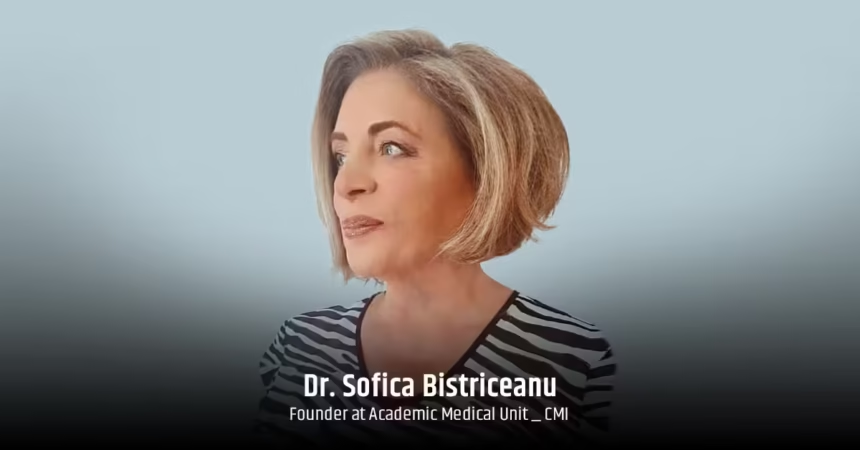
We interviewed Dr. Sofica Bistriceanu, an accomplished family medicine physician and global medical researcher, about her commitment to advancing holistic, patient-centered care. She shared insights on implementing the medical home model in practice, exploring the effects of communication on health, overcoming challenges in clinical leadership, balancing compassion with efficiency, contributing to international medical research, and her vision for the evolving role of women in healthcare and the future of family medicine.
Questions directed to Dr. Sofica Bistriceanu:
1. What motivated you to dedicate your career to family medicine, and how has your personal philosophy shaped your practice over the years?
Answer:
I selected this field of medicine because it offers a unique perspective on the practice of medicine: observing human evolution from birth to the end of life, genetic expressivity across generations, how people grow and develop into families and communities, and the external influences on their life paths.
Referring to the community, the medical professional usually serves people who prefer their services.
Currently, they subscribe to a provider’s list to receive medical services as needed. This selection is temporary or ephemeral because, when the provider retires or moves out of that area, they will pass the list to another provider, with no preference for that provider. Later, patients can select another provider if they are dissatisfied with their new provider. The provider will take the same actions if a patient exhibits inappropriate behavior toward the provider.
For the medical home model – a private practice, there is another nuance in medical work: the patient selects the provider for home visits, considering the provider’s expertise, reputation in real and online communities, availability when needed, interaction skills with the patient and their loved ones, prices, and alignment with social norms.
If they are pleased with the provider’s services, they spread a good name for their provider in the community, which increases return on investment, provider business stability and expansion, finances, provider career advancement, personal creativity, and work efficiency, and finally improves individual health. In this context, satisfied patients will remain loyal collaborators in a relationship with their providers.
2. Can you tell us what inspired you to create the medical home model and how it has transformed patient care within your community?
Answer
I initiated the medical home model to work independently. This approach creates a safe environment, selects honest, kind, respectful, and loyal collaborators, and avoids the time pressure of office visits, except in emergencies. It also allows observation of environmental factors that contribute to the onset and progression of disease, which are often hidden in office practice. These elements make the work more efficient and ultimately generate well-being for the provider, the patient, and their loved ones.
Suppose a patient with heart problems comes into the office. With the aid of IT advancements, the physician establishes an accurate diagnosis and appropriate drug
treatment. The patient returns home, where inappropriate communication with family members, usually across different generations, continues to negatively impact their balance. Similarities can be observed in the workplace. What is treatment effectiveness? First of all, we must identify the cause of a disorder, then try to eliminate or progressively attenuate the cause that initiated the disease.
The medical home model helps examine what happens in real life, where people live, and how people can be happy or depressed, and how people are registered with various disorders.
Informing people about changes in their behavior improves clinical outcomes, leading to satisfied patients, their families, and providers.
3. You’ve participated in numerous international conferences and published extensively. Which of these experiences has had the greatest influence on your professional growth?
Answers:
I reflected on different approaches to medical procedures, diagnoses, and treatments worldwide. I apply new data to a specific context and to patient data, continuously adjusting variables as necessary. Personalized disease management for each patient is required. Each patient is a unique entity with distinct responses to various internal and external stimuli and forces. Guidelines are orienting for practice. General data has to be applied differently in daily practice, depending on the varied conditions.
4. Communication seems to be a central theme in your research. What led you to explore the link between communication and physical health, and what key findings stand out to you?
Answer
No one can live in isolation. People must continuously interact to exchange goods and services, as no one can know or produce everything. How they interact shapes their life path. Exchanging goods or services involves communication through words and attitudes. This human interaction is key to initiating or ameliorating disorders. The individual’s power lies in their tongue. How they communicate can destroy collaborators or benefit them. Many facets of communication influence people’s health. I presented real case studies worldwide, highlighting how improper communication can initiate, aggravate, or exacerbate disorders in vulnerable individuals, such as arterial hypertension, depression, type 2 diabetes, other metabolic abnormalities, and even brain hemorrhage or tumors. Time spent exposed to inappropriate words, energy, frequency, and individual sensitivity to such communication are linked to the severity of human clinical disorders.
People must be aware of the negative impact of improper communication on their health and try to avoid or eliminate/block such influences. IT advancements facilitate self-protection from negative influences.
5. As a leader and founder, how do you maintain compassion and integrity while managing the demands of modern medical practice?
Answer
Professionals experiencing burnout are unable to provide compassionate care. Cool-hearted work declines work efficiency: disappointed collaborators/partners/clients, low patient adherence to the therapy plan, poor clinical outcomes, damage to the provider’s reputation, decreased return on investment, decreased client loyalty, decreased revenue, provider dissatisfaction with their work, decreased career advancement.
Eliminating burnout is essential in clinical practice. By being mindful of how to select collaborators, create a clean and friendly environment, and promote trust, empathy, respect, and generosity when needed, you can earn admiration, even love, from players in a relationship.
“Patients’ love shines on the physician transient trouble time” was the title of my storyboard presented at the IHI National Forum in December 2012 in Orlando, Florida. After this presentation, I was invited to join the American Academy of Communication in Healthcare.
6. You’ve received multiple international awards and recognitions. Which accomplishment do you consider the most defining moment of your career, and why?
Answer:
The first five awards and recognitions in my career had a great impact on my inner world:
-2002: the poster titled “Bed Rest Benefit for Acute Bronchitis in the Cold Season” was presented at the WONCA Europe Conference in London. This project was completed during the MATRA research program in Family Medicine in Romania, conducted at Maastricht University. It was selected for discussion. It highlights the value of air energy variation in predicting the duration of a respiratory illness.
-2006. — Dual Achievements in Research and Creativity
-Poster from doctoral thesis “Study of Plasma Level Cations in Dyslipidemia” received a perfect 5/5 rating among 230 entries at the NAPCRG Annual Meeting, Tucson, Arizona.
-Won Most Creative Storyboard at the 5th NICHQ Annual Forum, Orlando, for “Practical Model to Improve Waiting Time Management and Communication Skill in Our Medical Units,” built around my poem The Snowball.
2007 — Recognized for Innovative Presentation
● Received Certificate of Excellence at the 6th NICHQ Annual Forum, San Francisco, for storyboard “Face Light Reflects into Behavior.”
2013— Excellence in Service and Quality
● Honoured with the Service Quality Award at the 25th IHI National Forum on Quality Improvement in Health Care, Orlando.
● Recognized for presentation: “Offensive Talks, Attitudes, Effects on Older People.” ● Award presented by The Permanente Journal in partnership with IHI.
7. As a woman leader in medicine, how do you view your role in inspiring and mentoring the next generation of female healthcare professionals?
Answer
Females are stronger than men in failure, but more fragile than men in daily work. They have the capacity to offer more compassionate care than men, and that is their advantage. Their role in society is essential because their heart complements their specific knowledge. They can change everything with their heart – if they have a big heart.
The heart can change the world.
8. Looking ahead, what are your personal and professional goals for the coming years, and how do you hope your work will continue to influence the field of family medicine?
Answer
In the time ahead, I will explore how cultural diversity influences individual life paths, including health.
I believe that family medicine will evolve to include in-person visits, e-visits, e-programmed follow-ups, e-prescriptions, and patient self-monitoring of blood sugar, oxygen levels, blood pressure, and heart rate.
People will be encouraged to be polite, honest, and generous, to choose a clean and friendly environment, and to avoid or stop rude communications. In this way, they can prevent the major disorders listed above at no cost. If they do not pay attention to this data, they will end up paying for medical services. Every inattention has a price to pay later.
Alternatively, patients can pay for services at home or for e-visits. Additionally, they can receive free medical services at national system-operated medical centers.
Thank you,
Similar articles:successknocks.com