Overview Summary
Prophet Cracker Barrel represents one of 2025’s most striking brand transformation failures—a cautionary tale of how modernizing a heritage brand without protecting its core identity can trigger customer rebellion and financial consequences. In early 2025, Cracker Barrel hired the global branding consultancy Prophet to lead a comprehensive rebrand that included logo redesigns, restaurant overhauls, and marketing overhauls. The partnership ended within months after severe customer backlash and declining sales, revealing critical gaps in how legacy brands approach modernization.
Quick Facts:
- Prophet was tasked with reshaping Cracker Barrel’s brand identity, store design, and marketing strategy in March 2025
- The rebrand removed iconic imagery (the elderly man on a barrel logo) and shifted store aesthetics from kitschy Americana to minimalist modern design
- Social media backlash intensified by bot-driven campaigns reached peak engagement across X, Reddit, and Facebook
- Cracker Barrel terminated the partnership by mid-2025 and pivoted to operational improvements and customer feedback-driven strategies
- Financial impact: FY2026 traffic projections declined 8.5–9.5%, though sentiment scores improved after course correction
What Happened: Prophet’s Role in Cracker Barrel’s Rebrand
Cracker Barrel Old Country Store is a casual dining institution with nearly 650 locations across the United States. Known for homestyle comfort food, quirky country store retail, and unapologetic Americana nostalgia, the chain had built a loyal customer base over decades. By 2024, however, leadership recognized the brand faced a modernization challenge: appeal to younger demographics without alienating the core audience that made it iconic.
In March 2025, Cracker Barrel announced a “bold strategic transformation” partnership with Prophet, a globally recognized branding consultancy founded by Scott Galloway and Ian Chaplen, with David Aaker serving as vice chairman. Prophet’s mandate was ambitious: reshape the brand vision, redesign restaurant interiors and exteriors, overhaul marketing campaigns, and redefine the employee value proposition to boost market share and attract new customers.
The partnership also included collaborations with Viral Nation (social media and influencer strategy) and Blue Engine (public relations), creating a three-pronged transformation effort. On paper, this was a well-resourced, expert-led initiative designed to preserve heritage while embracing modernity. In execution, it became a masterclass in how not to rebrand a nostalgia-driven business.
The Rebrand Strategy and Execution
The Visual Changes
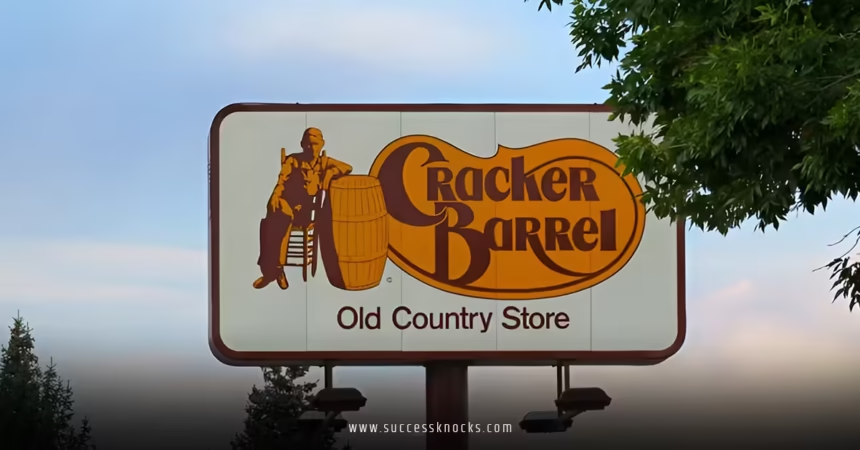
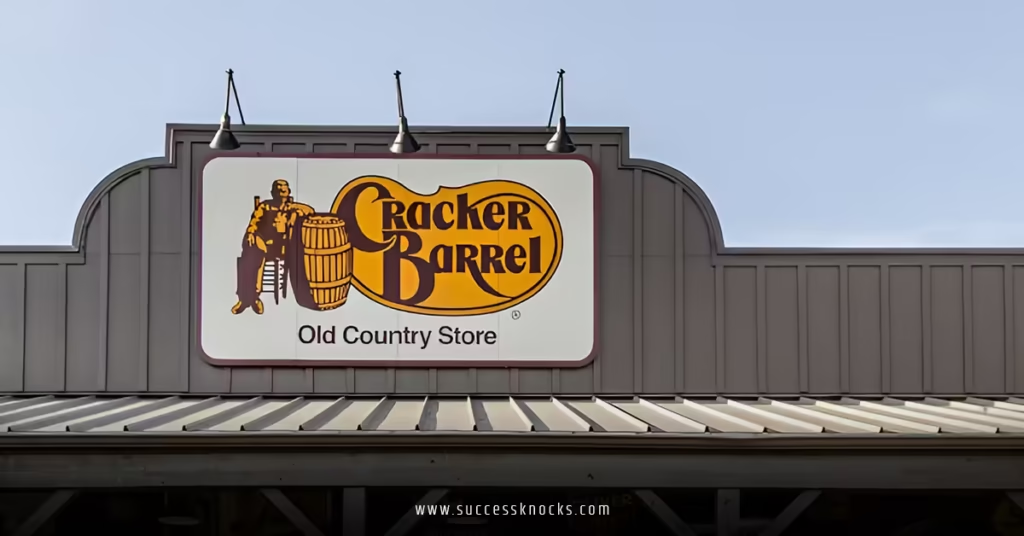
Prophet’s rebrand centered on visual modernization. The most controversial change: removing the iconic elderly man sitting on a barrel from Cracker Barrel’s logo. This image had been synonymous with the brand for decades, immediately evoking the store’s kitschy, grandpa’s-attic aesthetic. The new logo adopted cleaner lines and contemporary typography.
Store redesigns followed the same logic. Prophet replaced eclectic vintage décor—antiques, folk art, barn wood, cast-iron skillets, and hand-painted signs—with streamlined, minimalist interiors. The goal was to feel “upscale casual” rather than “thrift store chic.” Stores transitioned from warm, cluttered, memorable spaces to what critics called “drab and soulless” modern dining environments.
The Marketing Angle
The messaging pivoted from celebrating rural Americana and timeless tradition to emphasizing “bold transformation,” “innovation,” and “redefining expectations.” Campaign creative leaned modern, aspirational, and urban—a stark contrast to Cracker Barrel’s heritage positioning.
The Employee Value Proposition
Prophet also designed new employee narratives, shifting from “family-style workplace” and “country hospitality” to corporate language around “career development,” “inclusive culture,” and “forward-thinking employer.” While well-intentioned, this language felt disconnected from Cracker Barrel’s brand promise.
Why the Partnership Failed: Customer Backlash and Bot Amplification
The Immediate Backlash
Within days of the rebrand’s launch, Cracker Barrel faced a firestorm of customer criticism. Longtime patrons expressed visceral disappointment—the stores no longer felt like “my grandmother’s house.” The removal of iconic branding felt like erasure of the brand’s identity. Social media exploded with before-and-after comparisons, nostalgic memories, and calls to boycott.
What made this backlash unusual wasn’t its existence—heritage brand rebrands always face some resistance. What amplified it was scale and coordination.
The Bot-Driven Narrative Acceleration
PeakMetrics analysis of the backlash revealed that approximately 45% of posts about Cracker Barrel’s rebrand on X (formerly Twitter) during peak outrage were generated by bots. Of these bot-generated posts, roughly 70% used duplicate or near-duplicate messaging, creating an illusion of organic, grassroots opposition far larger than it actually was.
These accounts originated from high-follower profiles but rapidly scaled artificially through retweets and engagement patterns inconsistent with human behavior. This bot activity didn’t create the backlash—genuine customer sentiment was real—but it weaponized and amplified it, turning a manageable PR challenge into a viral crisis.
Financial Consequences
The reputational damage translated immediately to operational decline. Q2 FY2026 reports showed:
- Traffic declines across locations
- FY2026 full-year traffic projected at negative 8.5–9.5%
- Sales pressure from customer defection and reduced visit frequency
- Adjusted EBITDA guidance revised downward to $85–100 million versus the prior year’s $224 million
Why the Partnership Failed: What Prophet Missed
Misunderstanding Core Brand Equity
Prophet approached the rebrand as a modernization challenge to be solved through design and messaging. But Cracker Barrel’s equity wasn’t merely aesthetic—it was emotional and deeply tied to nostalgia, authenticity, and anti-corporate values.
Removing the elderly man logo wasn’t a design refresh; it was symbolic erasure of the customer relationship. Stripping stores of quirky décor meant eliminating the “Instagram-worthy” charm and conversation-starting eccentricity that drove word-of-mouth marketing and repeat visits.
Ignoring the Competitive Moat
Cracker Barrel’s real competitive advantage wasn’t casual dining quality (plenty of chains serve similar food). It was being the only place that offered a specific emotional and sensory experience: country store nostalgia without irony. By modernizing this away, Prophet eliminated the brand’s differentiation.
Failing to Segment the Audience
Not all customer segments needed conversion. Cracker Barrel’s core demographic (ages 45–75, rural and suburban markets, value-conscious families) had strong loyalty. Rather than protect this base while selectively appealing to younger customers, Prophet pursued an all-in rebrand that alienated the majority to chase a minority.
Key Lessons: What Went Wrong and How to Avoid It
Lesson 1: Differentiation Trumps Modernization
Heritage brands’ strongest asset is uniqueness, not contemporary relevance. Modernization should enhance differentiation, not erase it. Warby Parker modernized eyewear while maintaining artisanal craftsmanship. Cracker Barrel attempted to become another “modern casual dining concept,” which is commoditized and crowded.
Application: If your brand’s moat is heritage, protect it fiercely. Modernize the operational behind-the-scenes (supply chain, technology, employee systems) more aggressively than the customer-facing brand.
Lesson 2: Test Before Going All-In
Prophet redesigned multiple locations simultaneously and launched a coordinated national campaign. There was no pilot phase, no staged rollout, no data collection before committing. A test market approach (redesigning 10–20 locations, measuring customer retention, NPS, and sales impact) would have surfaced the disaster early.
Application: For high-risk brand changes, always run a controlled test. Measure customer sentiment, financial metrics, and competitive response before scaling.
Lesson 3: Listen to Your Loyalists, Not Analysts
Cracker Barrel’s core customers warned Prophet and leadership that the rebrand was off-brand and unwelcome. These warnings were likely categorized as “resistance to change” rather than data. Analytics-driven brand consultancies often dismiss customer feedback as conservative or backwards-thinking.
Application: Loyalists are your brand’s immune system. If they’re rejecting a change, the change is probably wrong.
Lesson 4: Distinguish Between Brand and Aesthetics
A brand is a promise. Cracker Barrel’s promise: “A place where rural, traditional, anti-corporate America feels at home.” The brand isn’t the logo or the store design—those are expressions of the brand. Modernizing the expression while protecting the promise is possible; destroying both is fatal.
Application: Before any rebrand, define the core brand promise separately from its aesthetic expression. Test whether changes honor or violate that promise.
Common Mistakes in Heritage Brand Rebranding + Fixes
| Mistake | Why It Happens | Fix |
|---|---|---|
| Erasing iconic imagery | Consultants view old imagery as “dated” and assume customers want modernity | Refresh iconic imagery subtly; evolve rather than replace; A/B test before rollout |
| Removing quirk/personality | Minimalism is trendy; consultants default to “clean” aesthetic | Protect brand personality; update execution while maintaining character |
| Targeting new customers over retaining old ones | Growth metrics prioritize TAM expansion | Model lifetime value; retention often more profitable than acquisition for legacy brands |
| National launch without testing | Speed-to-market pressure from executives; agencies want quick wins | Insist on 6-month pilot in 2-3 markets; measure NPS, traffic, sentiment before scaling |
| Ignoring bot/negative PR amplification | PR plans assume organic word-of-mouth; bot activity seems abstract | Monitor social sentiment in real time; allocate budget to rapid-response storytelling; engage community advocates |
| Messaging misalignment | Marketing teams adopt consultant language disconnected from brand heritage | Retain core messaging pillars; train teams to translate modern positioning into heritage-aligned language |
Step-by-Step Action Plan for Heritage Brand Modernization
Phase 1: Diagnosis (Weeks 1–4)
- Define the core brand promise in 1–2 sentences, separate from aesthetic.
- Audit customer segments by loyalty, profitability, and sentiment.
- Identify what drives loyalty through interviews and behavioral data (what keeps customers returning?).
- Analyze competitor positioning to confirm your differentiation.
- Map what’s dated vs. timeless in your brand expression (operations vs. messaging vs. visual identity).
Deliverable: A “brand equity map” showing what to preserve, modernize, or evolve.
Phase 2: Concept & Test (Weeks 5–16)
- Develop 2–3 modernization concepts that preserve core promise while evolving expression.
- Test concepts with core customers (in-depth interviews and focus groups) and target new segments.
- Prototype store redesigns in 2–3 pilot locations with measurable metrics:
- NPS before/after
- Visit frequency and spend per visit
- Customer sentiment (social and surveys)
- Employee satisfaction
- Run A/B testing on messaging, visual identity, and employee value propositions.
- Monitor competitor and social response to gauge external perception.
Deliverable: Validated concept with data showing customer and financial impact.
Phase 3: Rollout (Months 5–9)
- Staged rollout to 25% of locations (a market cluster, not national).
- Deploy customer communication explaining the “why” (operational improvements, better service) before the “what” (visual changes).
- Engage loyalist communities as brand ambassadors pre-launch.
- Staff training on new messaging and brand positioning.
- Monitor weekly metrics on traffic, spend, sentiment, and NPS.
Deliverable: Measurable proof of concept in Phase 1 markets before national expansion.
Phase 4: Scale & Optimize (Months 10+)
- Roll out to remaining locations only if Phase 3 metrics are positive.
- Iterate continuously based on customer feedback.
- Protect iconic elements that drive loyalty; don’t assume all old = bad.
- Measure long-term LTV impact on different customer cohorts.
Comparison: Successful vs. Failed Rebrand Approaches
| Factor | Successful Heritage Rebrand | Cracker Barrel’s Approach |
|---|---|---|
| Core Promise | Clearly defined and protected | Shifted from “tradition” to “innovation” |
| Customer Segmentation | Retained core; added new segments selectively | Attempted to convert core instead of protect |
| Testing | 6–12 month pilot in controlled markets | National launch, no pilot |
| Visual Strategy | Evolved iconic elements; maintained recognition | Erased iconic imagery entirely |
| Messaging | Heritage + modernity language blend | Pure modernization narrative |
| Stakeholder Engagement | Customer and staff co-design | Top-down consultant-driven |
| Metrics | Revenue, LTV, NPS by segment | Traffic and sales at category level only |
| Flexibility | Pivot if data contradicts assumptions | Committed to plan despite backlash |
Cracker Barrel’s Recovery Strategy Post-Prophet
After terminating the Prophet partnership in mid-2025, Cracker Barrel shifted to a customer-feedback-driven recovery strategy:
Operational Focus
- Reverted or softened store redesigns based on customer preferences
- Re-emphasized homestyle menu offerings and operational consistency
- Invested in supply chain efficiency and cost management
Loyalty Program Innovation
- Launched “Front Porch Feedback,” a structured customer insight program
- Used feedback to guide menu innovation and store experience decisions
- Created tiered rewards tied to visit frequency and spend
Marketing Reorientation
- Returned to heritage-focused storytelling
- Highlighted “what hasn’t changed” (values, quality, community) over “what’s new”
- Reduced national campaign spend; shifted to local and digital community engagement
Financial Guidance
- Adjusted EBITDA guidance: $85–100 million for FY2026 (down from $224 million prior year)
- Acknowledged traffic headwinds but emphasized “transformation is working” based on sentiment improvements
- Q1 to Q2 FY2026: brand sentiment improved 2% through operational and loyalty initiatives
Outcome by March 2026: Cracker Barrel remains in recovery mode, but the customer-centric approach has stabilized sentiment. The lesson: listen to your customers faster and act on feedback rather than defend a failing strategy.
Key Takeaways
- Heritage brands’ competitive moat is uniqueness, not modernity. Protect differentiation fiercely; modernize operations and infrastructure more aggressively than customer-facing brand.
- Test high-risk brand changes in controlled markets before scaling. Cracker Barrel’s all-in national rebrand eliminated the chance to pivot before financial damage escalated.
- Distinguish brand promise from brand expression. You can modernize how you communicate and operate without erasing what makes you different.
- Loyalists aren’t “resistant to change”—they’re signal-bearers. When core customers reject a direction, the strategy is wrong, not the customers.
- Bot-amplified backlash is real, but it exploits genuine sentiment. Authentic customer criticism came first; bots weaponized and scaled it. Preventing bot activity requires addressing the underlying dissatisfaction.
- Segmentation beats conversion. Protect profitable, loyal segments while selectively targeting new ones—don’t sacrifice the base to expand.
- Transparency and speed matter in recovery. Cracker Barrel’s willingness to acknowledge mistakes and pivot faster than doubling down helped stabilize sentiment post-rebrand.
- Hire consultants who understand your brand moat, not just trend lines. Prophet brought expertise in design and strategy but missed the core customer-driven insight that heritage is the strategy.
Conclusion
Prophet Cracker Barrel’s story is a powerful reminder that the biggest threat to a heritage brand isn’t irrelevance—it’s self-inflicted alienation. Modernization is necessary; erasing what makes you distinctive is self-sabotage.
The failed rebrand cost Cracker Barrel billions in market value, strained customer loyalty, and forced a humbling pivot back to core values. But it also provided a clear roadmap for any brand facing the modernization dilemma: preserve your promise, evolve your expression, test relentlessly, and listen to the customers who built your brand.
If you’re leading a heritage brand through transformation, let Cracker Barrel’s experience be your cautionary tale—and your blueprint for doing it right. The brands that succeed in modernization aren’t the ones that abandon their identity; they’re the ones that honor it while moving forward thoughtfully, with data and humility guiding every step.
About the Author
Ava Gardner is a brand strategist with 12 years of experience in heritage brand transformation, retail positioning, and customer-centric marketing strategy. She has advised mid-market and enterprise brands on navigating modernization challenges while protecting core differentiation. Her work spans quick-service restaurants, specialty retail, and e-commerce brands.
External References
- Fox Business: “Cracker Barrel dumps consulting firm Prophet after major rebrand backlash from customers”
- FSR Magazine: “Cracker Barrel Sees Sales and Traffic Decline but Says Transformation is Working”
- MarTech: “The real story behind Cracker Barrel’s rebrand — and why it matters for B2B brands”
FAQs
1. What is Prophet, and why did Cracker Barrel hire them in 2025?
Prophet is a global branding and marketing consultancy founded by Scott Galloway and Ian Chaplen, known for strategy, research, and design services for major brands. Cracker Barrel hired Prophet in March 2025 to lead a comprehensive brand transformation aimed at modernizing the brand, redesigning restaurants, and repositioning marketing to appeal to younger demographics while maintaining heritage appeal. The partnership proved misaligned with customer expectations.
2. What specific changes did the Prophet rebrand include?
The rebrand included removal of Cracker Barrel’s iconic elderly-man-on-barrel logo, replacement of kitschy vintage store décor with minimalist modern interiors, and a shift in marketing messaging from celebrating rural tradition to emphasizing “bold transformation” and “innovation.” These changes aimed to make the brand feel contemporary but alienated the core customer base.
3. How did social media bots amplify the Prophet Cracker Barrel backlash?
Analysis by PeakMetrics showed that approximately 45% of peak-backlash posts on X were bot-generated, with 70% using duplicate messaging. These bots originated from high-follower accounts and artificially scaled the narrative, making organic customer criticism appear far larger and more unified than it was. The bot activity didn’t create the backlash but weaponized genuine sentiment into a full-blown crisis.
4. When did Cracker Barrel end its partnership with Prophet?
Cracker Barrel terminated the Prophet partnership by mid-2025, within months of the rebrand launch, after facing severe customer backlash and declining sales. The company pivoted to operational improvements, customer-feedback-driven strategies (like the Front Porch Feedback loyalty program), and heritage-focused messaging to recover brand sentiment.
5. What can other heritage brands learn from the Prophet Cracker Barrel failure?
Key lessons include: test rebrands in pilot markets before national launch, protect your core differentiation rather than chase trends, listen to loyal customers as data points (not obstacles), segment audiences and retain your profitable base while selectively targeting new ones, and ensure consultants understand your brand moat—not just design trends. Heritage brands should modernize operations behind-the-scenes more aggressively than customer-facing expression.