Have you ever wondered how our ancestors thought we see the world? The emission theory of vision kicks off this fascinating journey, suggesting that our eyes actively beam out invisible rays to touch objects and bounce back with their images. It’s a wild concept from ancient times that shaped early science, and today, I’m diving deep into it with you—like we’re chatting over coffee about how humans once believed sight worked like a laser show from our peepers.
What Is the Emission Theory of Vision?
Picture this: instead of light streaming into your eyes, your eyes are the projectors. That’s the core of the emission theory of vision. Proposed by thinkers over 2,000 years ago, it claims visual rays—tiny tendrils of energy—emanate from the eye, hit objects, and reflect back to form what we perceive. Why does this matter? Because it dominated human understanding of sight for centuries, influencing philosophy, art, and even early medicine.
I love how this theory flips modern optics on its head. Today, we know light travels from sources to our retinas, but back then? Eyes were the stars of the show. Let’s break it down simply: imagine your gaze as a flashlight scanning a dark room. The light from your eyes illuminates the world, making it visible only where you “shine.” Crazy, right? This idea wasn’t just a hunch; it stemmed from observing how we control our vision—squint, and the “beam” narrows.
Historical Roots of the Emission Theory of Vision
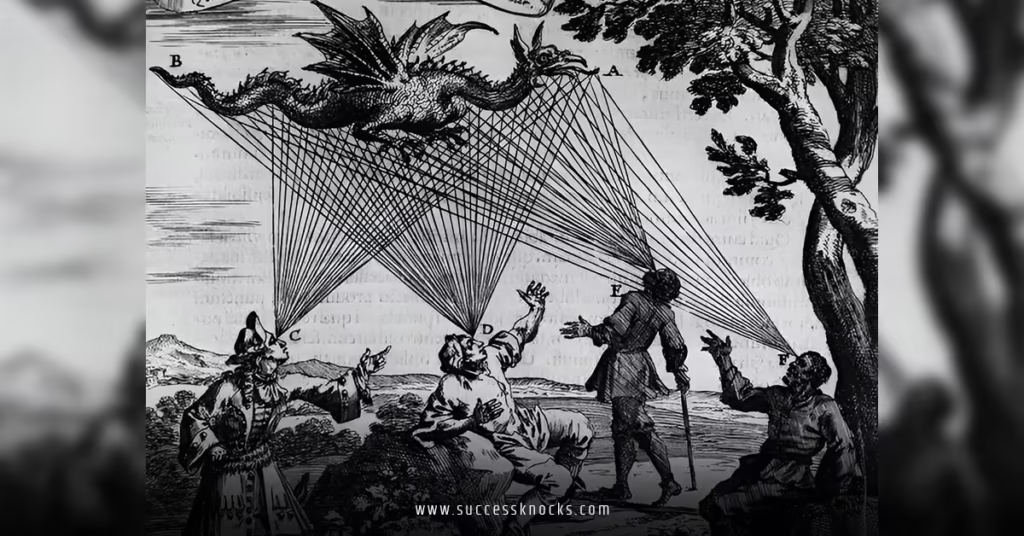
Digging into history, the emission theory of vision traces back to ancient Greece around 5th century BCE. Empedocles, that quirky philosopher, first floated it, arguing eyes emit fire-like particles. But it was Euclid who formalized it in his book Optics, treating vision like geometry—rays shooting straight from eyes in a cone shape.
Then came Ptolemy in the 2nd century CE, blending it with math in his Optics. He described these rays as feelers, probing the world. Have you ever felt like your stare could pierce something? That’s the vibe they captured. Even Islamic scholars like Alhazen flirted with modifications, but the pure emission theory of vision held sway until the Middle Ages.
Key Proponents and Their Contributions to Emission Theory of Vision
No deep dive into emission theory of vision skips its champions. Let’s spotlight a few.
Euclid’s Geometric Take on Emission Theory of Vision
Euclid, the math whiz, didn’t mess around. In his Optics, he modeled the emission theory of vision as a visual pyramid: apex at the eye, base on the object. Rays shot out at angles, explaining why nearby things look bigger—simple geometry! It’s like drawing lines from your eye to a basketball; closer lines spread wider. Brilliant for its time, though wrong.
Ptolemy’s Refinement of the Emission Theory of Vision
Ptolemy amped it up. His version in Optics added angles of incidence and reflection, almost bridging to modern ideas. He thought eyes emitted a “spirit” pneuma that mingled with object spirits. Metaphor time: think of it as your eyes high-fiving an apple’s aura to “see” it red and juicy. This emission theory of vision influenced optics for 1,400 years.
Later Echoes in the Emission Theory of Vision
Fast-forward to Roger Bacon in the 13th century—he tweaked it but stuck to emission basics. Even Leonardo da Vinci nodded to it in sketches. Why so sticky? It matched introspection: we “direct” our gaze, so eyes must send something out.
How Did the Emission Theory of Vision Explain Everyday Sight?
Ever puzzled why we don’t see in total darkness under this model? Proponents said rays need some ambient light to interact—your eye beams weak alone, but sunlight amps them. Binocular vision? Two cones overlapping for depth, like stereo speakers.
Strengths That Made Emission Theory of Vision Popular
It elegantly explained focus and peripheral blindness. Stare hard, rays intensify; glance away, they dim. Analogous to spotlights on a stage—only lit spots matter. For ancient surgeons, it guided eye treatments, assuming ray paths through lenses and humors.
Weird Predictions of the Emission Theory of Vision
Here’s the fun part: it implied long stares could tire eyes by “over-emission,” like draining a battery. Ever get eye strain? They nailed the symptom, wrong cause. It also struggled with bright lights blinding you—too much external light overwhelming your beams?
Why the Emission Theory of Vision Fell Apart
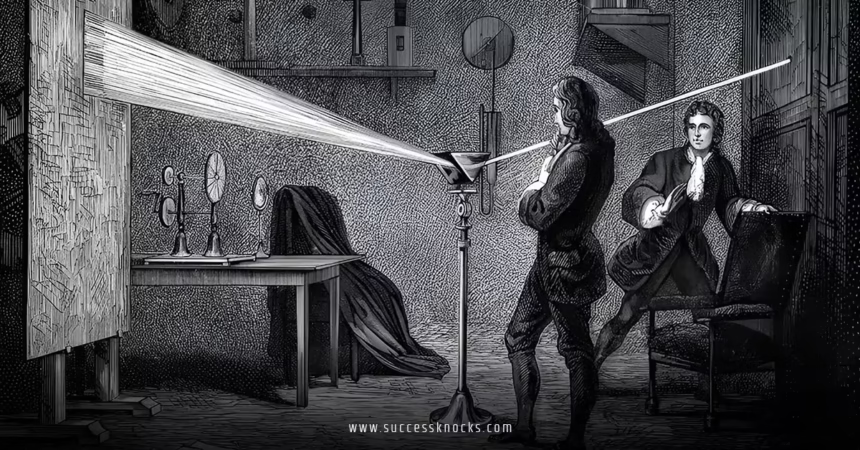
Science marches on, and by the 11th century, cracks showed. Alhazen’s experiments proved light enters eyes, not vice versa. He poked pinholes, watched images invert—emission couldn’t explain that.
Ibn al-Haytham’s Experiments Dismantling Emission Theory of Vision
Alhazen (Ibn al-Haytham) is the hero. In his Book of Optics, he used camera obscura: light from outside projects inside, inverted. If emission-theory of vision held, why no image without eye rays entering? Boom—intromission theory (light in) won. Check out his work on Stanford Encyclopedia of Philosophy for the deets.
Kepler and Descartes Seal the Deal Against Emission Theory of Vision
Johannes Kepler in 1604 mapped the eye as a camera, light focusing on retina. Descartes added math. No more eye lasers. Yet, echoes linger—think “evil eye” myths where gazes harm.
Modern Echoes and Fun Facts About Emission Theory of Vision
Does emission-theory of vision have legs today? Kinda. In psychology, “active vision” nods to eye movements scanning scenes, like emitting attention. Lasers? We emit coherent light from devices now, ironic twist.
Fun fact: Cats’ glowing eyes? Glow reflects, but ancients might’ve seen emission proof. Or consider VR—your “gaze” directs rendering, emission vibes digitally.
Emission Theory of Vision in Pop Culture and Myths
Ever hear of basilisks whose stare kills? Pure emission-theory of vision folklore—poison rays from eyes. Superman’s heat vision? Modern superhero emission!
Comparing Emission Theory of Vision to Intromission Theory
Let’s table this:
| Aspect | Emission Theory of Vision | Intromission Theory (Modern) |
|---|---|---|
| Light Direction | From eye to object | From object/source to eye |
| Key Proponent | Euclid, Ptolemy | Alhazen, Kepler |
| Explains Blindness | Rays exhausted or blocked | No light entering |
| Night Vision Issue | Needs some light for rays to work | Absolute dark = no photons |
| Evidence | Intuitive gaze control | Camera obscura, retinal images |
See? Emission theory of vision felt right but failed tests.
Emission Theory of Vision’s Lasting Impact on Science and Philosophy
Don’t dismiss it—emission-theory of vision birthed optics as a field. It pushed geometry into light, paving for telescopes. Philosophically, it fueled debates: are senses active projectors or passive receivers? Plato loved it for ideal forms “touched” by soul-rays.
In art, perspective drawing owes Euclid’s cones. Medicine? Early cataract ops targeted “ray paths.” Visit the History of Science Museum for artifacts.
Criticisms and Limitations of the Emission Theory of Vision
Beyond experiments, energy woes: eyes emitting enough to see afar? Infinite power needed—impossible. Stars? Rays to infinity? Nah. Pinhole eyes should’ve worked sans lens, but don’t.
Rhetorical Q: If eyes emit, why no mutual seeing in dark mutual stares? Exactly.
Reviving Interest: Emission Theory of Vision in Contemporary Research?
Quantum weirdness flirts back. Photon emission from retinas? Minimal, but theories explore biophotons. Not vision cause, but intriguing. Active inference in AI mimics “emitting predictions” to perceive—philosophical nod to emission-theory of vision.
Practical Lessons from Studying Emission Theory of Vision
Why care now? It teaches humility—intuition lies. Next time eyes hurt, chuckle at ancient beam-burn. Teaches science evolution: test, don’t trust gut.
Ever tried staring contests? Emission believers saw ray duels!
Conclusion: Why the Emission Theory of Vision Still Captivates
Wrapping up, the emission-theory of vision—from Euclid’s rays to Ptolemy’s spirits—enchanted minds for millennia with its eye-as-lantern magic. Though debunked by Alhazen’s genius and modern optics, it sparks wonder: how do we really see? Dive into history, question assumptions, and who knows—maybe your gaze holds untapped power. Keep exploring; the past illuminates the future!
Frequently Asked Questions (FAQs)
What is the emission theory of vision in simple terms?
The emission-theory of vision posits that eyes send out rays to touch objects and reflect images back, like built-in flashlights, dominating ancient thought.
Who invented the emission theory of vision?
Empedocles proposed early ideas, but Euclid systematized the emission-theory of vision geometrically around 300 BCE.
Why was the emission theory of vision rejected?
Experiments by Ibn al-Haytham showed light enters eyes via pinholes, contradicting emission-theory of vision’s outgoing rays.
Does the emission theory of vision influence modern science?
Indirectly yes—its geometry birthed optics, and concepts echo in active vision research tied to emission-theory of vision.
Can the emission theory of vision explain night blindness?
It tried, saying rays need ambient light, but modern views pin it on no incoming photons, debunking emission theory of vision.