

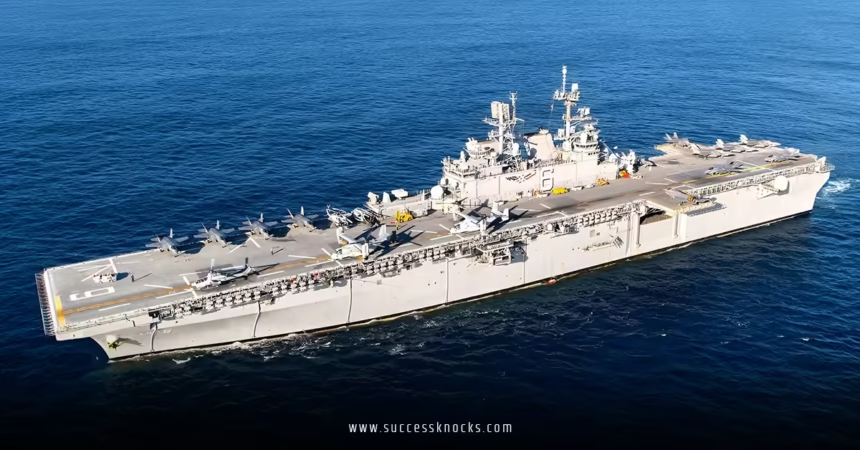
America-class amphibious assault ships stand as marvels of modern naval engineering, revolutionizing how the U.S. Navy projects power across global oceans. These massive vessels combine aircraft carrier capabilities with amphibious assault functionality, creating floating forward bases that can deploy troops, aircraft, and vehicles anywhere in the world.
If you’re fascinated by military technology or curious about naval strategy, dive into what makes America-class amphibious assault ships so revolutionary.
What Are America-Class Amphibious Assault Ships?
America-class amphibious assault ships represent the pinnacle of U.S. naval amphibious warfare technology. These behemoths serve multiple roles: aircraft carriers, command centers, hospitals, and assault platforms—all in one massive hull.
Think of them as Swiss Army knives of the sea. They can launch fighter jets, deploy Marines via helicopter or landing craft, provide humanitarian relief, or serve as command headquarters for joint operations. The USS Tripoli deployment Singapore 2026 port visit schedule showcases one such ship in action, demonstrating real-world operational capabilities.
Evolution from Wasp-Class to America-Class
The America-class evolved from the proven Wasp-class design but introduces revolutionary changes. While Wasp-class ships balanced aviation and well-deck operations, America-class ships prioritize aviation capabilities with enhanced flight decks and hangar spaces.
This evolution reflects modern warfare’s emphasis on air superiority, precision strikes, and rapid force deployment. America-class ships sacrifice some traditional amphibious capabilities for unmatched aviation power, making them perfect for 21st-century expeditionary operations.
Design and Technical Specifications
America-class amphibious assault ships push naval architecture boundaries with their impressive specifications:
Key Dimensions and Capabilities
| Specification | Details |
|---|---|
| Displacement | 45,000 tons (full load) |
| Length | 844 feet (257 meters) |
| Beam | 106 feet (32 meters) |
| Crew | ~1,200 sailors + 1,800 Marines |
| Speed | 22+ knots |
| Range | 9,500 nautical miles |
| Aircraft Capacity | 20+ F-35B Lightning II, MV-22 Ospreys, CH-53K King Stallions |
These stats make America-class ships larger than many nations’ entire navies. Their gas turbine propulsion system delivers tremendous power while maintaining fuel efficiency for extended deployments.
Revolutionary Flight Deck Design
The hallmark of America-class amphibious assault ships is their massive aviation facilities:
- Flight Deck: 844 feet long with three catapults and four aircraft elevators
- Hangar Space: Accommodates 20+ aircraft simultaneously
- F-35B Compatible: STOVL (Short Take-Off/Vertical Landing) operations
- Unmanned Systems: Drone launch/recovery capabilities
This aviation-centric design transforms America-class ships into light carriers capable of sustained air operations anywhere on the planet.
Operational Capabilities and Missions
America-class amphibious assault ships excel across diverse mission profiles, making them incredibly versatile:
Power Projection and Expeditionary Warfare
These ships form the core of Marine Expeditionary Units (MEUs), enabling rapid deployment of combat power:
- Aviation Combat Element: F-35B strikes, helicopter assaults
- Ground Combat Element: Marines via air or sea assault
- Logistics Combat Element: Sustainment for extended operations
- Command Element: Joint task force headquarters
During operations like the USS Tripoli deployment Singapore 2026 port visit schedule, these capabilities demonstrate real-world power projection in strategic regions.
Humanitarian Assistance and Disaster Relief (HA/DR)
America-class ships shine in crisis response:
- Hospital Facilities: 100+ bed hospital with operating rooms
- Helicopter Operations: Rapid medical evacuation and supply delivery
- Fresh Water Production: 100,000+ gallons daily
- Helipad Capacity: Multiple simultaneous helicopter operations
Their self-contained nature makes them ideal for disaster zones where infrastructure is destroyed.
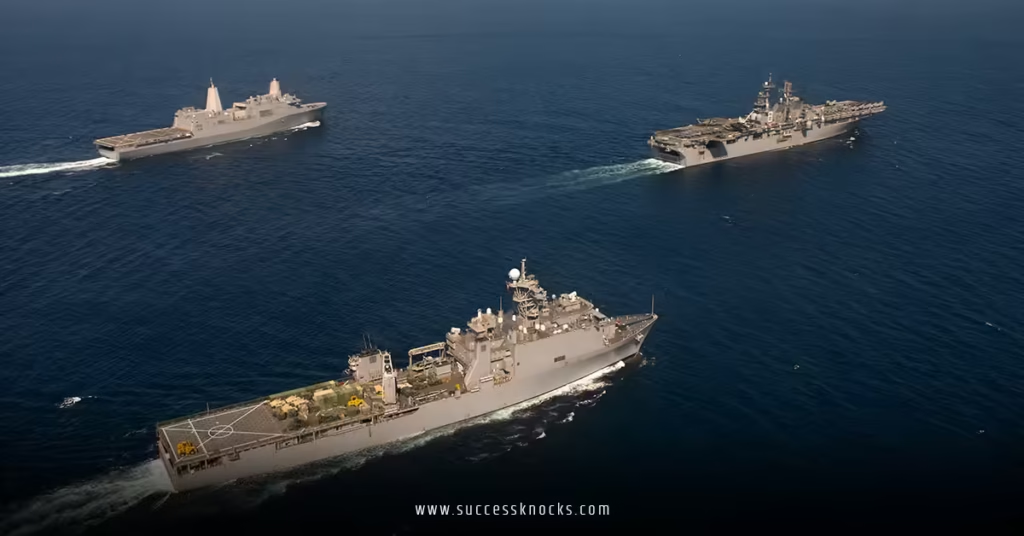
The Ships of the America-Class
Three America-class amphibious assault ships currently serve the U.S. Navy, with more under construction:
USS America (LHA-6) – Flight 0
Commissioned in 2014, USS America represents the class prototype:
- Proven Design: First operational F-35B carrier
- Global Deployments: Mediterranean, Western Pacific operations
- Combat Proven: Supported operations against ISIS
USS Tripoli (LHA-7) – Flight 0
Commissioned in 2020, USS Tripoli continues the lineage:
- Enhanced Systems: Improved radar and communication suites
- Recent Deployments: Indo-Pacific operations including the USS Tripoli deployment Singapore 2026 port visit schedule
- Modernized Hangar: Optimized for F-35B and unmanned systems
USS Bougainville (LHA-8) – Flight 1
The first Flight 1 ship introduces enhancements:
- Well Deck Restoration: Traditional amphibious capability returns
- Hybrid Design: Balances aviation and surface assault
- Advanced Sensors: Next-generation radar systems
Future Ships: LHA-9 and Beyond
- USS Fallujah (LHA-9): Under construction, expected 2026 delivery
- Flight 1 Continuation: Standardized well-deck configuration
- Integrated Power Systems: Future electrical propulsion upgrades
Strategic Importance in Modern Warfare
America-class amphibious assault ships reshape naval strategy:
Distributed Maritime Operations (DMO)
These ships enable the Navy’s DMO concept:
- Forward Presence: Persistent presence without large bases
- Lethal Reach: F-35B extends strike range 500+ miles
- Survivability: Low radar signature, damage control superiority
- Networked Warfare: Data fusion across joint forces
Countering Near-Peer Competition
Against sophisticated adversaries, America-class ships provide:
- Anti-Access/Area Denial (A2/AD) Penetration: Stand-off strike capability
- Island Chain Operations: Pacific theater power projection
- Allied Integration: Compatible with partner nation aircraft
Technological Innovations
America-class amphibious assault ships incorporate cutting-edge technologies:
Stealth and Survivability
- Reduced Radar Cross-Section: Angled surfaces, radar-absorbent materials
- Advanced Damage Control: Automated firefighting, modular repairs
- NBC Protection: Biological/chemical warfare defense systems
Digital Backbone
- AEGIS Combat System Integration: Shared situational awareness
- AI-Enabled Operations: Predictive maintenance, decision support
- High-Capacity Networks: 100Gbps+ data links
Aviation Revolution
The F-35B integration represents a game-changer:
F-35B Lightning II Capabilities on America-class:
├── Stealth Strike: Radar-evading precision weapons
├── Sensor Fusion: 360° battlespace awareness
├── Network Warfare: Data sharing with all services
└── Vertical Operations: No catapults/arresting gear required
Crew Life and Operations
Life aboard America-class amphibious assault ships combines high-tech operations with traditional naval life:
Daily Operations
- Flight Ops: 100+ daily aircraft launches/recoveries
- Marine Integration: Shared spaces, joint training
- 24/7 Operations: Three-section watch system
- Global Deployments: 6-9 month cycles
Modern Amenities
Even during intense operations, crew quality of life remains high:
- Gymnasiums and Fitness Centers
- Educational Opportunities: College courses, certifications
- Recreational Facilities: Movie theaters, sports equipment
- Mental Health Support: Comprehensive counseling services
Cost, Construction, and Sustainability
Building America-class amphibious assault ships represents massive industrial achievement:
Program Economics
- Unit Cost: ~$3.4 billion per ship
- Construction Time: 5-7 years from keel laying to commissioning
- Lifecycle Cost: $15+ billion over 40-50 year service life
Shipbuilding Locations
Primary Builders:
├── Huntington Ingalls Industries (Newport News, VA)
│   └── Primary integrator and outfitter
└── General Dynamics NASSCO (San Diego, CA)
    └── Module construction and assembly
Environmental Considerations
Modern America-class ships incorporate green technologies:
- Fuel Efficiency: Gas turbines with 20% better efficiency
- Waste Management: Advanced processing, zero-discharge capability
- Ballast Water Treatment: Prevents invasive species transfer
Global Comparisons and Strategic Context
America-class amphibious assault ships set the global standard:
International Equivalents
| Nation | Ship Class | Capabilities |
|---|---|---|
| UK | HMS Queen Elizabeth | Similar aviation focus, F-35B compatible |
| China | Type 075 | Emerging competitor, conventional propulsion |
| Japan | Izumo-class | F-35B conversion underway |
| France | Mistral-class | Smaller, helicopter-focused |
Strategic Positioning
America-class superiority stems from:
- Technological Edge: F-35B integration unmatched globally
- Logistical Backbone: Global sustainment network
- Training Superiority: Most experienced STOVL operators
- Allied Integration: Compatible with partner forces
Future of America-Class Operations
The America-class will evolve with naval warfare:
Near-Term Upgrades
- Directed Energy Weapons: Laser defense systems
- Hypersonic Integration: Future missile capabilities
- Drone Swarms: Autonomous offensive/defensive operations
Long-Term Vision
America-class ships will anchor Joint All-Domain Command & Control (JADC2):
Future America-class Role:
├── Expeditionary Advanced Base Operations (EABO)
├── Mobile Command Posts for Joint Forces
├── Unmanned Systems Motherships
└── Missile Defense Nodes
Conclusion
America-class amphibious assault ships redefine naval warfare, blending carrier strike group power with Marine expeditionary capabilities. Their ability to operate F-35B stealth fighters from almost anywhere gives the U.S. Navy unmatched global reach and flexibility.
From disaster relief to high-intensity combat, these ships serve as America’s forward-deployed crisis response force. Operations like the USS Tripoli deployment Singapore 2026 port visit schedule demonstrate their real-world impact on global security. As naval competition intensifies, America-class ships will remain central to maintaining maritime superiority and supporting allies worldwide.
Here are three high-authority external links relevant to America-Class Amphibious Assault Ships,
- U.S. Navy Fact File: America-class Amphibious Assault Ships
Official Navy specifications, capabilities, and ship histories. - Congressional Research Service: Navy Amphibious Ships
In-depth analysis of amphibious ship programs, costs, and strategic role. - Huntington Ingalls Industries: America-class Overview
Shipbuilder’s technical details on construction, innovations, and Flight 1 upgrades.
Frequently Asked Questions
1. How do America-class ships differ from traditional aircraft carriers?
America-class amphibious assault ships focus on STOVL operations with F-35B fighters rather than catapult-launched aircraft. They carry Marines and landing craft alongside aviation assets, creating hybrid capabilities traditional carriers lack.
2. Can America-class ships defend themselves in combat?
Yes, they carry extensive self-defense systems including SeaRAM missiles, Phalanx CIWS guns, advanced electronic warfare, and decoy launchers. Their low radar signature and layered defenses make them difficult targets.
3. What’s the most significant advantage of F-35B operations from these ships?
The F-35B’s stealth, sensor fusion, and vertical landing capability allow America-class ships to operate from austere locations without needing vulnerable airfields or large port facilities.
4. How many America-class ships does the Navy plan to build?
The Navy plans 11 total America-class ships, with three commissioned, several under construction, and Flight 1 variants continuing production to replace aging amphibious ships.
5. Are America-class ships nuclear-powered?
No, they use conventional gas turbine propulsion. This reduces complexity and cost while providing excellent range and speed for global deployments.


