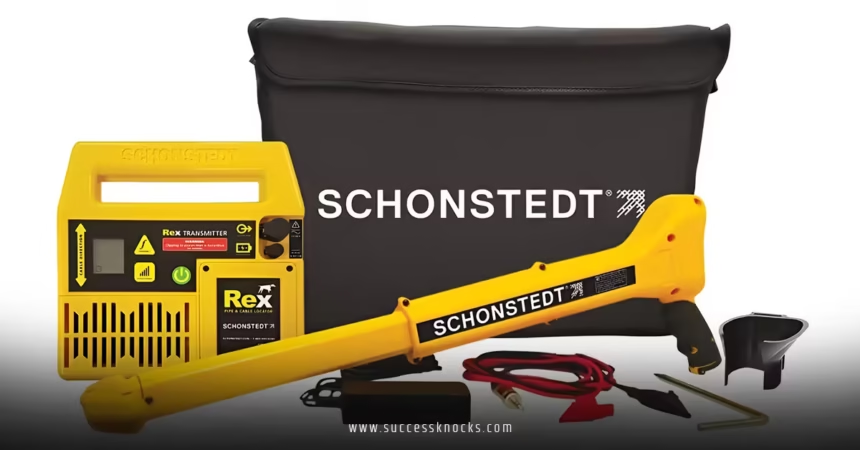
Multi-frequency locators are transforming how we hunt for buried utilities, turning what used to be a game of educated guesses into pinpoint science. If you’ve ever sweated over a shaky signal from a single-frequency tool, you know the frustration—false reads, missed lines, endless callbacks. These advanced devices use multiple signal frequencies simultaneously, slicing through interference like a hot knife through butter. In this guide, we’ll dive deep into multi-frequency locators, their tech, benefits, and why they’re essential for pros. Ready to upgrade your digs? Let’s roll.
What Are Multi-Frequency Locators and Why Do You Need One?
Picture this: underground utilities tangled like headphones in your pocket—power lines humming at 60Hz, telecom cables whispering at 8kHz, all masked by urban noise. A basic locator chokes here, but multi-frequency locators juggle several bands (like 512Hz, 8kHz, 33kHz, and 131kHz) at once. They transmit, receive, and analyze signals across the spectrum, delivering accurate depth, direction, and ID.
Why bother? Single-frequency units falter in depth or clutter; multi-frequency locators adapt, boosting accuracy by 30-50% per industry benchmarks. Whether you’re potholing for a solar farm or tracing fiber in a city grid, these tools save time, cash, and headaches. I’ve watched crews shave hours off jobs—pure efficiency.
The Science Behind Multi-Frequency Magic
At the core, it’s electromagnetism on steroids. The transmitter induces fields at varied frequencies; lower ones penetrate deep (great for pipes), higher ones sharpen surface traces (ideal for cables). Receivers use digital signal processing (DSP) to filter noise—think noise-cancelling headphones for utilities.
Analogy: Like switching radio stations to dodge static, multi-frequency locators auto-select the cleanest band. No manual swaps; algorithms do the heavy lifting.
How Multi-Frequency Locators Work: A No-BS Breakdown
Getting hands-on is straightforward. Here’s the flow:
- Select and Transmit: Clamp or inductively couple the transmitter. Pick auto-mode for multi-freq sweep.
- Receive and Trace: Receiver antenna captures fields, displaying vectors, depths, and current.
- Map and Verify: GPS logs paths; distortion meters flag bends or clusters.
- Pinpoint: Current direction arrows guide to the exact spot.
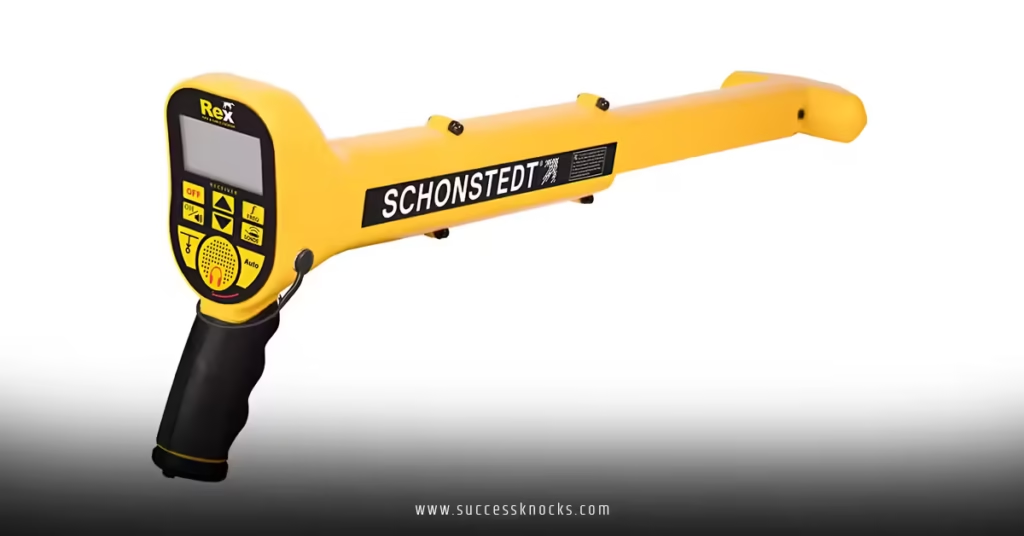
Pro tip: In active mode, direct-connect for max power; passive for live lines. Units like the renowned GeoRipper exemplify this, blending 8+ frequencies seamlessly.
Active vs. Passive Modes in Multi-Frequency Locators
- Active: You inject the signal—best for known targets, depths to 20+ feet.
- Passive: Detects ambient fields—quick scans for live utilities.
Multi-frequency-locators shine in hybrids, auto-switching for versatility.
Top Benefits of Multi-Frequency Locators for Pros
Why shell out for multi-frequency-locators? ROI hits fast:
- Interference Immunity: Filters RF noise from cell towers or motors.
- Depth Versatility: Low freq for 15-20ft, high for 3-5ft precision.
- Speed: Simultaneous traces mean fewer passes.
- Safety: Fewer misses = zero incidents. OSHA reports show tech like this cuts damages 70%.
Rhetorical question: Tired of “call-back king” status? Multi-frequency-locators make you the hero.
Real-World Wins with Multi-Frequency Locators
On a Florida pipeline job, multi-frequency-locators navigated sandy soil EMI, mapping gas lines flawlessly. Telecom installs use them for 5G densification—trace, avoid, deploy. Even municipalities love ’em for asset management.
Multi-Frequency Locators vs. Traditional Single-Frequency Tools
Time for a showdown:
| Feature | Multi-Frequency Locators | Single-Frequency Locators |
|---|---|---|
| Freq Range | 8+ (512Hz-131kHz) | 1-2 (e.g., 33kHz only) |
| Noise Handling | Excellent (DSP filters) | Poor (manual adjust) |
| Depth Accuracy | ±2-5% | ±10-15% |
| Trace Speed | 2-3x faster | Standard |
| Price | $3K-$7K | $1K-$3K |
| Best For | Complex sites | Simple rural jobs |
Multi-frequency-locators win on scalability. Check ASCE guidelines for why they’re standard now.
Common Challenges and Fixes
Shielded cables? High-freq punch-through. Wet soil? Low-freq stability. User error? Auto-gain levels the field.
Best Multi-Frequency Locators on the Market in 2026
2026 lineup sparkles:
- Budget Beast: SubSurface Instruments—solid 4-freq starter.
- Mid-Tier King: Vivax vLoc3—robust, app-integrated.
- Premium Pick: GeoRipper—8+ freq, GPS, unbeatable in clutter.
Test in demos; feel the difference.
Choosing the Right Multi-Frequency Locator for Your Needs
- Contractors: GPS-enabled for reports.
- Utilities: Sonde-compatible for plastics.
- Rent vs. Buy: Rentals for one-offs; own for volume.
Match to jobs—urban? Noise-proof. Rural? Deep-range.
Training and Best Practices for Multi-Frequency Locators
Newbie? 1-hour tutorials fly. Practice on known lines. Always 811 first—tech aids, doesn’t replace.
Maintenance:
- Firmware updates.
- Battery calibration.
- Antenna checks.
Join NUCA training for certs.
The Future of Multi-Frequency Locators
AI incoming: Auto-utility ID via machine learning. Drone pairing for overhead scans. 5G/6G boom demands it—expect cloud data sharing.
Conclusion: Level Up with Multi-Frequency Locators Today
Multi-frequency-locators aren’t a luxury—they’re your edge in a buried-world battlefield. From interference-busting tech to real-job heroics, they deliver precision that pays. Ditch singles, grab a multi-frequency powerhouse like GeoRipper, and watch productivity soar. Your next dig awaits—equip right, dig smart!
Frequently Asked Questions (FAQs)
What is the main advantage of multi-frequency locators?
They handle multiple signals at once, reducing interference and improving accuracy over single-frequency tools.
How deep do multi-frequency locators work?
Up to 20 feet or more, varying by frequency, soil, and power—perfect for most utilities.
Are multi-frequency locators worth the extra cost?
Yes, faster traces and fewer errors deliver quick ROI for pros.
Can multi-frequency locators detect plastic pipes?
With sondes, yes—they trace non-metallics via inserted signals.
What’s the best multi-frequency locator for urban jobs?
Models with strong noise rejection, like GeoRipper, excel in EMI-heavy areas.