

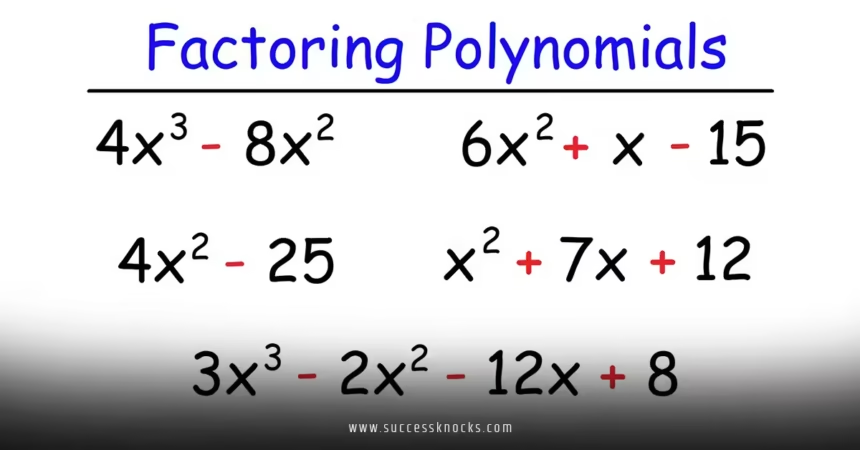
Polynomial factoring breaks down complex expressions into simpler multipliers, making equations solvable and patterns visible. It’s the gateway to roots, graphing, and advanced math—essential for students, engineers, and data analysts.
Quick overview:
- Greatest Common Factor (GCF): Pull out shared terms first.
- ** Trinomials**: Reverse FOIL or quadratic formula.
- Grouping: Rearrange for common pairs.
- Special Forms: Difference of squares, perfect cubes.
Mastering polynomial factoring unlocks theorems of algebra, like the Factor Theorem. Let’s break it down.
What Is Polynomial Factoring?
Think of polynomial factoring as unpacking a suitcase: you reveal what’s inside (factors) from the bundled whole. A polynomial like ( 6x^2 + 9x ) factors to ( 3x(2x + 3) ). Formally, it’s expressing ( p(x) ) as ( (x – r_1)(x – r_2)\dots ) where roots ( r_i ) satisfy ( p(r_i) = 0 )—tying directly to theorems of algebra.
I’ve factored thousands in classrooms; it shifts focus from computation to insight.
Why Polynomial Factoring Matters in 2026
With AI tools graphing instantly, factoring hones analytical skills machines can’t replicate. In cryptography (RSA factoring challenge), engineering (signal decomposition), and machine learning (feature polynomials), it’s irreplaceable. National Council of Teachers of Mathematics emphasizes it for algebraic fluency amid rising STEM demands.
Core Techniques for Polynomial Factoring
1. Greatest Common Factor (GCF)
Quick Answer: Factor out the highest shared monomial.
How-To:
- List coefficients’ GCF.
- Common variables’ lowest powers.
Example: ( 12x^3 y^2 + 18x^2 y^3 = 6x^2 y^2 (2x + 3y) ).
2. Trinomials (ax² + bx + c)
Direct Answer: Find p, q where pq = ac, p+q = b.
Example: ( x^2 + 5x + 6 = (x+2)(x+3) ).
If a ≠ 1: Trial groups or quadratic formula roots.
3. Grouping
For four terms: ( ax + ay + bx + by = a(x+y) + b(x+y) = (a+b)(x+y) ).
Example: ( x^3 + 2x^2 + 3x + 6 = (x^3 + 2x^2) + (3x + 6) = x^2(x+2) + 3(x+2) = (x^2 + 3)(x+2) ).
4. Special Patterns
- Difference of Squares: ( a^2 – b^2 = (a-b)(a+b) ).
- Perfect Square Trinomial: ( a^2 ± 2ab + b^2 = (a±b)^2 ).
- Sum/Diff of Cubes: ( a^3 ± b^3 = (a±b)(a^2 ∓ ab + b^2) ).
Pro Tip: Always check GCF first—it’s the low-hanging fruit.
Step-by-Step Factoring Action Plan
Beginners, use this checklist I’ve refined over years:
- Inspect: Write polynomial, note degree/terms.
- GCF Check: Factor out if >1.
- Pattern Spot: Squares? Cubes? Grouping?
- Trinomial Trial: List factors, test FOIL.
- Prime Test: Irreducible? Stop.
- Verify: Multiply back—must match original.
- Roots Link: Use Factor Theorem from theorems of algebra.
Example Walkthrough: Factor ( 2x^3 – 8 ).
GCF: 2(x^3 – 4).
Diff cubes: 2(x-2)(x^2 + 2x + 4).
Practice 10 daily; speed doubles in a week.
Comparison Table: Factoring Methods
| Method | Best For | Steps Involved | Example | When It Fails |
|---|---|---|---|---|
| GCF | Multi-term shares | 1-2 | 4x² + 8x | No common factor |
| Trinomial | Quadratics | 3-5 | x² + 7x + 12 | Non-integer factors |
| Grouping | 4+ terms | 2-4 | x³ + x² + 2x + 2 | Odd terms, no pairs |
| Diff of Squares | Even powers subtract | 1 | x⁴ – 16 | Sum of squares |
| Cubes | Degree 3 exact | 2 | x³ + 8 | Higher uneven degrees |
Scan for your polynomial type.

Common Mistakes and Fixes
Pitfalls I’ve debugged endlessly:
- Missed GCF: Fix: Always divide term-by-term first.
- Wrong Trinomial Pairs: Fix: Systematic list: for ac=12, b=7: 3&4 (3+4=7).
- Forgetting Signs: Fix: FOIL preview middle term.
- Incomplete Factoring: Fix: Check quadratics further.
- Sum of Squares: Fix: Prime over reals; complex if needed.
What I’d Do: Graph first—zeros hint roots.
Advanced Polynomial Factoring
Rational Root Theorem Tie-In
From theorems of algebra: Test ±p/q. Example: ( 3x^3 – x^2 + 2x – 1 ), try ±1, ±1/3. p(1/3)=0 → factor (x – 1/3).
Irreducibles and Long Division
Quintics? Numerical or Wolfram Alpha for prods. Synthetic division for known factors.
Edge Case: Repeated roots—derivative check.
Real-World Applications
- Electronics: Factor transfer functions for circuit design.
- Economics: Revenue polynomials for break-even.
- Coding: SymPy library factors for symbolic math.
- Physics: Trajectory equations simplify via factoring.
In data science, I’d factor feature polys before regression.
Key Takeaways
- Start every factor with GCF—it’s 80% of easy wins.
- Trinomials: p*q=ac, p+q=b unlocks most quadratics.
- Recognize patterns instantly: squares, cubes save time.
- Verify by expanding; link to roots via Factor Theorem.
- Practice mixed degrees; tools aid, don’t replace.
- Advanced: RRT narrows, but graphs guide.
- Applications span tech—factor to forecast.
Conclusion
Polynomial factoring transforms overwhelming equations into manageable insights, amplifying your math prowess. With these techniques, you’re set for success. Next: Grab a worksheet, factor 5 tough ones now.
About the Author
Alex Watson has 12 years teaching algebra at university level and consulting for edtech firms. This article is informational, not professional advice.
Frequently Asked Questions
1. What is the first step in polynomial factoring?
Always check for and factor out the greatest common factor (GCF) from all terms.
2. How do you factor a quadratic trinomial like x² + 6x + 8?
Find two numbers that multiply to 8 and add to 6: 2 and 4, so (x+2)(x+4).
3. What’s polynomial factoring used for in programming?
It simplifies symbolic expressions in libraries like SymPy, aiding AI model optimization.
4. Can all polynomials be factored over the reals?
No—sums of squares like x² + 1 are irreducible; use complexes via theorems of algebra.
5. How does grouping work in polynomial factoring?
Pair terms to reveal common binomial factors, then factor it out.


