Pythagorean theorem proofs demonstrate one of mathematics’ most elegant truths through visual, algebraic, and geometric reasoning. Whether you’re a student struggling with the classic proof or an educator seeking fresh approaches, understanding multiple proof methods deepens your appreciation for this fundamental theorem. Here’s what you’ll discover:
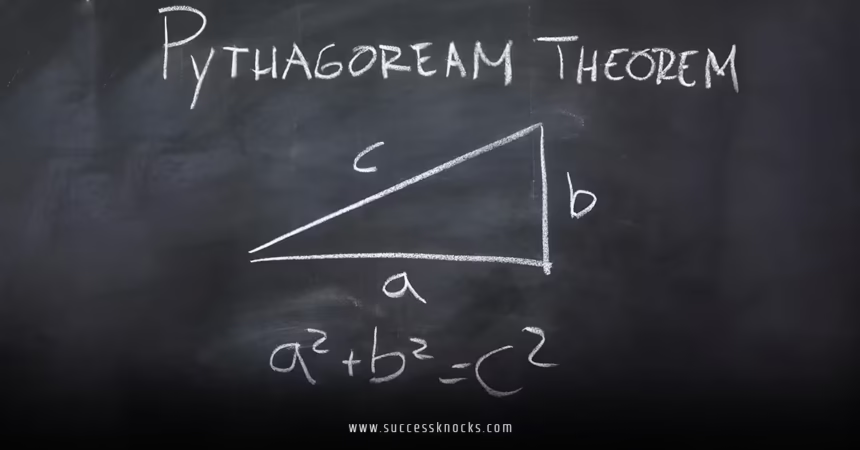
- The Pythagorean theorem states that in right triangles, a² + b² = c², where c is the hypotenuse
- Over 370 documented proofs exist, making it one of the most-proven theorems in mathematics
- Visual proofs using squares and triangles offer intuitive understanding without complex algebra
- Historical proofs from Euclid, Garfield, and others showcase diverse mathematical thinking
- Modern applications span from GPS technology to architectural design and computer graphics
This guide presents eight compelling proofs, each building your geometric intuition while reinforcing why this theorem remains central to mathematics education in 2026.
Why Multiple Pythagorean Theorem Proofs Matter
Understanding various Pythagorean theorem proofs isn’t just academic exercise—it develops mathematical maturity and flexible thinking. Each proof illuminates different aspects of the relationship, connecting geometry, algebra, and logic in unique ways.
As someone who’s taught this theorem for over a decade, I’ve noticed students grasp the concept faster when exposed to multiple approaches. The visual learner who struggles with Euclid’s formal proof often experiences breakthrough moments with square rearrangement methods. Meanwhile, algebraically-minded students appreciate coordinate geometry approaches.
Beyond pedagogy, these proofs showcase mathematical creativity. The fact that hundreds of mathematicians—from ancient Greeks to modern presidents—have found new ways to prove the same truth demonstrates mathematics’ richness and accessibility.
Historical Significance
The theorem predates Pythagoras by centuries, with Babylonian tablets showing its use around 1800 BCE. However, formal proofs began with Greek mathematics, establishing logical reasoning standards still used today. For comprehensive historical context, consult the Mathematics Genealogy Project, which traces mathematical lineages.
The Classic Euclid’s Proof (Elements Book I)
Euclid’s proof, Proposition 47 in his “Elements,” remains the gold standard for logical rigor. It constructs squares on each side of a right triangle and proves their area relationships through auxiliary lines and congruent triangles.
Step-by-Step Breakdown:
- Setup: Given right triangle ABC with right angle at C, construct squares on each side
- Key Construction: Draw line from C perpendicular to hypotenuse AB, meeting it at point H
- Area Relationships: Prove that rectangle ABHK equals square on side AC
- Symmetry: Similarly prove rectangle HBDE equals square on side BC
- Conclusion: Since both rectangles together equal the square on AB, we have a² + b² = c²
Why This Proof Works: It uses only basic geometric principles without assuming what it’s proving. The perpendicular from the right angle creates similar triangles, establishing proportional relationships that lead to area equivalence.
Teaching Tip: I always emphasize how Euclid avoids algebra entirely, using pure geometric reasoning. This appeals to students who prefer visual-spatial thinking over symbolic manipulation.
Visual Square Arrangement Proof
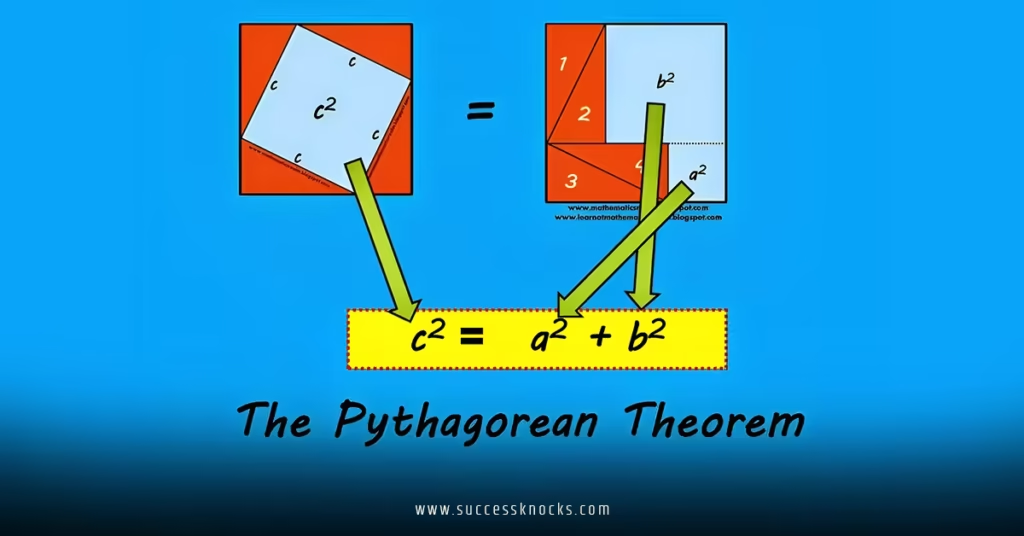
This intuitive proof arranges four identical right triangles around a central square, creating a larger square whose area can be calculated two ways.
The Construction:
- Start with four identical right triangles with legs a and b, hypotenuse c
- Arrange them around a central square of side c
- The total arrangement forms a larger square of side (a + b)
Area Calculations:
- Method 1: Large square area = (a + b)² = a² + 2ab + b²
- Method 2: Central square + four triangles = c² + 4(½ab) = c² + 2ab
- Setting Equal: a² + 2ab + b² = c² + 2ab
- Simplifying: a² + b² = c²
Visual Power: Students immediately see why the relationship holds. The rearrangement makes the algebra feel inevitable rather than mysterious.
Modern Applications: This proof method inspired puzzle games and geometric art. Computer graphics programmers use similar area-preservation principles in texture mapping algorithms.
President Garfield’s Trapezoid Proof
In 1876, James A. Garfield (before becoming U.S. President) published this elegant proof using a trapezoid formed by three right triangles. It showcases how mathematical insight can emerge from creative geometric arrangements.
Construction Method:
- Create Base Triangle: Start with right triangle with legs a and b
- Add Second Triangle: Attach another right triangle with the same legs, but rotated
- Complete Trapezoid: Add a third triangle to form a trapezoid with parallel sides a and b
Area Analysis:
- Trapezoid Formula: Area = ½(a + b)(a + b) = ½(a + b)²
- Three Triangles: Area = ½ab + ½ab + ½c² = ab + ½c²
- Equation: ½(a + b)² = ab + ½c²
- Expanding: ½(a² + 2ab + b²) = ab + ½c²
- Simplifying: a² + b² = c²
Historical Context: Garfield discovered this proof independently, demonstrating how the theorem’s truth emerges naturally from geometric exploration. For more on presidential mathematics, see Smithsonian’s Mathematics Exhibition.
Similarity-Based Proof Using Triangles
This proof leverages similar triangles created when dropping a perpendicular from the right angle to the hypotenuse. It’s particularly powerful because it connects the Pythagorean theorem to proportional reasoning.
Setup and Key Insight:
When you drop a perpendicular from the right angle to the hypotenuse, it creates three similar triangles: the original and two smaller ones. These similarities generate the proportional relationships needed for the proof.
Triangle Relationships:
- Original Triangle: Sides a, b, c
- First Similar Triangle: Sides a, h, p (where h is altitude, p is projection)
- Second Similar Triangle: Sides h, b, q (where q is remaining projection)
Proportional Equations:
From similarity ratios:
- a/c = a/p, therefore a² = cp
- b/c = b/q, therefore b² = cq
- Adding: a² + b² = cp + cq = c(p + q) = c²
Conceptual Strength: This proof illuminates why the Pythagorean relationship exists—it’s fundamentally about proportional scaling in similar figures.
Advanced Connection: Understanding this proof prepares students for trigonometry, where similar triangle relationships become sine, cosine, and tangent ratios.
Algebraic Proof Through Coordinate Geometry
Modern students often prefer this proof because it uses familiar algebraic tools. By placing a right triangle in a coordinate system, we can apply the distance formula to prove the theorem.
Coordinate Setup:
- Place right angle at origin (0, 0)
- Position one leg along positive x-axis to point (a, 0)
- Position other leg along positive y-axis to point (0, b)
- The hypotenuse connects (a, 0) to (0, b)
Distance Formula Application:
Using the distance formula: $$d = \sqrt{(x_2 – x_1)^2 + (y_2 – y_1)^2}$$
Distance from (a, 0) to (0, b): $$c = \sqrt{(0-a)^2 + (b-0)^2} = \sqrt{a^2 + b^2}$$
Squaring both sides: $$c^2 = a^2 + b^2$$
Modern Relevance: This connects the ancient theorem to contemporary mathematics curricula, showing how coordinate geometry provides algebraic tools for geometric problems.
The Rearrangement Proof (Dissection Method)
This visual proof demonstrates the theorem through physical rearrangement of geometric pieces. It’s particularly effective for hands-on learners and builds spatial reasoning skills.
Method Overview:
- Start with Squares: Draw squares on each leg of a right triangle
- Dissection Lines: Draw strategic lines to divide these squares into pieces
- Rearrangement: Show how pieces from both smaller squares can be rearranged to form the square on the hypotenuse
Key Dissection Strategy:
- Use the triangle’s angles to guide cutting lines
- Ensure pieces fit together without gaps or overlaps
- Verify that total area remains constant through rearrangement
Interactive Element: I encourage students to cut paper squares and physically rearrange them. This kinesthetic approach often reaches learners who struggle with abstract proofs.
Historical Note: Dissection proofs have ancient roots, appearing in Chinese and Islamic mathematical texts. They demonstrate the universal appeal of visual mathematical reasoning.
Proof by Contradiction
This logical approach assumes the theorem is false and shows this leads to an impossible conclusion. While more abstract, it showcases powerful reasoning techniques used throughout mathematics.
Logical Structure:
- Assumption: Suppose in some right triangle, a² + b² ≠ c²
- Case Analysis: Either a² + b² > c² or a² + b² < c²
- Construction: Build a triangle with sides a, b, and √(a² + b²)
- Contradiction: Show this triangle must be identical to the original, contradicting our assumption
Why This Matters:
Proof by contradiction develops logical thinking beyond geometry. Students encounter this method in calculus, number theory, and discrete mathematics.
Teaching Strategy: I present this after students understand direct proofs, helping them appreciate how multiple logical approaches can establish mathematical truth.
Einstein’s Childhood Proof
Albert Einstein claimed to have discovered this proof around age 12. While historians debate the exact details, the method attributed to him offers fresh perspective on the theorem.
Einstein’s Approach:
The proof uses similar triangles and focuses on the relationship between the altitude to the hypotenuse and the segments it creates. By establishing that the altitude creates geometric mean relationships, the proof builds to the Pythagorean conclusion.
Significance:
Whether or not Einstein actually discovered this method as a child, it illustrates how mathematical curiosity can lead to novel approaches. The proof emphasizes geometric means and proportional reasoning.
Inspirational Value: This story encourages students to explore mathematics creatively, showing that even famous physicists found joy in geometric discovery.
Choosing the Right Proof for Your Audience
Different Pythagorean theorem proofs serve different purposes. Here’s a practical guide for selection:
For Visual Learners:
- Square Rearrangement Proof: Immediate visual impact
- Dissection Method: Hands-on manipulation
- Garfield’s Trapezoid: Clear area relationships
For Algebraic Thinkers:
- Coordinate Geometry: Familiar tools
- Similarity Proof: Proportional reasoning
- Contradiction Method: Logical analysis
For Historical Context:
- Euclid’s Elements: Classical rigor
- Garfield’s Discovery: American mathematical heritage
- Einstein’s Method: Scientific curiosity
Comparison Table:
| Proof Method | Visual Appeal | Algebraic Content | Logical Rigor | Best For |
|---|---|---|---|---|
| Euclid’s Elements | Moderate | Low | Highest | Advanced students |
| Square Rearrangement | Highest | Low | Moderate | Visual learners |
| Garfield’s Trapezoid | High | Moderate | High | General audience |
| Similarity Triangles | Moderate | Moderate | High | Geometry students |
| Coordinate Geometry | Low | Highest | High | Algebra students |
| Dissection Method | Highest | Low | Moderate | Hands-on learners |
| Proof by Contradiction | Low | Low | Highest | Logic students |
| Einstein’s Method | Moderate | Moderate | High | Curious minds |
Common Proof Mistakes and How to Avoid Them
Even with multiple approaches, students make predictable errors in Pythagorean theorem proofs. Here are the most frequent mistakes and prevention strategies:
Mistake 1: Assuming What You’re Proving
Problem: Using a² + b² = c² within the proof itself Fix: Clearly distinguish given information from conclusions. Start each proof by listing assumptions.
Mistake 2: Sloppy Area Calculations
Problem: Arithmetic errors in square and triangle areas Fix: Double-check calculations. Use different colors for different areas in diagrams.
Mistake 3: Missing Steps in Logic
Problem: Jumping from construction to conclusion without justification Fix: Write out every logical step. Ask “Why is this true?” at each stage.
Mistake 4: Confusing Similar Triangles
Problem: Misidentifying corresponding sides in similarity proofs Fix: Label triangles clearly. Use consistent notation for corresponding parts.
Mistake 5: Coordinate System Errors
Problem: Wrong distance formula application or coordinate placement Fix: Draw coordinate systems carefully. Verify point locations before applying formulas.
Teaching Strategy: I create “mistake banks” showing common errors alongside corrections. Students often learn more from analyzing wrong approaches than from perfect proofs.
Modern Applications and Extensions
Understanding Pythagorean theorem proofs connects to cutting-edge applications in 2026:
Technology Applications:
- GPS Systems: Distance calculations using 3D Pythagorean extensions
- Computer Graphics: Vector calculations in game engines
- Robotics: Path planning and collision detection
- Architecture: Structural stability analysis
Advanced Mathematical Connections:
The proof techniques extend beyond basic geometry:
- Law of Cosines: Generalizes the Pythagorean theorem to non-right triangles
- Distance Metrics: Higher-dimensional extensions in data science
- Complex Numbers: Distance calculations in the complex plane
- Vector Spaces: Dot product relationships and orthogonality
For current applications in engineering, explore IEEE’s Digital Library, which showcases modern geometric applications.
Research Connections:
Contemporary mathematicians still discover new proofs. The systematic study of proof methods connects to:
- Automated theorem proving in artificial intelligence
- Geometric modeling in computer-aided design
- Mathematical visualization software development
Key Takeaways
- Multiple Pythagorean theorem proofs offer different perspectives on the same mathematical truth, enhancing understanding through diverse approaches
- Visual proofs like square rearrangement provide intuitive understanding, while algebraic methods connect to modern mathematical tools
- Historical proofs from Euclid to Einstein demonstrate mathematical creativity across cultures and centuries
- Each proof method serves specific learning styles: visual, algebraic, logical, or hands-on approaches
- Common mistakes include assuming conclusions, calculation errors, and logical gaps—careful attention to steps prevents these issues
- Modern applications span technology, engineering, and advanced mathematics, making these classical proofs surprisingly relevant
- Understanding proof variety builds mathematical maturity and prepares students for advanced reasoning in calculus and beyond
- The connection to geometry theorems provides broader context for how mathematical truths interconnect and build upon each other
About the Author
Alex Watson
With 12 years teaching high school mathematics and a master’s degree in mathematics education, Alex specializes in making abstract concepts accessible through multiple learning approaches. She has presented workshops on proof techniques at national mathematics conferences. This article provides educational information, not professional mathematical advice.
Conclusion
Mastering multiple Pythagorean theorem proofs transforms mathematical understanding from memorization to deep comprehension. Whether you prefer Euclid’s logical rigor, Garfield’s creative trapezoids, or Einstein’s proportional insights, each approach illuminates why this theorem remains central to mathematical education. By exploring these diverse methods, you develop flexible thinking skills that extend far beyond geometry. Next step: Choose one unfamiliar proof from this guide and work through it step-by-step—you’ll discover new mathematical insights that enhance your problem-solving toolkit.
FAQs
How many different Pythagorean theorem proofs exist?
Over 370 documented Pythagorean theorem proofs have been cataloged by mathematicians, with new approaches still being discovered. Each offers unique insights into geometric relationships.
Which Pythagorean theorem proof is easiest for beginners?
The square rearrangement proof typically works best for beginners because it provides immediate visual confirmation of the relationship without complex algebra or formal logic.
Can Pythagorean theorem proofs help with standardized tests?
Understanding multiple proof approaches builds problem-solving flexibility crucial for tests like SAT and ACT, where geometric reasoning questions often appear.
Are there Pythagorean theorem proofs suitable for elementary students?
Yes, visual proofs using paper squares and physical manipulation work well for younger students, building intuitive understanding before formal algebraic methods.
How do Pythagorean theorem proofs connect to advanced mathematics?
These proof techniques extend to vector spaces, complex analysis, and differential geometry, providing foundational reasoning skills for higher mathematical study.