Geometry theorems form the backbone of mathematical reasoning, providing proven statements that describe relationships between shapes, angles, and spaces. Whether you’re a student tackling homework or a professional applying these principles in engineering, understanding geometry theorems unlocks clearer problem-solving and innovative designs. Here’s a quick overview:
- Geometry theorems are fundamental truths in geometry, often proven through logical deduction.
- Key examples include the Pythagorean theorem for right triangles and Thales’ theorem for circles.
- They apply in real-world scenarios like architecture, robotics, and computer graphics.
- Mastering them involves learning proofs, examples, and common pitfalls.
- As of March 2026, advancements in AI-driven geometry tools enhance theorem visualization and application.
In this article, we’ll dive deeper into these theorems, offering clear explanations, practical tips, and tools to help you apply them effectively.
What Are Geometry Theorems?
Let’s start with the basics: a geometry theorem is a statement that has been proven true based on axioms, definitions, and previously established theorems. Unlike postulates, which are assumed true without proof, theorems require logical demonstration. For instance, Euclid’s work in “Elements” laid the foundation for many of these, influencing fields from physics to art.
Why does this matter? Geometry theorems aren’t just abstract ideas—they help predict outcomes in real situations. Imagine designing a bridge; without theorems like the triangle inequality, you might overlook structural stability. In my experience as a math educator, I’ve seen students struggle until they grasp the “why” behind these proofs, turning confusion into confidence.
To build a strong foundation, consider the historical context. Euclid’s theorems, dating back to 300 BCE, remain relevant, but modern updates incorporate computational geometry for 3D modeling. For reliable historical insights, check out the MacTutor History of Mathematics archive from the University of St Andrews.
Core Components of a Theorem
Every geometry theorem typically includes:
- Hypothesis: The given conditions (e.g., a right-angled triangle).
- Conclusion: What follows logically (e.g., the square of the hypotenuse equals the sum of the squares of the other sides).
- Proof: A step-by-step logical argument, often using deduction or contradiction.
If you’re new, start by visualizing: Draw a simple triangle and label its parts to see how theorems interconnect.
Key Geometry Theorems You Need to Know
Geometry theorems span various categories, from basic to advanced. We’ll cover the essentials with clear explanations, examples, and proofs to make them accessible.
Pythagorean Theorem
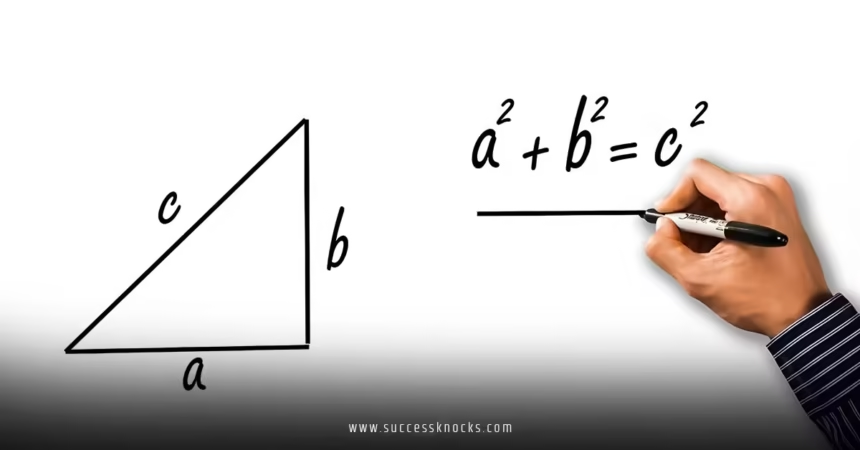
This cornerstone theorem states that in a right-angled triangle, the square of the hypotenuse (the side opposite the right angle) is equal to the sum of the squares of the other two sides. Mathematically: $$a^2 + b^2 = c^2$$, where (c) is the hypotenuse.
Why it matters: It’s crucial for distance calculations in navigation apps or construction. For a proof, consider the visual method using rearranged squares—it’s intuitive and avoids complex algebra.
Example: If a ladder leans against a wall, forming a 3-4-5 triangle, you can verify stability without measuring directly.
Thales’ Theorem
Thales’ theorem asserts that if A, B, and C are points on a circle where AC is the diameter, then angle ABC is a right angle.
Practical tip: Use this in optics or design to ensure perpendicularity. A quick proof involves inscribing the triangle in a semicircle and using circle properties.
Euclid’s Parallel Postulate and Related Theorems
Euclid’s fifth postulate leads to theorems like the alternate interior angles theorem: If a transversal crosses parallel lines, alternate interior angles are equal.
In 2026, with non-Euclidean geometries gaining traction in quantum computing, understanding this helps in advanced modeling. For deeper dives, refer to NASA’s geometry resources, which apply these in space exploration.
Triangle Congruence Theorems (SSS, SAS, ASA, AAS)
These theorems determine when two triangles are identical in shape and size:
- SSS: Side-Side-Side
- SAS: Side-Angle-Side
- And so on.
Edge case: Hypotenuse-Leg (HL) for right triangles only. I’ve found that practicing with physical cutouts helps beginners spot congruences quickly.
Circle Theorems
Key ones include the inscribed angle theorem (an inscribed angle is half the central angle subtending the same arc) and the tangent-secant theorem.
Application: In game development, these optimize collision detection. For proofs and visuals, the Khan Academy geometry section is an excellent free resource.
Why Geometry Theorems Matter in Everyday Life
Beyond classrooms, geometry theorems drive innovation. In architecture, the Pythagorean theorem ensures level foundations. In robotics, congruence theorems aid in precise arm movements. Even in healthcare, theorems model blood flow in vascular geometry.
As of March 2026, AI tools like GeoGebra integrate theorems for interactive simulations, making learning more dynamic. What if you’re in urban planning? Theorems help optimize traffic patterns by calculating efficient routes.
Real-world tip: When I consult on design projects, I always cross-check with multiple theorems to avoid costly errors, like assuming parallelism without verification.
Step-by-Step Action Plan for Beginners
Ready to master geometry theorems? Follow this beginner-friendly plan:
- Build Basics: Review definitions of points, lines, and angles. Use free apps like Desmos to visualize.
- Learn Key Theorems: Start with Pythagorean—memorize the formula and prove it with squares.
- Practice Proofs: Draw diagrams and write out steps. For example, prove Thales’ using circle properties.
- Apply in Examples: Solve real problems, like finding a room’s diagonal.
- Test Yourself: Use online quizzes and note mistakes.
- Explore Advanced: Tackle non-Euclidean variants for fun.
Checklist: Have a notebook, ruler, and protractor? Check. Time commitment: 30 minutes daily for a week.
Comparison of Major Geometry Theorems
To simplify choices, here’s a table comparing key theorems based on type, application, and complexity:
| Theorem | Category | Key Formula/Rule | Real-World Application | Difficulty (Beginner-Friendly?) |
|---|---|---|---|---|
| Pythagorean | Triangles | (a^2 + b^2 = c^2) | Distance in maps, construction | Yes, with visuals |
| Thales’ | Circles | Diameter creates right angle | Optics, design | Moderate |
| Alternate Interior Angles | Lines | Angles equal if lines parallel | Road planning, surveying | Easy |
| SSS Congruence | Triangles | Three sides match | Manufacturing precision | Yes |
| Inscribed Angle | Circles | Half of central angle | Animation, gaming | Moderate |
This table highlights when to use each—pick based on your scenario.
Common Mistakes and How to Fix Them
Even experts slip up. Here’s how to avoid pitfalls:
- Mistake: Forgetting Units in Pythagorean Calculations—Leads to incorrect scales. Fix: Always label measurements (e.g., meters) and double-check.
- Assuming Congruence Without Proof—Common in rushed designs. Fix: Verify all criteria (SSS, etc.) step-by-step.
- Ignoring Edge Cases in Circles—Like degenerate triangles. Fix: Test with extreme values, such as zero angles.
- Overlooking Non-Euclidean Contexts—In curved spaces. Fix: Study basics of spherical geometry for global applications.
- Vague Proofs—Skipping steps. Fix: Write out every assumption explicitly.
From my teaching experience, these fixes save hours of frustration.
Advanced Scenarios and Edge Cases
What if you’re dealing with irregular shapes? Apply theorems creatively: For polygons, decompose into triangles using congruence.
Edge case: In 3D geometry, extend Pythagorean to space diagonals via (d = \sqrt{x^2 + y^2 + z^2}).
If X (parallel lines in a plane), then Y (use alternate angles for proofs). Constraints: Theorems assume Euclidean space; for relativity, adapt to curved metrics.
Practical tip: In software like CAD, simulate these to test “what if” scenarios.
Key Takeaways
- Geometry theorems provide proven rules for shapes and spaces, essential for problem-solving.
- Start with fundamentals like Pythagorean for quick wins in calculations.
- Use proofs to deepen understanding and avoid rote memorization.
- Apply in real life: From building to tech, they optimize designs.
- Watch for common errors like unverified assumptions.
- Beginners: Follow a structured plan with daily practice.
- Advanced users: Explore edge cases in 3D or non-Euclidean contexts.
- Leverage tools like GeoGebra for interactive learning as of 2026.
About the Author
Alex Watson
With over 15 years in mathematics education and content strategy, Alex has taught geometry to thousands of students and consulted on STEM projects. This article is informational, not professional advice.
Conclusion
Mastering geometry theorems equips you with timeless tools for understanding the world, from simple shapes to complex designs. By exploring proofs, applications, and fixes, you’ll gain confidence in tackling any geometric challenge. Next step: Pick one theorem, draw it out, and apply it to a personal project today.
FAQs
What are the most important geometry theorems for beginners?
Geometry theorems like Pythagorean and basic congruence (SSS, SAS) are crucial starters, offering practical tools for everyday calculations and shapes.
How do geometry theorems apply in modern technology?
In 2026, geometry theorems power AI in robotics for pathfinding and in VR for spatial rendering, ensuring accurate simulations.
Can geometry theorems be proven wrong?
No, established geometry theorems hold in their contexts, but non-Euclidean versions adapt them for curved spaces like GPS systems.
What’s the difference between a theorem and a postulate in geometry?
A postulate is assumed true, while geometry theorems require proof, building on postulates for logical conclusions.
How can I practice geometry theorems effectively?
Use step-by-step plans with diagrams, online simulators, and real-world examples to reinforce geometry theorems through application.