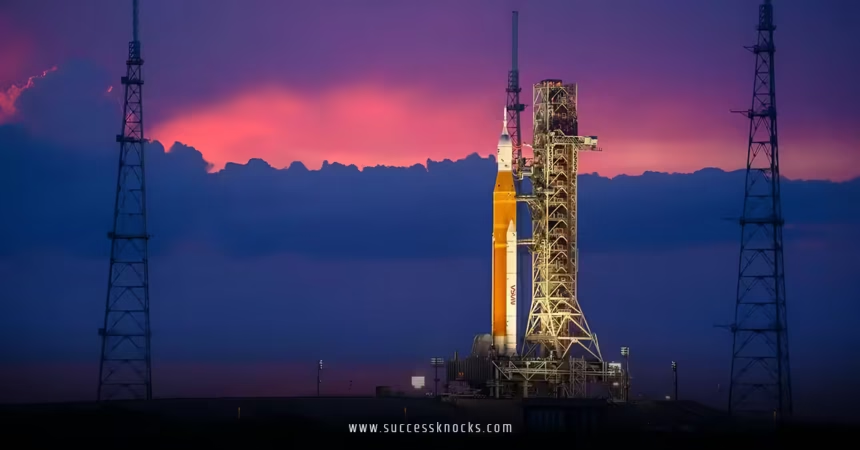
NASA Artemis II SLS rocket arrives Launch Pad 39B March 20 2026 countdown April 1 launch window—and this isn’t just another rocket sitting on a launchpad. This is humanity’s next giant leap toward the Moon, and the machinery is finally in position. After years of delays, engineering refinements, and relentless problem-solving, the Space Launch System (SLS) and its Orion crew capsule are locked in and ready for the countdown to begin.
What You Need to Know (Right Now)
Here’s the quick breakdown—bookmark this if you’re following the mission:
- The hardware is here: SLS arrived at Launch Pad 39B on March 20, 2026, marking the final major milestone before launch.
- Launch window opens April 1, 2026: NASA has a specific launch window—not a single day, but a frame of opportunity to achieve optimal conditions.
- This is Artemis II: The second crewed Artemis mission will carry four astronauts (three U.S., one Canadian) on a lunar flyby mission, testing life support and navigation for eventual crewed Moon landings.
- Why it matters: This mission validates the SLS and Orion for human spaceflight and paves the road to sustained lunar exploration starting with Artemis III.
- What’s at stake: Any technical issues discovered now affect the entire Artemis program timeline and future deep-space missions.
The Journey to Pad 39B: Why March 20 Was a Big Deal
The arrival of the SLS at Launch Pad 39B on March 20, 2026, represents the culmination of years of testing, stacking, and integrated systems checks. This wasn’t a casual roll-out. It was a precisely choreographed operation.
Think of it like this: you’ve been assembling a car in the shop, stress-testing every component, and now you’re finally rolling it into the race garage. But you’re not starting the engine yet—you’re running final diagnostics.
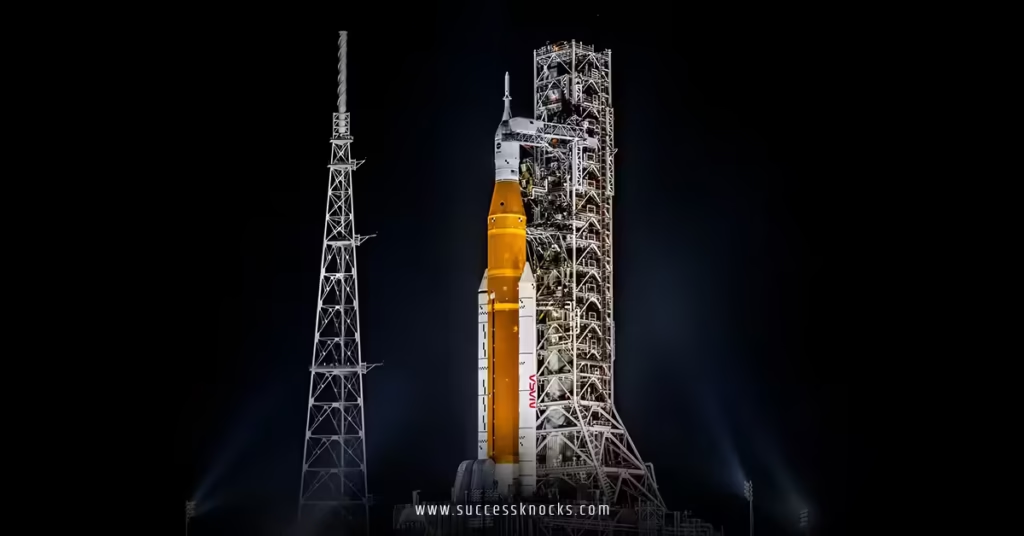
The SLS standing 322 feet tall (taller than the Statue of Liberty) had to be transported from the Vehicle Assembly Building, positioned on the Mobile Launcher, and placed with millimeter-precision alignment. The rocket’s four RS-25 engines (legacy Space Shuttle engines, refurbished and upgraded) and two solid rocket boosters were already mated to the core stage before this move. Once at Pad 39B, the ground systems team begins a new battery of checks: fuel system integrity, avionics connections, emergency procedures, and interface testing with ground support equipment.
This phase, called “Terminal Countdown Demonstration Test” (TCDT), is mandatory. It simulates a full launch countdown—minus the actual engine ignition—to catch any gremlins hiding in the system.
Understanding the April 1 Launch Window
Here’s a common misconception: “Launch window” doesn’t mean April 1 is the launch date. It means NASA has a specific window of time when conditions align for a safe, mission-effective launch.
Several factors constrain this window:
- Lunar geometry: For a lunar flyby mission, you need the Moon positioned correctly relative to Earth. Miss this window, and you’re waiting weeks or months for the next opportunity.
- Earth-Moon trajectory: The spacecraft must follow a precise path. Launch too early or too late, and you either overshoot or fall short.
- Weather conditions: Kennedy Space Center must have acceptable conditions—low wind shear, minimal lightning risk, no debris hazards.
- Daily launch times: Within the April 1 window, there are specific hours each day when ignition is feasible, typically a 2-4 hour window per day.
NASA publishes these windows in detail. If an issue crops up during the TCDT, they roll back, fix it, and recycle to the next available window. That’s happened before (Artemis I experienced multiple delays), and it’ll happen again if needed. No launch is worth a crew’s safety.
The Artemis II Mission: What’s Actually Flying?
Artemis II is fundamentally different from a single-operator mission. Four astronauts will occupy Orion: Reid Wiseman (spacecraft commander), Victor Glover (pilot), Christina Koch (mission specialist), and Jeremy Hansen (lunar specialist, and the first Canadian to journey beyond low Earth orbit).
The mission profile:
- Launch day: SLS ignites, accelerates the crew to Earth orbit, then performs a trans-lunar injection burn.
- Lunar flyby: Orion swings around the Moon at approximately 8,600 miles distance (closer than Apollo), testing high-speed re-entry at nearly 25,000 mph.
- Microgravity testing: The crew performs experiments and validates life support, navigation systems, and in-space procedures.
- Return: Splashdown in the Pacific Ocean after approximately 10 days in space.
The kicker is: this isn’t a landing mission. It’s a validation flight. Artemis III (planned for 2027–2028) will actually put boots on the lunar surface and test a new spacesuit design and landing technologies.
SLS vs. Other Launch Systems: Context Matters
You’ve probably heard the comparison: SpaceX’s Starship, Blue Origin’s New Glenn, or others. Here’s what’s different about SLS:
| Aspect | SLS (Artemis II) | Other Heavy-Lift Systems |
|---|---|---|
| Payload capacity | 95,200 lbs to lunar orbit | Varies; Starship targets 150+ tons (Mars-capable) |
| Crew capability | 4 astronauts (Orion) | Varies by vehicle; Starship not human-rated yet |
| Test heritage | RS-25 engines flown 135+ times on Space Shuttle | Mixed; some engines untested at this scale |
| Program maturity | Decades of design, now operational | Most in development or limited flights |
| Cost per mission | ~$2 billion (contested; estimates vary) | Starship aiming for $62M+ per launch (long-term goal) |
The SLS exists because NASA needed a heavy-lift vehicle right now capable of meeting specific Orion performance requirements. Other systems are advancing, but timing and capability alignment matter in real-world spaceflight.
Countdown to Launch: What Happens Next (Timeline)
After Pad 39B arrival, here’s the rough sequence:
Late March: Terminal Countdown Demonstration Test (TCDT) runs—a full dress rehearsal minus ignition.
Days before launch: Fuel cells loaded, cryogenic propellant systems chilled and pressurized, final systems validation.
Launch day (April 1 window): Ground crew performs final checks, weather officers give go/no-go, NASA leadership signs off, and the Launch Director initiates the Automated Countdown Sequence.
T-minus 6 hours: Main engines chill to cryogenic temperatures (-423°F for liquid hydrogen).
T-minus 30 seconds: Computer control takes over.
T-minus 0: RS-25 engines ignite, followed by solid rocket booster ignition. The SLS accelerates from 0 to 17,500 mph in roughly 8 minutes.
Any anomaly detected? The Automated Abort System can trigger an Emergency Egress—pulling the crew away via the emergency slides in seconds.
Why Delays Happen (And Why They’re Actually Good)
Artemis I (uncrewed, October 2022) experienced multiple delays. People complained. But here’s the thing: every delay added scrutiny, uncovered issues, and improved confidence.
Common culprits for SLS delays:
- Weather holds: Storms, wind shear, or high-altitude winds force 24-hour recycles.
- Technical anomalies: Ground equipment faults, sensor issues, or communications glitches require troubleshooting.
- Supply chain delays: Specialized components and refurbished engines take time to integrate.
- Software updates: Modern spacecraft run millions of lines of code. Updates and patches are continuous.
The message: delays aren’t failures. They’re the process working as designed. A launch held for 48 hours beats a catastrophic anomaly any day.
Common Mistakes People Make About Artemis II
Mistake #1: “It’s just a repeat of Apollo.”
The fix: Artemis is a completely different architecture. Apollo used a single-stage Lunar Module for landing. Artemis uses an integrated lunar lander (being developed separately) that’ll dock with Orion. The mission profile, technology, and objectives have evolved dramatically.
Mistake #2: “Why is this taking so long and costing so much?”
The fix: Modern spaceflight is incredibly complex. SLS carries 4 people—each one’s life depends on redundancies, testing, and margins built into the design. A rover takes months to develop; a human-rated spacecraft takes years. Budget overruns are real, but so are the engineering realities.
Mistake #3: “Starship will replace SLS soon anyway.”
The fix: Maybe eventually. But Starship isn’t human-rated, and Artemis II needs to fly now with proven hardware. Long-term strategy can pivot; near-term missions use what’s ready.
Mistake #4: “The launch window is fixed—if something goes wrong, the mission’s cancelled.”
The fix: NASA maintains multiple launch windows (days, weeks apart). If April 1 doesn’t work, the next window might be days or weeks later. The mission adjusts; it doesn’t evaporate.
Key Takeaways
- NASA Artemis II SLS rocket arrives Launch Pad 39B March 20 2026 countdown April 1 launch window marks the final stage before a crewed lunar flyby mission.
- The launch window isn’t a single day—it’s a frame of optimal conditions, typically hours each day over multiple days.
- Four astronauts (three U.S., one Canadian) will test life support and navigation systems, validating the SLS and Orion for eventual crewed lunar landings.
- Terminal Countdown Demonstration Test (TCDT) runs final simulations to catch any system anomalies before ignition.
- RS-25 engines (refurbished Space Shuttle heritage) power the SLS, combining proven flight history with modern upgrades.
- Delays aren’t setbacks—they’re the system working. Every hold adds scrutiny and confidence.
- Artemis II is fundamentally different from Apollo, using modern spacecraft architecture and technology.
- The mission success paves the way for Artemis III (lunar landing) and sustained lunar exploration.
Step-by-Step: What to Expect from April 1 Launch Onward
Step 1: Monitor the weather forecast. Starting 72 hours before the launch window, check NASA’s official forecast. Weather delays are the most common hold.
Step 2: Know the launch window. NASA publishes specific launch times for each day of the window. You’ll find these on NASA.gov and the Artemis website. Most windows open early morning (ET).
Step 3: Watch for technical announcements. If any anomaly is detected during TCDT, NASA will reschedule publicly. Follow official NASA channels (not rumors on social media).
Step 4: Tune in on launch day. NASA provides live coverage hours before launch, including commentary from engineers and mission specialists. The crew does a final suit-up and walkout—this is worth watching.
Step 5: Follow the mission for 10 days. Once in flight, daily mission updates cover experiments, system performance, and navigation adjustments. Lunar flyby happens around day 3-4; splashdown follows approximately 10 days later.
Step 6: Understand the bigger picture. Artemis II isn’t the end goal—it’s the validation run. Results directly inform Artemis III (landing mission) and everything that follows.
Why This Moment Matters
Here’s the honest truth: space is hard. Really hard. NASA, contractors, and a global community of engineers have spent decades and tens of billions of dollars to get to this point. The SLS is controversial—budget overruns, delays, alternative systems emerging—but it’s also a marvel of engineering. Four people are about to ride a rocket that’s been refined, tested, and validated in ways few machines ever are.
The April 1 launch window isn’t just a date on the calendar. It’s a deadline that says, “We’re ready.” And after years of preparation, that’s worth paying attention to.
Conclusion
NASA Artemis II SLS rocket arrives Launch Pad 39B March 20 2026 countdown April 1 launch window—and everything that follows depends on executing this mission flawlessly. From the arrival of the vehicle to the ignition of the RS-25 engines, every detail matters. The four-person crew will test systems and procedures that inform the next generation of lunar exploration. Delays might frustrate you, but they’re part of the process. Weather holds, technical scrutiny, and careful validation aren’t obstacles—they’re guardrails.
If you’re following the Artemis program, April 1 is the moment to watch. Not because it’s a given, but because it represents the culmination of relentless engineering, sacrifice, and the audacious belief that humans belong in deep space. The countdown begins now.
Next step: Bookmark NASA’s official Artemis mission page and check back a week before launch for the confirmed launch window and viewing details.
External References:
- NASA’s Official Artemis Program Page — Comprehensive mission updates, crew profiles, and real-time launch information.
- Kennedy Space Center Visitor Complex — Public launch viewing options, accommodations, and official event details for Artemis II.
- ESA’s Guide to Deep Space Exploration — Context on international lunar exploration efforts and how Artemis fits into global space strategy.
Frequently Asked Questions
Q: What if the April 1 launch window closes without a launch?
A: NASA maintains several launch windows over consecutive weeks and months. If April 1 doesn’t work—whether due to weather, technical issues, or other factors—the next available window opens days or weeks later. The mission doesn’t disappear; it recycles to optimal conditions.
Q: Why is NASA Artemis II SLS rocket arrives Launch Pad 39B March 20 2026 countdown April 1 launch window taking so long compared to the 1960s Apollo program?
A: Modern spacecraft carry vastly more instrumentation, redundancy systems, and safety protocols. Apollo flew 11 crewed missions in roughly a decade with much simpler technology and higher risk tolerance. Artemis prioritizes crew safety, which means slower, more deliberate timelines. Also, you’re building a program for sustained exploration, not a race to plant a flag.
Q: Can I watch the launch in person?
A: Yes. Kennedy Space Center allows public viewing in designated areas during launch events. Book accommodations and viewing passes through Kennedy Space Center’s official website or authorized vendors. Be prepared for weather delays and large crowds.
Q: How hot do the RS-25 engines get, and why does that matter?
A: The engines operate at approximately 6,000°F in the combustion chamber. Managing this extreme heat requires advanced materials and cooling channels running through the engine walls. Any degradation or leak can cascade into failure, which is why ground testing is so rigorous. It’s a fundamental engineering constraint that drives timeline and safety protocols.
Q: If Artemis II succeeds, what happens next?
A: Artemis III will attempt the actual lunar landing with a crew of two (staying on the surface for about a week). Subsequent Artemis missions will establish a sustainable lunar presence, test resource utilization, and eventually support deep-space exploration beyond the Moon. Artemis II is a critical stepping stone—prove the vehicle and crew systems work, then land.