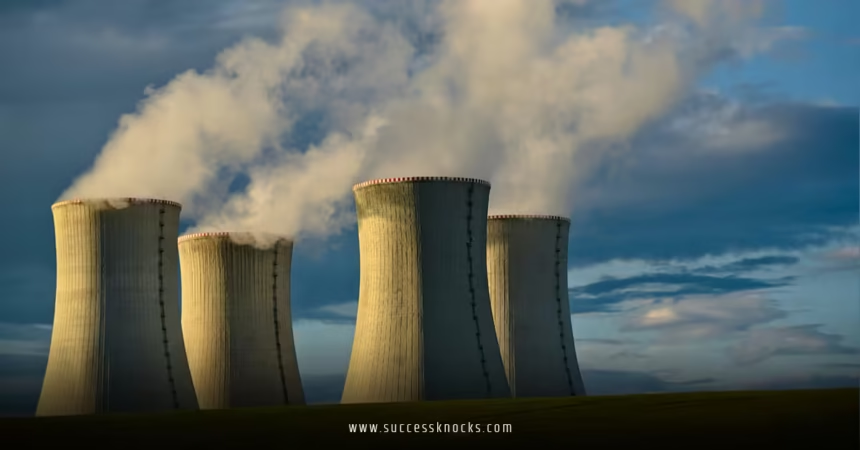
Comparing fusion vs. nuclear power for the future boils down to one simple truth: today’s nuclear fission plants deliver reliable, low-carbon electricity right now, while fusion promises a cleaner, safer, nearly limitless upgrade—if we can crack the engineering in time.
In the United States as of 2026, fission powers about 18% of electricity with a fleet of roughly 96 operating reactors. Fusion? Still mostly labs and startups racing toward pilot plants in the early 2030s.
Here’s the quick breakdown:
- Fission (current nuclear power): Splits heavy atoms like uranium. Proven, scalable today, but produces long-lived radioactive waste and carries meltdown risks (though modern designs minimize them).
- Fusion: Smashes light atoms like hydrogen isotopes. Mimics the sun. No meltdown risk, minimal long-lived waste, abundant fuel from seawater. But it demands extreme conditions and hasn’t hit consistent commercial net energy yet.
- Why it matters: Rising electricity demand from AI data centers, EVs, and industry needs firm, clean baseload power. Fission bridges the gap. Fusion could dominate later this century if costs drop.
Both beat fossil fuels on emissions. The real contest? Reliability, cost, safety, waste, and deployment speed.
What Nuclear Fission Actually Delivers Today
Nuclear fission works by splitting uranium atoms in a controlled chain reaction. Heat boils water, spins turbines, makes electricity.
U.S. plants run at high capacity factors—often over 90%—delivering steady power unlike solar or wind. The fleet set records in 2025 and keeps climbing. Vogtle Units 3 and 4 in Georgia marked the first new large reactors in decades, though costs ballooned.
Small modular reactors (SMRs) and restarts like Palisades or Three Mile Island aim to change that. Tech giants are signing deals for nuclear to power data centers. Fission isn’t going anywhere soon—it’s the workhorse.
Yet challenges bite: high upfront capital, long build times (sometimes 10+ years), spent fuel storage debates, and public perception shaped by past accidents.
Fusion: The Sun in a Bottle, Finally Getting Closer?
Fusion joins light nuclei—usually deuterium and tritium—releasing massive energy and helium as byproduct. No chain reaction. Stop the conditions, reaction halts.
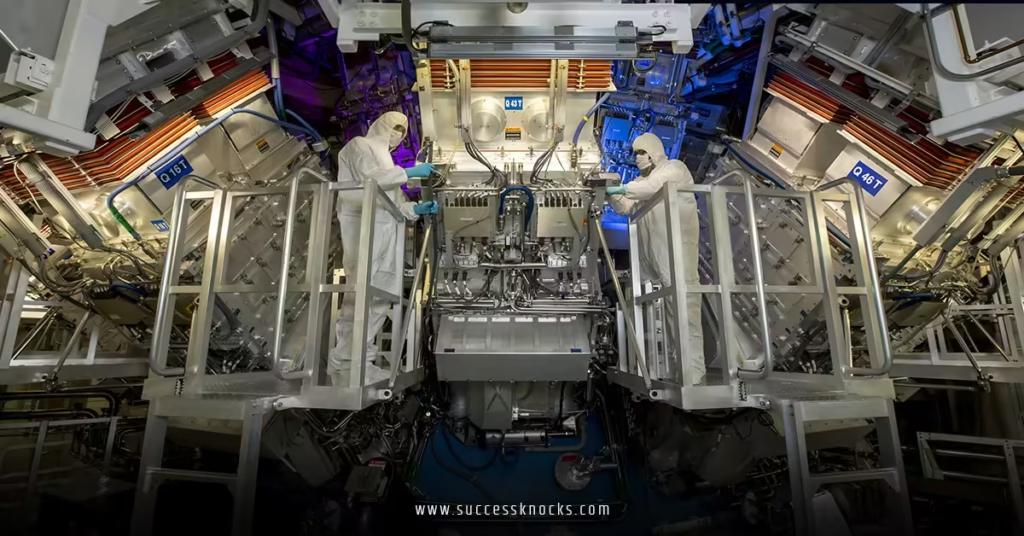
As of 2026, breakthroughs stack up. The National Ignition Facility (NIF) hit repeated net energy gains with lasers, including a 2025 record of 8.6 MJ output from 2.08 MJ input. Commonwealth Fusion Systems pushes SPARC, targeting net energy around 2027 using high-temperature superconductors for compact, powerful magnets. ITER in France eyes first plasma later this decade, full operations in the 2030s.
Private investment surged past $10 billion cumulatively. Over 160 fusion projects worldwide. Optimists eye commercial pilots in the early 2030s, scaling by 2050. Skeptics note the old joke: fusion is always 30 years away.
The kicker? Fuel is cheap and abundant. Deuterium from seawater. Tritium bred inside the reactor. Energy density dwarfs fission and fossils by orders of magnitude.
Head-to-Head: Fusion vs. Nuclear Power for the Future
Let’s cut through the hype with a clear comparison. Numbers draw from established sources and industry patterns—no made-up stats.
Key Differences Table
| Aspect | Fission (Current Nuclear) | Fusion (Emerging) |
|---|---|---|
| Energy Source | Splitting uranium/plutonium atoms | Fusing hydrogen isotopes |
| Safety | Meltdown possible (rare with modern safeguards) | No meltdown; reaction stops without continuous input |
| Waste | Long-lived radioactive spent fuel (thousands of years) | Short-lived, low-volume activated materials; minimal long-lived waste |
| Fuel Availability | Uranium mining; finite but manageable | Deuterium from water; virtually unlimited |
| Current Status (2026) | ~96 U.S. reactors operating; SMRs advancing | Lab net gains achieved; pilots targeted for 2030s |
| Build Time/Cost | 7–15+ years; billions per large plant | Unknown commercially; expected high initially, potentially lower long-term |
| Emissions | Near-zero operational CO2 | Near-zero operational CO2 |
| Proliferation Risk | Higher (weapons-usable material possible) | Very low |
Fission wins on proven deployment. You flip the switch today and get gigawatts. Fusion wins on paper for waste and safety. Imagine a power plant that produces helium you could breathe and waste that decays in decades, not millennia.
Here’s the thing: fission’s waste problem is real but managed in the U.S. through dry cask storage and geologic repository plans. Fusion’s “activated” structural materials still need handling, but the hazard profile drops dramatically.
Cost? Fission levelized costs sit competitive with other baseload when plants run long (60–80 years). Early fusion plants will likely cost more per kWh until scale kicks in. IAEA modeling suggests fusion could grab 10–50% of global electricity by 2100 depending on capital costs.
In the U.S., fission expansion focuses on uprates, restarts, and SMRs to meet surging demand. Fusion? Private players like Commonwealth Fusion bet on compact designs to slash size and cost.
Safety and Environmental Realities
Fusion’s inherent safety edge stands out. No runaway reaction. Disrupt magnets or lasers? Plasma cools in seconds.
Fission plants incorporate multiple redundant safety layers—containment domes, emergency cooling. Modern Gen III+ designs improve further. Still, public worry lingers from Chernobyl and Fukushima.
Environmentally, both slash carbon versus coal or gas. Fission mining and enrichment carry footprints; fusion fuel extraction is lighter. Waste volume favors fusion heavily.
One memorable analogy: fission is like a carefully controlled bonfire that risks getting out of hand. Fusion is more like juggling plasma torches—spectacular energy, but drop one and it just fizzles.
Deployment in the USA Context
America’s nuclear fleet provides nearly 20% of electricity and a huge share of carbon-free power. Policy in 2026 pushes hard: restarts, SMR funding, uprates via initiatives like UPRISE. Tech companies pour billions into deals for reliable power.
Fusion gets federal support too, through DOE programs and public-private partnerships. But timelines differ. Fission can add capacity in years via restarts or SMRs. Fusion needs the 2030s for meaningful grid contribution, scaling later.
What I’d do if advising a utility: lean on fission and SMRs for the next 10–15 years to secure baseload while monitoring fusion demos. Don’t bet the grid on unproven tech, but don’t ignore it either. Diversify.
Common Mistakes When Weighing Fusion vs. Nuclear Power for the Future
People often trip here. Fix them straight.
- Mistake: Treating fusion as “ready now.” It’s not. Lab gains excite, but engineering a 24/7 power plant with materials surviving neutron bombardment is brutal. Fix: Track milestones like SPARC net energy or ITER progress, not headlines alone.
- Mistake: Dismissing fission because of waste. Waste exists but is tiny in volume compared to coal ash and highly regulated. Fix: Support advanced recycling and repository development while pushing SMRs with better fuel use.
- Mistake: Assuming one kills the other. They complement. Fission bridges; fusion transforms. Fix: Advocate policies accelerating both—streamlined licensing, supply chain rebuilding, workforce training.
- Mistake: Ignoring economics. Early fusion will cost plenty. Fix: Demand transparent LCOE projections and focus on total system costs in a high-renewables grid.
- Mistake: Over-focusing on safety theater. Both are among the safest energy sources per TWh. Fix: Compare full lifecycle risks including mining, construction, and waste transport.
Your Beginner Action Plan: How to Follow and Engage with Comparing Fusion vs. Nuclear Power for the Future
You don’t need a physics degree. Here’s a practical 5-step plan:
- Build basics: Read simple explainers on fission (splitting) vs. fusion (joining) from official sources. Understand terms like “net energy gain” (Q > 1).
- Track real projects: Follow U.S. SMR deployments (NuScale, Holtec, etc.) and fusion efforts (NIF, Commonwealth Fusion, ITER). Check annual DOE or IAEA updates.
- Monitor policy and deals: Watch for tech company nuclear PPAs, federal funding rounds, and state-level SMR laws. These signal market confidence.
- Evaluate claims critically: Ask: Is it lab-scale or grid-ready? What’s the timeline and cost? Who funds it?
- Engage locally: Attend public hearings on new reactors or support workforce programs. Vote with data on energy reliability needs.
Start small. Spend 30 minutes weekly on credible updates. You’ll spot patterns fast.
Key Takeaways
- Fission provides proven, dispatchable clean power today in the U.S., powering millions of homes with high reliability.
- Fusion offers superior safety, waste profile, and fuel abundance but remains pre-commercial as of 2026, with promising net energy demos.
- The U.S. needs both: fission for near-term growth via SMRs and restarts, fusion for long-term transformation.
- Costs favor fission now; fusion’s edge depends on rapid scaling and capital reduction.
- Public-private momentum is real—don’t bet against progress, but temper expectations with engineering realities.
- Waste and safety concerns shrink dramatically with fusion, easing public acceptance.
- Energy demand surge makes firm low-carbon sources non-negotiable; comparing fusion vs. nuclear power for the future is really about timelines and trade-offs.
Conclusion
Comparing fusion vs. nuclear power for the future shows fission holding the fort with steady, expandable capacity while fusion chases the ultimate clean energy prize. Fission’s here, delivering terawatt-hours and avoiding emissions daily. Fusion could rewrite the rules with minimal waste and endless fuel—if timelines hold.
The smart move? Build aggressively on today’s nuclear strengths. Invest in fusion R&D without pausing practical deployment. Your next step: dig into a specific project near you—maybe an SMR proposal or fusion company update—and see how it fits the bigger picture.
Energy abundance isn’t coming from wishful thinking. It’s coming from hard engineering choices made today.
FAQs
What is the main difference when comparing fusion vs. nuclear power for the future?
Fusion joins light atoms and produces minimal long-lived waste with no meltdown risk, while current nuclear (fission) splits heavy atoms, generates manageable but longer-lived waste, and powers grids reliably today.
Will fusion replace nuclear fission plants in the USA?
Not soon. Fission will likely expand through the 2030s via SMRs and uprates to meet demand. Fusion pilots may arrive mid-2030s, scaling significantly later if successful.
Is fusion safer than nuclear power?
Yes, inherently. Fusion reactions self-terminate without precise conditions; fission requires active safety systems to prevent overheating.
How does waste from fusion compare to nuclear fission?
Fusion produces far less long-lived radioactive waste. Activated materials decay faster, and the primary byproduct is inert helium.
When might fusion contribute meaningfully to U.S. electricity?
Optimistic projections point to commercial pilots in the early 2030s, with broader impact possible by 2050, depending on cost and engineering success. Fission remains the backbone in the meantime.