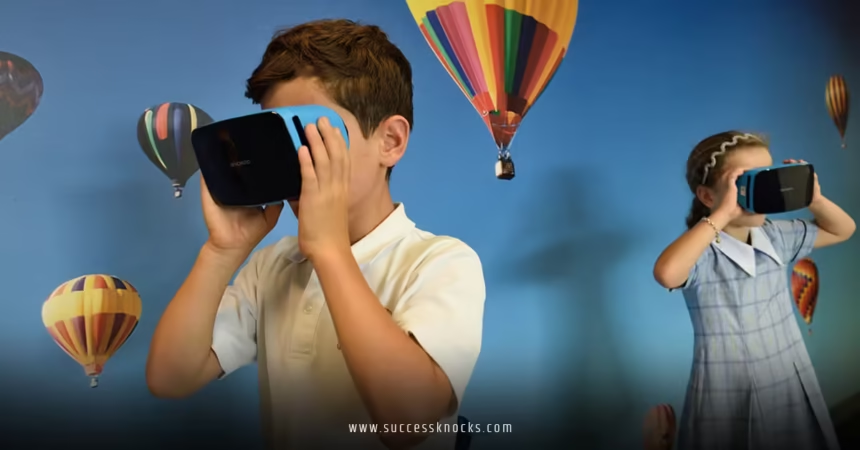
Future of VR gaming in education and training looks nothing like dusty textbooks or passive lectures. It blends the addictive pull of games with real skill-building in safe, repeatable virtual worlds. Think dissecting a virtual frog without the mess, piloting an airplane without leaving the ground, or negotiating a high-stakes deal while your heart rate spikes like it’s real.
By 2026, this isn’t sci-fi. Affordable headsets, better content, and proven results have pushed VR beyond gimmicks into classrooms, corporate offices, and specialized training programs across the USA.
Here’s what stands out right now:
- Market momentum: The VR in education sector is expanding fast, with projections showing strong growth driven by immersive simulations that beat traditional methods on engagement and retention.
- Learning gains: VR training can deliver up to a 76% increase in learning effectiveness and train people four times faster than classroom sessions in some cases.
- Safe practice: High-risk fields like medicine, aviation, and manufacturing let learners fail forward without real consequences.
- Accessibility shift: Standalone headsets like Meta Quest models have dropped barriers, making deployment easier for schools and companies.
- Gamification edge: Game mechanics—points, levels, immediate feedback—keep users hooked while they master complex concepts.
The kicker? VR turns passive observers into active participants. You don’t just read about history. You stand in the Colosseum. You don’t watch a surgery video. You hold the scalpel (virtually).
Why VR gaming mechanics supercharge education and training
Games excel at one thing: keeping you engaged through challenge, reward, and progression. Apply that to learning, and magic happens.
In traditional settings, attention drifts. In VR, presence—the feeling of “being there”—locks you in. Add game elements like leaderboards, achievement badges, or adaptive difficulty, and learners push harder. Retention climbs because emotions and actions tie directly to the material.
Imagine a history class where students relive the American Revolution, making decisions that alter outcomes. Or a corporate sales team practicing pitches in branching scenarios where body language and tone get scored in real time. The game-like feedback loop accelerates mastery.
In my experience working with edtech teams over the years, the biggest wins come when VR feels playful yet purposeful. Pure simulations can feel clinical. Layer in gaming DNA—story, competition, exploration—and completion rates soar.
Current applications making waves in 2026
VR has moved from pilot programs to scaled use, especially in the US.
K-12 and higher education: Students explore virtual ecosystems, manipulate 3D molecules, or visit ancient civilizations. STEM subjects benefit hugely from spatial understanding that flat screens can’t provide. Some universities now offer VR-based courses as standard options.
Corporate training: Companies use VR for everything from soft skills (public speaking, conflict resolution) to hard procedural tasks (equipment maintenance, safety protocols). Employees report higher confidence—up to 275% in some studies—when applying skills post-training.
High-stakes fields:
- Medical: Surgical rehearsals and patient interaction practice without risk.
- Aviation and manufacturing: Scenario repetition that would be prohibitively expensive or dangerous in reality.
- Military and emergency services: Tactical drills in varied environments.
Standalone headsets have been game-changers here. No powerful PC required. Teachers or trainers manage fleets more easily, and students jump in quickly.
The future of VR gaming in education and training: What’s next
Expect tighter integration with AI. Adaptive systems will adjust scenarios based on your performance, offering personalized paths. Haptic feedback will improve—feeling resistance when you “touch” virtual objects. Mixed reality (MR) will blend virtual elements with your real surroundings for hybrid experiences.
Cloud streaming could reduce hardware demands further. Multi-user sessions will let classrooms or teams collaborate in shared virtual spaces from anywhere in the USA.
By the late 2020s, VR could become as common as laptops in many institutions, especially as costs continue trending down and content libraries grow. Gaming engines like Unity and Unreal already power much of this content, so the pipeline from entertainment to education stays strong.
The shift isn’t just technical. It’s pedagogical. VR supports experiential learning—doing instead of hearing—which aligns with how humans actually retain knowledge best.
Pros and cons: A realistic breakdown
Here’s a clear comparison to help you weigh it up:
| Aspect | Traditional Methods | VR Gaming-Style Training |
|---|---|---|
| Engagement | Often passive; variable retention | High due to immersion and game mechanics |
| Speed of learning | Standard pace | Up to 4x faster in targeted skills |
| Safety for high-risk | Real consequences or limited reps | Zero real risk; unlimited repetition |
| Cost (long-term) | Lower upfront; ongoing materials | Higher initial hardware; lower per-trainee over time |
| Accessibility | Easy for most settings | Improving with standalone devices; still needs management |
| Skill transfer | Good for theory; variable for practice | Strong for procedural and soft skills |
| Customization | Limited | High with adaptive AI and branching scenarios |
VR shines where practice matters most. But it won’t replace every lecture or discussion. Hybrid approaches usually win.
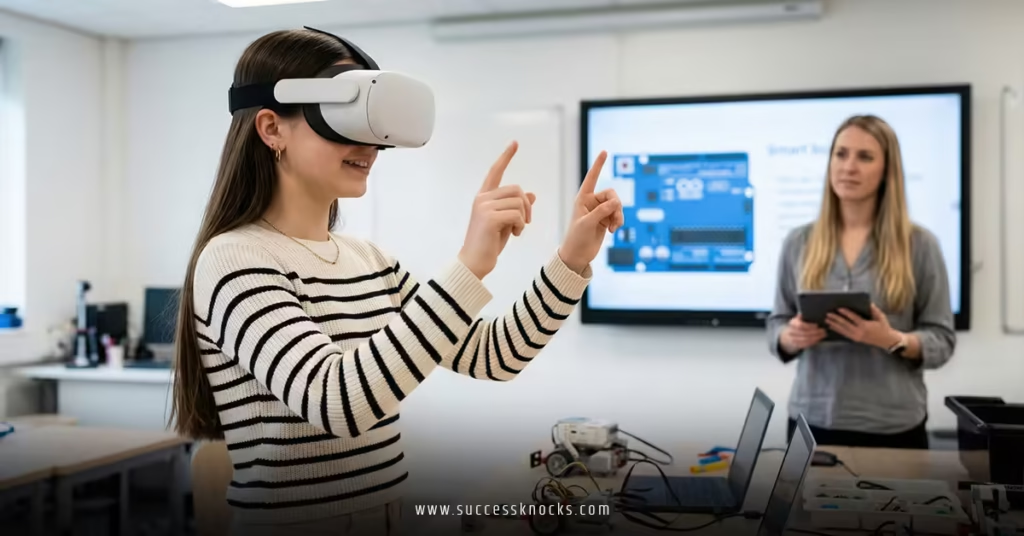
Common mistakes when adopting VR (and how to fix them)
I’ve seen teams stumble here. Don’t repeat these.
- Treating VR as a shiny toy
Fix: Tie every experience directly to clear learning objectives. Ask: What skill or concept improves? If it doesn’t answer, rethink. - Ignoring motion sickness and comfort
Fix: Start with short sessions (10-15 minutes). Choose lighter headsets. Offer seated or standing options. Test with your actual users. - Poor content or no teacher training
Fix: Invest in quality, curriculum-aligned experiences. Train educators on facilitation—not just tech setup. A great VR module flops without proper integration. - Scaling without infrastructure
Fix: Plan device management, charging, hygiene, and IT support upfront. Cloud tools and MDM software help. - Assuming one size fits all
Fix: Segment by age, experience level, and goals. Beginners might need simpler gaming elements; advanced users want complex simulations.
Rule of thumb: Pilot small, measure results (completion rates, pre/post tests, feedback), then expand.
Step-by-step action plan for beginners
Ready to dip your toe in? Here’s a practical starter guide for educators or training leads in the US:
- Define your goal — Pick one pain point. Example: Improve safety training retention or make abstract science concepts tangible.
- Research hardware — Look at affordable standalone options like Meta Quest series. Compare specs for your group size and content needs.
- Explore ready-made content — Check education-focused apps and platforms. Many cover STEM, history, or soft skills out of the box.
- Pilot with a small group — Run 3-5 sessions. Gather feedback on engagement, comfort, and learning gains. Track simple metrics.
- Integrate and iterate — Blend VR with existing curriculum. Use game elements to boost motivation. Adjust based on results.
- Scale thoughtfully — Budget for multiple headsets, storage/charging solutions, and ongoing content or updates.
- Measure ROI — Look beyond “fun.” Track knowledge retention, skill application, training time saved, or error reduction on the job.
Start simple. One strong use case builds momentum and justifies bigger investment.
Key takeaways
- Future of VR gaming in education and training combines immersive simulation with game mechanics for deeper engagement and faster skill acquisition.
- Proven benefits include higher retention, confidence, and transfer of learning—especially valuable in high-risk or complex domains.
- Costs are dropping while content and hardware improve, making 2026 a practical time for wider adoption in US schools and companies.
- Success depends on clear objectives, user comfort, and thoughtful integration—not just buying headsets.
- Hybrid models (VR + traditional methods) deliver the best results for most contexts.
- AI personalization and better haptics will drive the next leap forward.
- Pilot programs with measurable goals reduce risk and demonstrate value quickly.
Conclusion
The future of VR gaming in education and training isn’t about replacing teachers or books. It’s about amplifying what works—hands-on practice, immediate feedback, emotional connection—and making it scalable and safe. Learners remember what they do and feel. VR lets more people experience more, more often.
If you’re just starting, pick one targeted application, run a tight pilot, and let results guide you. The technology has matured. Now it’s about smart implementation.
The real win? Students and trainees who walk away not just informed, but transformed.
Frequently Asked Questions
1. What is the future of VR gaming in education and training?
The future of VR gaming in education and training involves blending immersive virtual environments with game mechanics like rewards, levels, and instant feedback to make learning more engaging and effective. By 2026, expect wider adoption of standalone headsets, AI-driven personalization, improved haptics, and hybrid experiences that combine VR with real-world classrooms and corporate training programs across the USA.
2. How does VR gaming improve learning outcomes compared to traditional methods?
VR gaming improves learning outcomes by creating a strong sense of presence that boosts engagement and retention. It allows safe, repeatable practice of high-risk skills, often delivering up to 4x faster training and significantly higher confidence levels. Game elements keep learners motivated while traditional lectures frequently struggle with attention and knowledge transfer.
3. Which fields benefit most from VR gaming in education and training?
High-stakes fields benefit most, including medicine (surgical practice), aviation, manufacturing, emergency services, and military training. In schools, STEM subjects like biology, chemistry, and history see strong gains. Corporate training also uses VR gaming effectively for soft skills such as public speaking, sales, and leadership development.
4. What hardware and costs should schools or companies consider for VR gaming in education?
In 2026, standalone headsets like the Meta Quest series are the most practical choice because they don’t require powerful PCs. Initial costs include headsets, charging stations, and content licenses, but long-term savings come from reduced travel, materials, and repeated real-world training expenses. Starting with a small pilot helps control budget.
5. How can beginners get started with VR gaming in education and training?
Beginners should start by identifying one clear learning goal, researching affordable standalone VR headsets, testing ready-made educational content, and running a small pilot group. Focus on short sessions, teacher/facilitator training, and measuring results like engagement and skill improvement before scaling up. Hybrid approaches that combine VR with traditional teaching usually work best.