

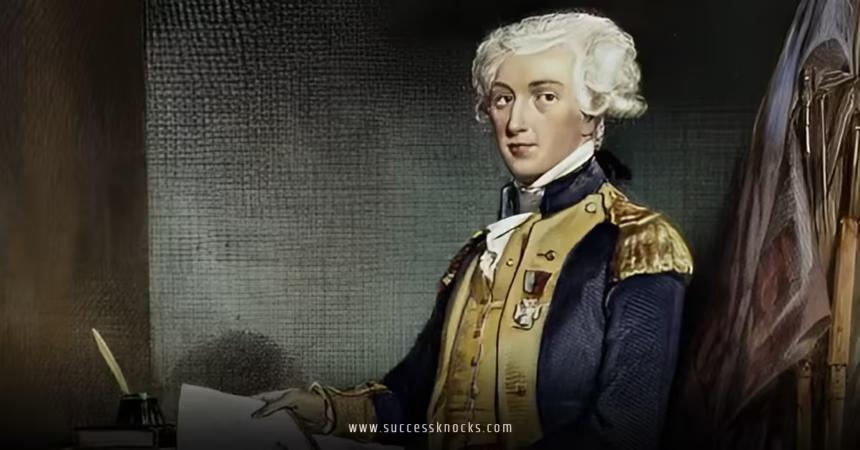
Marquis de Lafayette American Revolution story reads like fiction, but every impossible detail actually happened. A 19-year-old French aristocrat defied his king, crossed an ocean, and became George Washington’s surrogate son—all while helping secure American independence and shaping the course of two nations forever.
Quick Overview:
- Lafayette volunteered for the American Revolution at age 19, against French royal orders
- Developed a father-son relationship with George Washington that lasted decades
- His wealth, connections, and military skills proved crucial to American victory
- Returned to France as a hero, bringing American democratic ideals to Europe
- His legacy continued through his son, Georges Washington de La Fayette, who lived with Washington
The Boy Who Bought His Way Into History
Most teenagers rebel by staying out late. Gilbert du Motier, Marquis de Lafayette, rebelled by starting a revolution.
In 1777, this French aristocrat was everything you’d expect from nobility: wealthy, well-connected, and bored out of his mind. What you wouldn’t expect? His willingness to risk everything—title, fortune, life itself—for a cause he’d only read about in newspapers.
The Marquis de Lafayette American Revolution connection began with a dinner party conversation. That’s right. World history pivoted because Lafayette overheard some American diplomats discussing their desperate need for French support.
The Audacious Plan
Lafayette’s decision defied every rational calculation:
- King Louis XVI explicitly forbade French nobles from joining the American cause
- Lafayette had never commanded troops in actual combat
- His wife was pregnant with their first child
- The journey alone could kill him—Atlantic crossings were deadly gambles
So naturally, he bought his own ship.
Not chartered. Bought. Lafayette purchased the vessel La Victoire, loaded it with supplies, and sailed for America in April 1777. The French government was so furious they issued a warrant for his arrest.
The kid was committed.
Landing in South Carolina: Culture Shock Meets Reality
When Lafayette finally reached American shores, reality hit hard.
The Continental Army wasn’t the professional force he’d imagined. These weren’t European soldiers with matching uniforms and disciplined formations. They were farmers, shopkeepers, and craftsmen wearing whatever clothes they owned, carrying whatever weapons they could find.
Most European aristocrats would have turned around immediately.
Lafayette saw something different. He saw citizen-soldiers fighting for an idea so powerful they’d risk everything to defend it. This wasn’t just military service—it was ideological warfare between two completely different visions of human society.
The Meeting That Changed Everything
When Lafayette first met George Washington in August 1777, both men were desperate for different reasons.
Washington’s situation:
- Congress was breathing down his neck about military failures
- His army was underfunded, undersupplied, and demoralized
- European military experts kept arriving with unrealistic expectations
- He needed allies who understood both warfare and politics
Lafayette’s situation:
- Surrounded by a language he barely spoke
- No real military command experience
- Carrying letters of introduction but no guarantee of acceptance
- Burning bridges back home with every day he stayed
The chemistry was immediate. Washington saw Lafayette’s genuine commitment and political potential. Lafayette saw the father figure he’d lost as a child—his own father died when he was barely two years old.
From Brandywine to Brotherhood: The Making of a Military Partnership
The Marquis de Lafayette American Revolution story truly began at the Battle of Brandywine in September 1777.
Lafayette’s first major combat experience went badly. The Continental Army suffered a tactical defeat, and Lafayette took a musket ball through his leg. But something remarkable happened during the retreat.
Instead of complaining about his wound or demanding special treatment, Lafayette helped rally the troops.
Washington noticed. This wasn’t some European dilettante playing soldier—this was a leader willing to bleed for American independence.
The Valley Forge Crucible
Winter 1777-1778 at Valley Forge tested everyone’s commitment to the revolutionary cause. While Congress debated politics in comfortable rooms, the Continental Army nearly starved in the Pennsylvania wilderness.
Lafayette’s wealth made the difference. He used his personal fortune to:
- Purchase supplies for his men when official requisitions failed
- Buy winter clothing for soldiers who were literally barefoot
- Fund intelligence operations Washington couldn’t afford
- Maintain morale through personal example and genuine care for enlisted soldiers
But more importantly, he provided Washington with emotional support during the darkest period of the war.
The relationship deepened from military partnership to genuine paternal affection. Washington began treating Lafayette like the son he never had, while Lafayette found in Washington the strong father figure missing from his own childhood.
The Strategic Masterstroke: Bringing France Into the War
Here’s where Lafayette’s story becomes a masterclass in international relations.
His presence in America wasn’t just symbolic—it was strategic. Every letter he sent home to French aristocrats and government officials carried implicit messages about American military potential and moral legitimacy.
The Diplomatic Chess Game
| Lafayette’s Advantage | Strategic Impact |
|---|---|
| Personal wealth | Proved Americans had credible international support |
| Aristocratic connections | Opened channels to French government decision-makers |
| Combat credibility | Demonstrated that European military professionals took the American cause seriously |
| Washington’s trust | Provided inside information about American military capabilities |
The brilliance of the Lafayette strategy? He made American independence seem inevitable rather than impossible.
French government officials couldn’t dismiss the American cause as a hopeless rebellion when one of their own most prominent young aristocrats was willing to risk everything for it. Lafayette’s participation legitimized American independence in European eyes.
Return to France: The Revolutionary Export
When Lafayette returned to France in 1779, he wasn’t the same young man who’d left two years earlier. He was now a battle-tested veteran carrying American democratic ideals into the heart of European aristocracy.
The cultural impact was immediate and profound.
Lafayette didn’t just talk about American liberty—he embodied it. His behavior, his language, even his clothing style reflected American democratic values. French society noticed.
Key Contributions to French Support
- Military Intelligence: Provided detailed reports on British military capabilities and weaknesses
- Strategic Planning: Helped design the French expeditionary force that would prove decisive at Yorktown
- Diplomatic Networking: Used his court connections to build support for American alliance
- Public Relations: Became the human face of Franco-American cooperation
His success in America proved that French aristocrats could excel in democratic environments. This wasn’t theoretical anymore—Lafayette had lived it and succeeded.
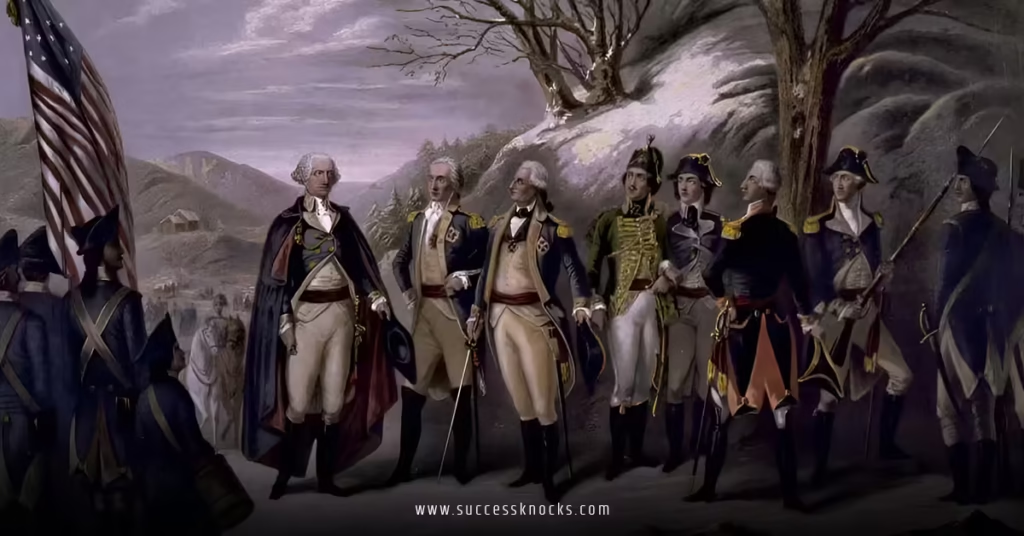
The Yorktown Campaign: Lafayette’s American Revolution Masterpiece
By 1781, Lafayette had evolved from enthusiastic volunteer to seasoned commander. When Washington assigned him to Virginia, everyone understood the stakes.
The mission: Keep British General Cornwallis busy while Washington and Rochambeau planned the final campaign.
The challenge: Lafayette commanded a force of mostly inexperienced troops against one of Britain’s most capable generals.
The result: Lafayette’s tactical skill helped trap Cornwallis at Yorktown, setting up the decisive victory that ended the war.
The Virginia Campaign Strategy
Lafayette’s approach in Virginia demonstrated how much he’d learned about American-style warfare:
- Avoided decisive battles until conditions favored American forces
- Used mobility and local knowledge to offset British advantages
- Coordinated with local militia leaders who understood terrain and supply routes
- Maintained communication with Washington despite distances and British interference
- Built relationships with Virginia political leaders to ensure continued support
When Cornwallis finally surrendered at Yorktown in October 1781, Lafayette stood beside Washington as both a military commander and surrogate son. The circle was complete—the young French volunteer had helped secure American independence.
Step-by-Step: How Lafayette Built His Revolutionary Legacy
For modern leaders interested in international cooperation and cross-cultural bridge-building, the Marquis de Lafayette American Revolution approach offers timeless lessons:
Phase 1: Commitment Demonstration (1777)
- Made personal sacrifices that proved genuine commitment to the cause
- Invested his own resources rather than seeking immediate benefits
- Learned the language and customs of his adopted country
- Built relationships based on shared values rather than personal advantage
Phase 2: Competence Development (1777-1779)
- Gained practical experience in American military and political systems
- Developed skills that complemented rather than competed with existing leadership
- Built trust through consistent performance under pressure
- Maintained connections to both French and American networks
Phase 3: Influence Multiplication (1779-1781)
- Leveraged credibility in both countries to facilitate cooperation
- Used personal relationships to overcome institutional barriers
- Became a trusted advisor to key decision-makers on both sides
- Applied lessons learned in one context to challenges in the other
Common Mistakes in Understanding the Marquis de Lafayette American Revolution Story
Mistake #1: Viewing Lafayette as just a wealthy volunteer Fix: Recognize his genuine military and diplomatic contributions that went far beyond financial support.
Mistake #2: Underestimating his strategic importance Fix: Understand that his presence helped legitimize the American cause in European eyes and facilitated French government support.
Mistake #3: Missing the personal relationship with Washington Fix: The father-son bond between Washington and Lafayette influenced both men’s decisions throughout their lives and shaped American foreign policy.
Mistake #4: Ignoring his impact on French political development Fix: Lafayette brought American democratic ideals to France, contributing to the intellectual foundation of the French Revolution.
Mistake #5: Overlooking the family legacy Fix: The Lafayette commitment to Franco-American friendship continued through his descendants, including Georges Washington de La Fayette, who lived with Washington as his ward.
The Washington-Lafayette Bond: A Relationship That Shaped Nations
The emotional core of the Marquis de Lafayette American Revolution story lies in his relationship with George Washington. This wasn’t just military cooperation—it was genuine paternal affection that influenced both men’s major life decisions.
Washington’s letters to Lafayette reveal remarkable intimacy:
- “You know the place you hold in my affection and how much I love you”
- “I never parted from a man whose company was more agreeable to me”
- “Your prudent and good conduct has gained you universal esteem”
Lafayette’s devotion to Washington was equally profound:
- Named his son Georges Washington de La Fayette in Washington‘s honor
- Kept a portrait of Washington in his home throughout his life
- Sent his son to live with Washington during the French Revolution’s chaos
The Lasting Impact
This relationship established patterns for Franco-American cooperation that continue today. The U.S. State Department still references Lafayette’s contributions when discussing the historical foundations of the alliance.
Personal bonds between leaders created institutional relationships that survived political changes, wars, and centuries of diplomatic challenges. The Lafayette model demonstrates how individual relationships can shape international relations across generations.
Revolutionary Lessons for Modern Leaders
The Marquis de Lafayette American Revolution story offers a blueprint for effective cross-cultural leadership that remains relevant today.
Core Principles That Transcend Time
- Commitment over comfort: Lafayette chose difficult service over easy privilege
- Investment over extraction: He put resources into the cause before seeking benefits
- Relationship over transaction: Built genuine personal bonds rather than purely professional connections
- Learning over lecturing: Studied American culture instead of imposing French methods
- Bridge-building over side-taking: Used his dual identity to connect rather than divide
Modern applications include:
- International business partnerships
- Cross-cultural team leadership
- Diplomatic and NGO work
- Global nonprofit initiatives
- Academic and cultural exchanges
The French Revolution Connection: Exporting American Ideas
Lafayette’s American experience fundamentally shaped his approach to French political reform. When the French Revolution began in 1789, Lafayette emerged as a key leader precisely because he’d seen democratic governance work in America.
He literally drafted the Declaration of the Rights of Man and Citizen, using principles he’d learned while fighting alongside Washington. The document explicitly referenced American revolutionary ideals, creating direct intellectual connections between the two revolutions.
The Lafayette Legacy in France
- Commanded the National Guard during the early French Revolution
- Advocated for constitutional monarchy based on American federal models
- Protected both revolutionary gains and moderate stability
- Maintained correspondence with American leaders throughout French political upheavals
The irony? Lafayette’s American experience made him too moderate for radical French revolutionaries and too revolutionary for conservative French monarchists. His commitment to American-style balanced government put him at odds with extremists on both sides.
Key Takeaways: The Enduring Impact of Lafayette’s American Revolution Service
- Personal relationships between leaders can establish international partnerships lasting centuries
- Cross-cultural competence requires genuine immersion, not just surface knowledge
- Individual commitment can legitimize broader institutional cooperation
- Military service creates bonds that transcend national boundaries
- Wealth used for public service multiplies its impact exponentially
- The Franco-American alliance began with personal relationships before becoming formal policy
- Democratic ideals spread through personal networks as much as official channels
- Lafayette’s family continued his legacy of Franco-American friendship for generations
The Network Effect: How Lafayette’s Connections Multiplied
Understanding the Marquis de Lafayette American Revolution impact requires recognizing how his network effects multiplied his individual contributions.
Every relationship Lafayette built created additional connections between French and American leaders. His friends became America’s friends. His contacts became diplomatic channels. His reputation became collateral for American credibility in Europe.
The multiplication effect worked both ways. American leaders gained access to French political, military, and financial networks through Lafayette’s introductions. French leaders gained insight into American political thinking through Lafayette’s experiences and relationships.
This network approach to international relations—building multiple personal connections rather than relying solely on formal diplomatic channels—proved remarkably resilient. When official relations grew tense, informal networks kept communication flowing.
Conclusion
The Marquis de Lafayette American Revolution story proves that history’s most important changes often begin with individual courage and personal relationships. Lafayette’s decision to risk everything for American independence created bonds between nations that continue shaping global politics today.
His approach—commitment before comfort, investment before extraction, relationships before transactions—offers a timeless model for anyone working across cultural boundaries. Whether in business, diplomacy, or community leadership, the Lafayette principles remain surprisingly relevant.
The next step? Consider how your own international experiences, relationships, or cultural knowledge might serve larger purposes. The world still needs bridge-builders who can translate between different societies and value systems.
Lafayette’s greatest insight was understanding that ideas become powerful when they’re embodied in genuine relationships. American liberty became real for French aristocrats because they could see it working in Lafayette’s own life and character.
In our interconnected but often divided world, we need more leaders willing to make Lafayette’s choice: to risk comfort for conviction and to build bridges instead of walls.
Frequently Asked Questions
Q: How young was Marquis de Lafayette when he joined the American Revolution?
A: Lafayette was only 19 years old when he sailed for America in 1777, making his military and diplomatic achievements even more remarkable given his youth and inexperience.
Q: Did Lafayette ever return to America after the Revolutionary War ended?
A: Yes, Lafayette made a triumphant return tour of America in 1824-1825, visiting all 24 states and receiving hero’s welcomes everywhere he traveled, demonstrating the lasting affection Americans felt for him.
Q: What role did Lafayette play in the French Revolution?
A: Lafayette commanded the National Guard and helped draft the Declaration of the Rights of Man and Citizen, applying American democratic principles to French revolutionary politics, though he eventually fell out of favor with more radical revolutionaries.
Q: How did Lafayette’s relationship with Washington affect his family?
A: The Washington-Lafayette bond was so strong that Lafayette named his son Georges Washington de La Fayette, and during the French Revolution’s chaos, he sent this son to live with Washington in America as his ward.
Q: What happened to Lafayette’s wealth after he invested so much in the American Revolution?
A: Lafayette spent enormous amounts of his personal fortune supporting the American cause, and later lost much of his remaining wealth during the French Revolution, though he never regretted these sacrifices for liberty.


