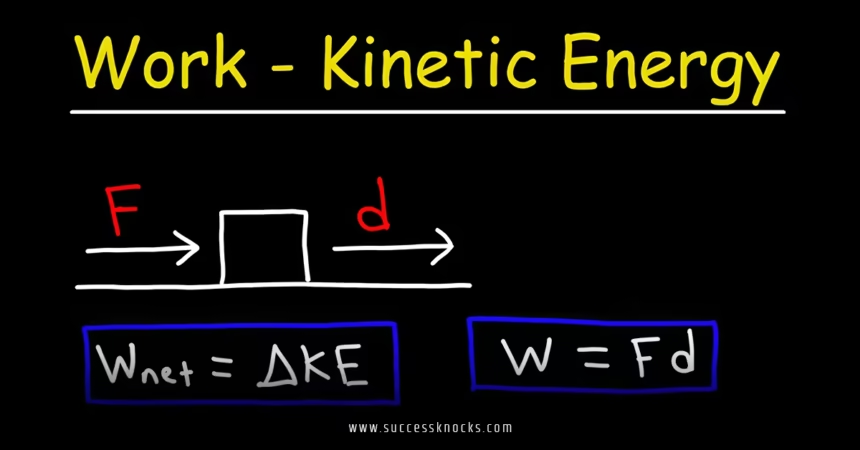
Work kinetic energy theorem states that the net work done on an object equals the change in its kinetic energy. This fundamental physics principle connects force, motion, and energy in a way that explains everything from why your car accelerates when you press the gas pedal to how a baseball gains speed when a pitcher throws it.
Here’s what makes this theorem essential:
- It links work (force × distance) directly to kinetic energy changes
- It applies to any object in motion, from atoms to planets
- It provides a powerful problem-solving tool for mechanics
- It bridges the gap between force-based and energy-based physics
- It explains why stopping distances matter for vehicle safety
Understanding the Work Kinetic Energy Theorem
The work kinetic energy theorem isn’t just another physics formula to memorize. It’s the bridge that connects two fundamental concepts: work and kinetic energy.
Think of it this way: when you push a shopping cart from rest, you’re doing work on it. That work doesn’t just disappear—it transforms into the cart’s kinetic energy, giving it motion. The theorem tells us exactly how much energy that motion represents.
The Mathematical Foundation
The theorem expresses itself through a deceptively simple equation:
$$W_{net} = \Delta KE = KE_f – KE_i$$
Where:
- W_net = net work done on the object
- ΔKE = change in kinetic energy
- KE_f = final kinetic energy
- KE_i = initial kinetic energy
Since kinetic energy equals ½mv², we can expand this to:
$$W_{net} = \frac{1}{2}mv_f^2 – \frac{1}{2}mv_i^2$$
Why This Matters in Real Life
Every time you brake your car, the work kinetic energy theorem is at play. Your brakes do negative work on the car, removing kinetic energy and converting it to heat through friction. The faster you’re going, the more work your brakes must do—which is why stopping distances increase dramatically with speed.
Key Components of the Work Kinetic Energy Theorem
Net Work: The Driver of Change
Net work represents the total effect of all forces acting on an object. It’s not just one force—it’s the sum of everything pushing, pulling, or resisting motion.
Consider a cyclist pedaling uphill. The pedaling force does positive work, while friction and gravity do negative work. The net work determines whether the cyclist speeds up, slows down, or maintains constant speed.
Kinetic Energy: Motion Made Measurable
Kinetic energy quantifies motion. A 2,000-pound car traveling at 30 mph has about 201,000 foot-pounds of kinetic energy. Double the speed to 60 mph, and that energy jumps to 804,000 foot-pounds—four times as much.
This quadratic relationship with velocity explains why high-speed crashes are so devastating and why engineers obsess over vehicle safety at different speeds.
Work Kinetic Energy Theorem Applications
Automotive Engineering
Car manufacturers use this theorem extensively. They calculate how much work brakes must do to stop vehicles from various speeds, design crumple zones to absorb kinetic energy safely, and optimize engine power to achieve desired acceleration.
Sports Science
Athletes and coaches leverage this principle constantly. A sprinter applies force over distance to build kinetic energy. A high jumper converts horizontal kinetic energy into vertical motion. Even golfers use it—the work done by the club on the ball determines the ball’s final speed and distance.
Industrial Safety
Construction sites rely on this theorem for safety calculations. When a tool falls from a scaffold, its kinetic energy at impact depends on the work gravity does over the falling distance. Safety helmets and barriers are designed to absorb this energy safely.
Step-by-Step Problem-Solving Guide
Step 1: Identify Your System
Define exactly what object you’re analyzing. Is it a single particle, a rigid body, or a system of connected parts? Clear boundaries prevent confusion later.
Step 2: Catalog All Forces
List every force acting on your object:
- Applied forces (pushes, pulls)
- Gravitational forces
- Friction forces
- Normal forces
- Tension forces
Step 3: Calculate Individual Work Values
For each force, determine the work it does. Remember that work equals force times displacement in the direction of force. Forces perpendicular to motion do zero work.
Step 4: Find Net Work
Add up all individual work values, paying attention to signs. Positive work increases kinetic energy; negative work decreases it.
Step 5: Apply the Theorem
Set net work equal to the change in kinetic energy. Solve for whatever unknown you’re seeking—final velocity, stopping distance, required force, etc.
Common Scenarios and Solutions
| Scenario | Key Insight | Common Application |
|---|---|---|
| Object starting from rest | Initial KE = 0, so W_net = ½mv_f² | Launching projectiles |
| Object coming to stop | Final KE = 0, so W_net = -½mv_i² | Braking calculations |
| Constant speed motion | Net work = 0, forces balanced | Terminal velocity |
| Work against gravity | mgh appears in work calculation | Lifting objects |
Common Mistakes and How to Avoid Them
Mistake 1: Ignoring Direction
The Problem: Treating all work as positive regardless of force direction.
The Fix: Carefully consider whether each force helps or hinders motion. Forces opposing motion do negative work.
Mistake 2: Forgetting About Friction
The Problem: Overlooking friction in “frictionless” problems or miscalculating it in real-world scenarios.
The Fix: Always check problem statements carefully. When friction exists, include it in your force analysis.
Mistake 3: Misusing the Work Formula
The Problem: Using W = Fd when force and displacement aren’t parallel.
The Fix: Use W = Fd cos(θ) where θ is the angle between force and displacement vectors.
Mistake 4: Sign Confusion
The Problem: Getting positive and negative work mixed up.
The Fix: Establish a clear coordinate system at the start. Stick to it throughout the problem.
Mistake 5: Units Mishaps
The Problem: Mixing units without proper conversion.
The Fix: Convert everything to consistent units before calculating. Double-check your final answer’s units.
Advanced Applications of Work Kinetic Energy Theorem
Variable Forces
When forces change with position (like springs), the work calculation becomes:
$$W = \int F \cdot ds$$
This integral approach handles complex scenarios where simple W = Fd doesn’t apply.
Rotational Systems
The theorem extends to rotating objects using rotational kinetic energy:
$$W_{net} = \Delta KE_{rot} = \frac{1}{2}I\omega_f^2 – \frac{1}{2}I\omega_i^2$$
Where I is moment of inertia and ω is angular velocity.
Energy Efficiency Calculations
Engineers use this theorem to calculate energy efficiency in machines. The work input compared to kinetic energy output reveals how much energy is lost to friction, heat, and other factors.
Connecting Work Kinetic Energy Theorem to Other Physics Principles
Conservation of Energy
The work kinetic energy theorem is actually a specific case of energy conservation. When you account for all forms of energy—kinetic, potential, thermal—total energy remains constant in isolated systems.
Newton’s Second Law
The theorem provides an alternative approach to problems typically solved with F = ma. Sometimes the energy method proves simpler, especially when dealing with variable forces or complex motion paths.
Power and Time
Power equals work divided by time. When you know power output and time duration, you can calculate work done and predict kinetic energy changes.
Key Takeaways
- Work kinetic energy theorem connects force, distance, and motion in one powerful relationship
- Net work always equals the change in kinetic energy—no exceptions
- The theorem applies to everything from subatomic particles to galaxies
- Problem-solving becomes systematic: identify forces, calculate work, apply the theorem
- Real-world applications span automotive safety, sports performance, and industrial design
- Common mistakes involve sign errors, unit confusion, and overlooking friction
- Advanced applications include variable forces, rotational motion, and energy efficiency
- The theorem bridges Newtonian mechanics and energy-based physics approaches
Making It Practical
The beauty of the work kinetic energy theorem lies in its practical power. Whether you’re designing a roller coaster, calculating fuel efficiency, or analyzing athletic performance, this theorem provides the mathematical foundation.
Next time you accelerate your car from a traffic light, remember: the engine does work on the vehicle, and that work becomes kinetic energy. When you brake for the next red light, the brakes do negative work, converting that kinetic energy back into heat.
The theorem doesn’t just describe motion—it quantifies the energy transfers that make motion possible. That’s the kind of insight that transforms physics from abstract equations into practical tools for understanding our world.
Frequently Asked Questions
Q: Does the work kinetic energy theorem apply when an object moves at constant velocity?
A: Yes, but the net work equals zero. When velocity is constant, kinetic energy doesn’t change, so the work done by all forces must sum to zero. This means forces are balanced.
Q: How does the work kinetic energy theorem relate to stopping distances for vehicles?
A: The theorem directly determines stopping distances. A car’s kinetic energy must be completely removed through brake work. Since kinetic energy increases with the square of velocity, stopping distances increase dramatically at higher speeds.
Q: Can the work kinetic energy theorem be used for objects moving in circles?
A: Yes, but with care. For uniform circular motion, the centripetal force does no work because it’s perpendicular to motion. The theorem still applies—zero net work means no kinetic energy change, which matches constant speed circular motion.
Q: What happens when multiple forces act on an object in the work kinetic energy theorem?
A: You calculate the work done by each force separately, then add them algebraically to find net work. The theorem uses this net work value to determine kinetic energy change.
Q: How does friction affect work kinetic energy theorem calculations?
A: Friction typically does negative work, removing kinetic energy from moving objects. You must include friction work in your net work calculation. The “lost” kinetic energy converts to thermal energy through friction.