


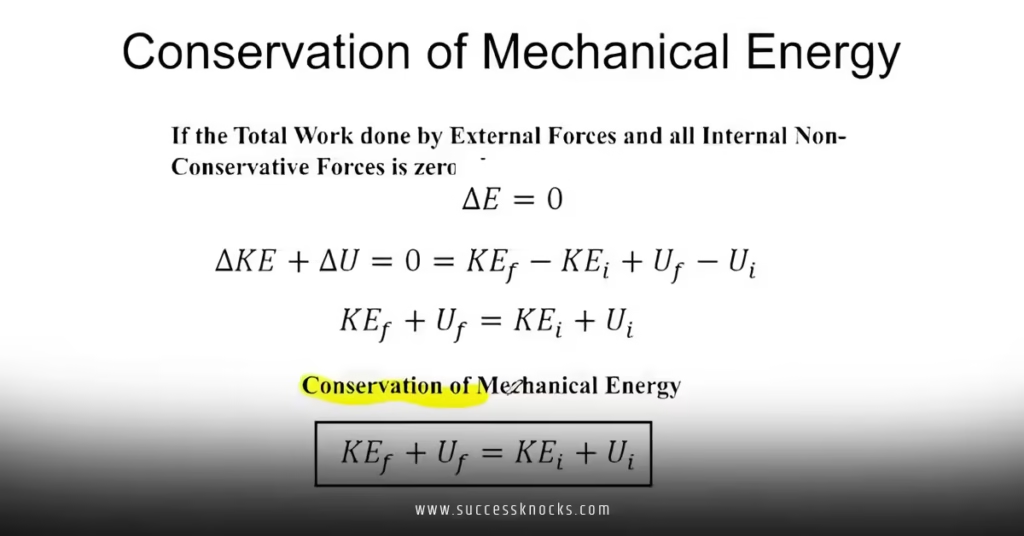
Conservation of mechanical energy states that the total mechanical energy of a system remains constant when only conservative forces act upon it. This fundamental principle reveals that energy transforms between kinetic and potential forms without being lost, creating a powerful tool for analyzing motion from pendulums to planetary orbits.
Here’s why this conservation law matters:
- It simplifies complex motion problems by eliminating time from calculations
- It applies to systems ranging from roller coasters to satellite trajectories
- It reveals the fundamental relationship between position and velocity
- It provides insight into maximum speeds and turning points in motion
- It connects seamlessly with the work kinetic energy theorem for comprehensive analysis
Understanding Conservation of Mechanical Energy
Conservation of mechanical energy isn’t just another physics principle—it’s nature’s accounting system. Energy never vanishes; it simply changes form. When a ball falls, gravitational potential energy converts to kinetic energy. When it bounces back up, kinetic energy transforms back to potential energy.
This transformation follows strict rules. The total amount stays constant, but the distribution between kinetic and potential energy shifts continuously.
The Mathematical Foundation
The conservation principle expresses itself through:
$$E_{mechanical} = KE + PE = constant$$
More specifically:
$$\frac{1}{2}mv_1^2 + PE_1 = \frac{1}{2}mv_2^2 + PE_2$$
For gravitational potential energy:
$$\frac{1}{2}mv_1^2 + mgh_1 = \frac{1}{2}mv_2^2 + mgh_2$$
When Conservation Applies
Mechanical energy conservation requires conservative forces only. These forces have a special property: the work they do depends only on starting and ending positions, not on the path taken.
Gravity is conservative. Whether you walk up a mountain via a gentle trail or climb straight up a cliff face, gravity does the same work against you. The path doesn’t matter—only the height change.
Conservative vs. Non-Conservative Forces
Conservative Forces: Energy’s Best Friends
Conservative forces preserve mechanical energy. They include:
- Gravitational force
- Elastic spring force
- Electrostatic force
- Magnetic force (in certain configurations)
These forces store energy temporarily as potential energy, then release it back as kinetic energy.
Non-Conservative Forces: Energy Transformers
Non-conservative forces convert mechanical energy into other forms:
- Friction transforms mechanical energy to thermal energy
- Air resistance converts motion energy to heat and sound
- Viscous drag in fluids dissipates energy as heat
- Inelastic collisions convert kinetic energy to deformation and heat
When these forces are present, mechanical energy isn’t conserved, but total energy still is—it just changes form.
Conservation of Mechanical Energy in Action
Pendulum Motion
A simple pendulum perfectly demonstrates energy conservation. At the highest points, velocity equals zero—all energy is gravitational potential energy. At the bottom, potential energy reaches its minimum while kinetic energy peaks.
The beauty? You can calculate the maximum speed without knowing anything about the forces involved. Just apply energy conservation between the highest and lowest points.
Roller Coaster Physics
Roller coaster designers are energy conservation masters. They know that a coaster starting from rest at height h can never go higher than h (ignoring friction). Each hill must be slightly lower than the previous one to account for energy lost to friction and air resistance.
The thrilling drops convert potential energy to kinetic energy, while climbs do the reverse. The careful balance creates the perfect mix of speed and height changes.
Satellite Orbits
Satellites showcase energy conservation on a cosmic scale. As a satellite moves closer to Earth, it gains kinetic energy while losing gravitational potential energy. Moving farther away, it slows down as kinetic energy converts to potential energy.
This principle determines orbital speeds: closer satellites must move faster, while distant ones can move more slowly.
Step-by-Step Problem-Solving with Energy Conservation
Step 1: Identify the System
Define your system boundaries clearly. Are you analyzing a single object, multiple connected objects, or a complex system? Establish what’s inside your energy “container.”
Step 2: Check for Conservative Forces
Verify that only conservative forces do work on your system. If non-conservative forces are present, you’ll need to account for energy losses.
Step 3: Choose Reference Points
Select convenient positions for your analysis. Often, this means choosing points where either kinetic energy or potential energy equals zero, simplifying calculations.
Step 4: Write Energy Equations
Set up the conservation equation: $$E_1 = E_2$$
Include all relevant forms of potential energy (gravitational, elastic, etc.).
Step 5: Solve for Unknowns
Algebra becomes your friend. Isolate the variable you’re seeking and calculate the result.
Types of Mechanical Energy
| Energy Type | Formula | When Maximum | Example |
|---|---|---|---|
| Kinetic | ½mv² | At lowest point or highest speed | Ball at bottom of swing |
| Gravitational PE | mgh | At highest point | Ball at top of trajectory |
| Elastic PE | ½kx² | At maximum compression/extension | Spring fully compressed |
| Total Mechanical | KE + PE | Constant (if conservative) | Any point in motion |
Real-World Applications
Hydroelectric Power
Hydroelectric dams harness gravitational potential energy. Water stored behind the dam has potential energy that converts to kinetic energy as it flows downward. Turbines capture this kinetic energy and transform it into electrical energy.
Archery and Ballistics
An archer’s bow stores elastic potential energy when drawn. Releasing the string converts this to kinetic energy in the arrow. Ignoring air resistance, the arrow’s mechanical energy remains constant throughout its flight.
Automotive Design
Car manufacturers apply energy conservation in crash testing. A vehicle’s kinetic energy at impact must be absorbed by crumple zones, airbags, and other safety systems. The faster the car, the more energy must be managed.
Advanced Applications of Conservation of Mechanical Energy
Variable Mass Systems
Rockets present interesting conservation challenges. As fuel burns and mass changes, the conservation equations become more complex. The principle still applies, but you must account for the changing system mass.
Multi-Body Systems
When analyzing connected objects (like two masses on a pulley), total mechanical energy conservation still holds. The challenge lies in tracking kinetic and potential energy for each component while ensuring the constraint conditions are met.
Energy in Collisions
Elastic collisions conserve both momentum and kinetic energy. Inelastic collisions conserve momentum but not mechanical energy—some kinetic energy converts to heat, sound, and deformation.
Common Mistakes and How to Avoid Them
Mistake 1: Ignoring Reference Points
The Problem: Using inconsistent or poorly chosen reference points for potential energy.
The Fix: Establish clear reference points at the problem’s start. Ground level for gravitational PE and natural length for spring PE work well.
Mistake 2: Forgetting About Multiple Energy Forms
The Problem: Considering only one type of potential energy when multiple types exist.
The Fix: Systematically check for all energy forms: kinetic, gravitational potential, elastic potential, and others relevant to your system.
Mistake 3: Applying Conservation When It Doesn’t Apply
The Problem: Using mechanical energy conservation when non-conservative forces do significant work.
The Fix: Always verify that only conservative forces act on your system. When friction or air resistance matter, use the work kinetic energy theorem instead.
Mistake 4: Sign Errors in Energy Calculations
The Problem: Getting positive and negative potential energies mixed up.
The Fix: Stick to your chosen coordinate system consistently. Above your reference point means positive gravitational PE.
Mistake 5: Unit Inconsistencies
The Problem: Mixing different unit systems without proper conversion.
The Fix: Convert all quantities to consistent units before beginning calculations. Check that your final answer has the right units.
Connecting Energy Conservation to Other Physics Principles
The Work Kinetic Energy Theorem Bridge
Conservation of mechanical energy and the work kinetic energy theorem work hand-in-hand. When only conservative forces act, the work kinetic energy theorem shows that net work equals zero, confirming that kinetic energy changes exactly balance potential energy changes.
For systems with non-conservative forces, the work kinetic energy theorem accounts for the “missing” mechanical energy by calculating work done by non-conservative forces.
Momentum Conservation
While mechanical energy conservation deals with scalar quantities, momentum conservation handles vector quantities. Both principles can apply simultaneously to the same system, providing complementary analysis tools.
Newton’s Laws
Energy methods often simplify problems that would be complex using force-based approaches. Instead of tracking forces and accelerations through complex paths, energy conservation lets you jump directly from initial to final states.
Energy Conservation in Emerging Technologies
Regenerative Braking
Electric vehicles use energy conservation principles in regenerative braking systems. Instead of converting kinetic energy to waste heat through friction, these systems convert motion back to electrical energy, storing it in batteries.
Energy Storage Systems
Grid-scale energy storage often relies on mechanical energy conservation. Pumped hydroelectric storage lifts water to high reservoirs during low demand, then releases it through turbines when power is needed.
Space Technology
Spacecraft designers use gravity assists—close encounters with planets that use conservation of mechanical energy to change spacecraft trajectories and speeds without using fuel.
Environmental and Engineering Implications
Wind Energy
Wind turbines extract kinetic energy from moving air masses. The conservation principle determines maximum theoretical efficiency limits and helps engineers optimize blade designs.
Seismic Engineering
Earthquake-resistant building design considers how seismic energy transfers through structures. Buildings must either absorb this energy safely or allow it to pass through without causing damage.
Sports Equipment Design
From golf clubs to tennis rackets, sports equipment design leverages energy conservation. Engineers optimize energy transfer from athlete to equipment to projectile.
Key Takeaways
- Mechanical energy conservation applies when only conservative forces do work on a system
- Total mechanical energy equals kinetic energy plus all forms of potential energy
- Energy transforms between kinetic and potential forms while remaining constant overall
- This principle simplifies complex motion analysis by eliminating time-dependent calculations
- Real-world applications span from playground swings to spacecraft trajectories
- Non-conservative forces like friction convert mechanical energy to other forms
- The work kinetic energy theorem handles cases where mechanical energy isn’t conserved
- Problem-solving becomes systematic: identify forces, choose reference points, apply conservation
The Power of Energy Thinking
Conservation of mechanical energy represents a shift in perspective. Instead of tracking forces and accelerations moment by moment, you can analyze entire motions by comparing energy states.
This approach reveals insights that force-based analysis might miss. It shows why certain motions are possible while others aren’t, predicts maximum speeds and heights, and connects seemingly different phenomena through common energy principles.
The elegance lies in its universality. Whether analyzing a child on a swing or a comet approaching the sun, the same energy conservation principles apply. Energy may change form, but it never disappears—a profound truth that shapes our understanding of motion throughout the universe.
Frequently Asked Questions
Q: Can conservation of mechanical energy be applied to systems with friction?
A: Not directly. Friction converts mechanical energy to thermal energy, violating mechanical energy conservation. However, you can still use energy methods by accounting for the energy dissipated through friction work.
Q: How does conservation of mechanical energy relate to the work kinetic energy theorem?
A: They’re complementary tools. When only conservative forces act, the work kinetic energy theorem confirms that net work equals zero, validating mechanical energy conservation. When non-conservative forces are present, the work kinetic energy theorem accounts for mechanical energy changes.
Q: What’s the difference between conservative and non-conservative forces in energy conservation?
A: Conservative forces (like gravity) can store and release energy as potential energy, preserving total mechanical energy. Non-conservative forces (like friction) convert mechanical energy to other forms like heat, reducing total mechanical energy.
Q: Can mechanical energy conservation be used for rotational motion?
A: Yes, but you must include rotational kinetic energy (½Iω²) along with translational kinetic energy and potential energy. The conservation principle applies to total mechanical energy including all forms.
Q: Why is mechanical energy conservation useful for solving physics problems?
A: It eliminates the need to track forces and accelerations through complex motions. Instead, you can directly relate initial and final energy states, often making difficult problems much simpler to solve.


