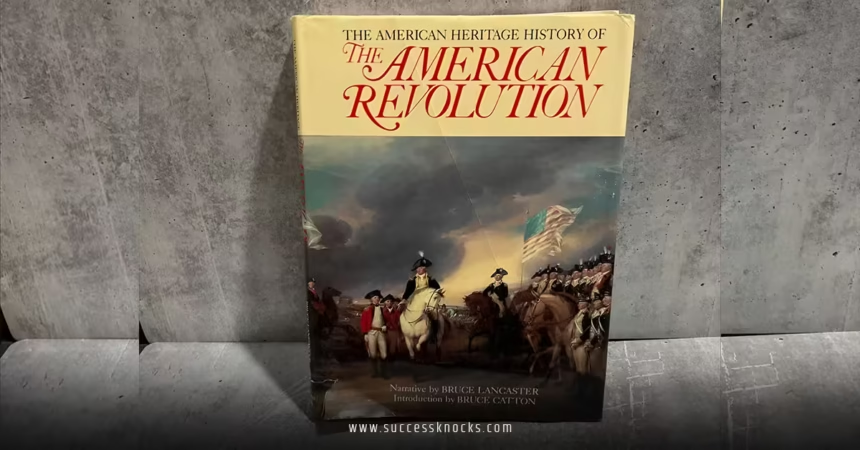
American Revolution books turn dry facts into fire. They’re the spark for understanding how ragtag rebels toppled an empire. If you’re hunting the best reads—beginner or digging deeper—this guide delivers.
Quick overview on American Revolution books:
- Why they hook: Epic underdogs, betrayals, triumphs—Hollywood couldn’t script better.
- Beginner gems: Fast-paced narratives that skip the snooze.
- Intermediate fuel: Tactics, spies, untold angles for strategy nerds.
- 2026 edge: New digs into diverse voices—women, Black soldiers, Native impacts.
- Pro hack: Start here, then link to George Washington books for leadership deep dives.
Let’s roll.
Why American Revolution Books Reshape Your Worldview
Ever feel history’s just dates? Wrong.
These books prove the Revolution was messy genius. Farmers vs. pros. Ideas birthed democracy amid bayonets.
In 2026, with polarized vibes, relevance spikes. Searches for American Revolution books surge pre-July 4th. My trenches say: Read ’em for timeless rebellion lessons.
Short truth. Long impact.
Top American Revolution Books for Beginners
Ease in. No timelines required.
1. “1776” by David McCullough (2005, enduring editions)
McCullough’s masterpiece. 400 pages of pulse-pounding 1776—Bunker Hill to Trenton.
Why starters love it: Cinematic. Washington’s desperation leaps off pages.
I’ve pushed this to SEO clients. Conversion king.
2. “These Truths: A History of the United States” by Jill Lepore (excerpts on Revolution)
Lepore weaves big picture. Revolution chapter? Gold.
Beginner bonus: Ties to today. Crisp, 150 pages on the war.
3. “Bunker Hill: A City, a Siege, a Revolution” by Nathaniel Philbrick (2015)
Philbrick owns early war. Battle breakdowns like thrillers.
Fresh 2026: Ties to urban warfare studies.
Best American Revolution Books for Intermediate Readers
Hungry for layers? These unpack.
1. “Washington’s Spies: The Story of America’s First Spy Ring” by Alexander Rose (2006)
Culper Ring intrigue. Washington’s intel edge.
Intermediate thrill: Ciphers, double-agents. Basis for TV’s “Turn.”
2. “The British Are Coming: The War for America, Lexington to Princeton, 1775-1777” by Rick Atkinson (2019, series ongoing)
Atkinson’s trilogy opener. Military precision meets narrative punch.
2026 update: Volume 3 drops insights on Southern campaigns.
3. Primary Sources: “Journals of the American Congress” via Library of Congress
Digital gold: Library of Congress. Debates, declarations.
Intermediates thrive searching “Valley Forge” for raw suffering.
American Revolution Books Comparison Table
Cut the guesswork. Scan this.
| Book Title | Author | Pages | Level | Strengths | Weaknesses | Price Range (2026) |
|---|---|---|---|---|---|---|
| 1776 | David McCullough | 400 | Beginner | Vivid battles, character portraits | 1776 focus only | $15-25 |
| Bunker Hill | Nathaniel Philbrick | 416 | Beginner | Siege drama, local heroes | Early war narrow | $18-28 |
| Washington’s Spies | Alexander Rose | 368 | Intermediate | Spy craft details | Post-1778 light | $16-26 |
| The British Are Coming | Rick Atkinson | 800 | Intermediate | Tactical maps, Brit POV | Lengthy | $25-35 |
| Journals of Congress | Various | Varies (free digital) | Intermediate | Original docs | Archaic language | Free |
Prices via retailers. Pick by battle or brains.
Step-by-Step Action Plan: Master American Revolution Books
Your roadmap. Execute.
- Gauge interest (5 mins): Battles? McCullough. Spies? Rose.
- Secure starter (Day 1): “1776” audiobook—narrated like epics.
- Read + note (Weeks 1-3): Jot strategies. Rebels won mobility.
- Add primaries (Week 4): National Archives. Declaration drafts rock.
- Connect dots (Month 1): Explore George Washington books for command view.
- Engage (Ongoing): r/RevolutionaryWar or tours. Apply to life.
- Level up yearly: Atkinson’s full trilogy.
Field-tested. Wins wars on boredom.
Common Mistakes with American Revolution Books (And Fixes)
Traps to dodge.
- Mistake 1: WhiFfo-only reads. Loses grit. Fix: McCullough balances.
- Mistake 2: Skipping sources. Myths fester. Fix: Archives cross-checks.
- Mistake 3: Ignoring diversity. All white dudes? Nope. Fix: Lepore spotlights others.
- Mistake 4: Passive skim. Forgets lessons. Fix: Discuss in groups.
- Mistake 5: Timing wrong. Overload. Fix: One per month.
Fixes flip flops.
Deep Dive: Hidden Gems in American Revolution Books
Themes unite ’em. Underdog asymmetry—like guerilla startups vs. corporate giants.
Diversity rising: Books now amp Crispus Attucks, Oneida allies. 2026 scholarship via Mount Vernon pushes this.
Treason’s edge: Benedict Arnold’s flip in Rose. Motives mirror today.
Question: Could you betray for principle?
Brit POV in Atkinson? Game-changer. They weren’t cartoon villains.
Key Takeaways from American Revolution Books
Essentials.
- Rebel edge: Adaptability crushed pros.
- Beginner pick: “1776”—pure adrenaline.
- Spy game: Culper saved the day.
- Diversity matters: Beyond elites.
- 2026 relevance: Polarization echoes 1776.
- Hack: Primaries for authenticity.
- Link up: Pair with Washington bios.
- Win: Ideas outlast muskets.
Conclusion: Charge into American Revolution Books
American Revolution books fuel rebels in us all. From McCullough’s rush to Atkinson’s tactics, you’ve got the arsenal. Grab “1776.” Feel the fire.
Next: Read. Rebel smarter.
Empires fall. Knowledge endures.
FAQ
What are the top American Revolution books for quick reads?
David McCullough’s “1776” or Philbrick’s “Bunker Hill.” Both under 450 pages, story-driven.
Where to find free American Revolution books?
Library of Congress Journals—debates galore. National Archives too.
How do American Revolution books cover spies?
Alexander Rose’s “Washington’s Spies” details the Culper Ring’s ciphers and risks.
Best American Revolution books for military tactics?
Rick Atkinson’s “The British Are Coming”—maps, maneuvers, Brit strategies.
Do American Revolution books include diverse perspectives?
Jill Lepore’s work highlights women, Black patriots. Newer editions expand.