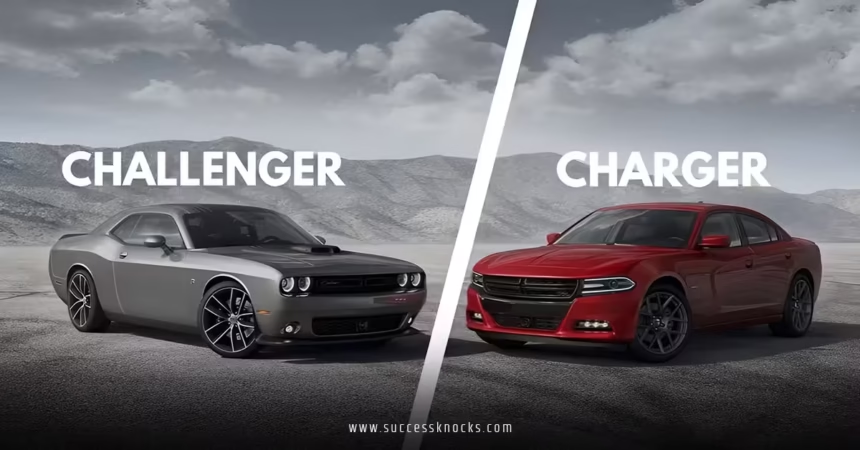
Dodge Charger vs Challenger—this matchup has sparked debates in garages and online forums for years, and for good reason. Both are legendary American muscle cars with cult followings, but they’re fundamentally different beasts. One’s a four-door sedan built for practicality and power. The other is a pure two-door coupe that prioritizes raw performance and classic muscle car aesthetics. If you’re trying to figure out which one belongs in your driveway, the answer depends on what you actually need—and what you’re willing to sacrifice.
Quick Breakdown: Dodge Charger vs Challenger at a Glance
| Aspect | Dodge Charger | Dodge Challenger |
|---|---|---|
| Body Style | 4-door sedan | 2-door coupe |
| Seating | 5 passengers | 2 front + 2 back |
| Practicality | Daily driver friendly | Performance-focused |
| Engine Options (2026) | V8 variants available | Multiple powerplant choices |
| Handling | More nimble, responsive | Heavier, muscle-focused |
| Cargo Space | Sedan trunk (12+ cu. ft.) | Coupe trunk (16+ cu. ft.) |
| Price Range | $32k–$50k+ | $28k–$55k+ |
| Best For | Families needing speed | Collectors & enthusiasts |
What’s the Real Difference? Understanding the Core Split
Here’s the thing: comparing a Charger to a Challenger is like comparing a performance sedan to a sports coupe. Technically similar DNA, wildly different execution.
The Charger is a four-door muscle sedan. It’s got back doors that actually open for passengers, a trunk you can use for groceries, and a footprint designed for highway cruising with a crew. Think “fast family car” rather than “weekend warrior.”
The Challenger, meanwhile, is pure muscle car ideology in two-door form. It’s larger overall, heavier, and unapologetically focused on straight-line power and that iconic front-fender-to-windshield proportion that screams 1970s aggression. Back seats exist, technically, but they’re tight—and you’re not taking them seriously for long trips.
Engine & Performance: Where They Actually Diverge
Dodge Charger lineup (2026):
- Entry-level V6 models (though these are becoming less common)
- V8 options delivering 370–495 HP depending on configuration
- Slightly better weight distribution thanks to sedan architecture
- Tighter turning radius and more responsive steering
Dodge Challenger lineup (2026):
- High-displacement V8s dominating the range
- Performance variants pushing 500+ HP
- Heavier curb weight (4,500–4,800 lbs) means more momentum but less agility
- Longer wheelbase adds stability at speed but reduces maneuverability
The acceleration figures are close enough that real-world performance depends on trim level. A top-tier Charger and a comparable Challenger will trade blows on the quarter-mile. But on twisty roads? The Charger’s lighter frame and tighter chassis give it the edge.
Practicality & Daily Life: This Is Where It Gets Real
Charger strengths:
- Four doors mean easier access for passengers and kids
- Better for grocery runs, hardware store trips, and road trips with crew
- Easier to fit in tight parking spots (relatively speaking)
- Sedan trunk is more user-friendly for everyday cargo
- Back seats are legitimately usable for second and third passengers
Challenger strengths:
- Larger trunk space (great for weekend getaways)
- Back seats are there if you absolutely need them, but expectations should be modest
- More imposing presence—turns heads in ways a sedan can’t quite match
- Shorter overall length in some metrics makes it feel more “carlike”
Real talk: if you’ve got kids, a partner who needs consistent seating, or you’re carpooling regularly, the Charger is the adult’s choice. The Challenger is for people who don’t need to justify their car purchases to anyone. Neither is “practical” by sedan standards, but the Charger gets closer.
The 2026 Price Reality Check
Dodge Charger (2026 estimates):
- Base V8: ~$32,000–$38,000
- Mid-range performance trims: $40,000–$48,000
- Top-tier packages: $50,000+
Dodge Challenger (2026 estimates):
- Base V8: ~$28,000–$35,000
- Performance trims: $42,000–$55,000+
- Rare/limited editions: beyond that
Counterintuitive, right? The Challenger can start cheaper, but when you’re shopping for comparable power and features, they’re often in the same ballpark. Factor in insurance (usually cheaper on the Charger due to sedan classification) and the math tightens further.
Handling & Driving Experience: The Chassis Matters
This is where personal preference gets spicy.
The Charger feels like what it is: a capable sports sedan. Tight steering response, decent grip through corners, and a sense that the car is working with you. The four-door architecture means a lower center of gravity and more predictable weight distribution. On a winding road, it’s the one that’ll make you smile through turns.
The Challenger is heavier. Significantly. That mass translates to planted cruising at highway speeds and straight-line stability, but it also means body roll in hard turns and a need for more input to change direction. It’s not imprecise—it’s just different. More “point it and go” than “carve it up.”
Here’s an analogy: the Charger is a scalpel; the Challenger is a sledgehammer. Both effective, completely different purposes.
Aesthetics: Design Philosophy Clash
The Charger looks like what a modern muscle sedan should: aggressive proportions, sculpted sides, but unmistakably a four-door family car. It turns heads in parking lots, but your accountant won’t be shocked if you show up to a business meeting in one.
The Challenger? It’s retro-future theater. The proportions, the hood, the stance—they’re channeling 1970 Dodge Challenger DNA. There’s no subtlety. That’s either its greatest strength or its biggest weakness, depending on your taste. Some find it iconic; others see it as playing dress-up with a modern chassis.
If you care what your car says about you when it’s parked, this matters. The Charger says “I like speed but also have responsibilities.” The Challenger says “I like speed, full stop.”
Dodge Charger vs Challenger: Head-to-Head Decision Framework
Choose the Charger if you:
- Need to fit actual passengers regularly
- Want a daily driver that doesn’t sacrifice performance
- Prefer sharper handling and easier maneuverability
- Like the idea of a sedan but refuse to be boring
- Plan to drive in all seasons (more stable weight distribution)
Choose the Challenger if you:
- Rarely carry backseat passengers
- Want maximum visual impact and head-turning presence
- Prioritize straight-line acceleration and raw power feel
- Love classic muscle car aesthetics and proportions
- Plan to keep the car as a weekend/collector vehicle
Fuel Economy & Maintenance: The Hidden Costs
Neither is a hybrid. Neither is fuel-efficient. Accept this upfront.
Charger (V8): Expect 15–18 MPG combined under normal driving, possibly dipping lower with aggressive acceleration.
Challenger (V8): Similar range, sometimes slightly worse due to added weight.
Maintenance costs are comparable. Both share Dodge/Chrysler parts and dealership networks. Neither is cheap to maintain once you’re outside warranty, but repair parts are available and affordable compared to exotics. Oil changes, tire rotations, brake service—standard stuff. A good independent mechanic can handle most work without specialization.

Insurance, Registration & Ownership Reality
Insurance rates vary by region and driver profile, but here’s the typical split:
- Charger: Classified as a sedan, so sometimes eligible for modest insurance discounts. Multi-passenger vehicle, which some insurers view as less risky.
- Challenger: Classified as a sports car, which can bump premiums. Single-minded performance focus = higher risk in actuarial tables.
Real-world difference? Maybe $50–$150 per year, depending on your location and carrier. Not massive, but it adds up.
Registration and taxes follow similar patterns. The Charger might be slightly cheaper, but don’t bank on it.
Dodge Charger vs Challenger: Common Mistakes to Avoid
Mistake 1: Assuming the Challenger is automatically faster Reality: Trim level matters way more than body style. A high-end Charger will outrun entry-level Challengers. Compare specific models, not brand positioning.
Mistake 2: Underestimating backseat cramping in the Challenger Reality: That back seat isn’t designed for long trips. Test drive with actual passengers if you’ll use them regularly.
Mistake 3: Thinking fuel economy doesn’t matter Reality: It doesn’t exist on either car. Budget for frequent fill-ups if you drive daily.
Mistake 4: Ignoring test drive differences Reality: The sedan vs. coupe split feels different in real driving. Don’t buy based on specs alone—sit in both, feel the steering, experience the seating position.
Mistake 5: Overlooking warranty details Reality: Used markets vary wildly. If buying used, verify warranty coverage and service history carefully. A neglected Charger or Challenger becomes expensive fast.
Action Plan: How to Choose (Step-by-Step)
Step 1: Define your actual needs Will passengers sit in back regularly? Do you need trunk space for non-car stuff? Write down genuine use cases, not fantasy ones.
Step 2: Set a firm budget Total cost of ownership = purchase price + insurance + fuel + maintenance. Know your ceiling before walking into a dealership.
Step 3: Test drive both with similar power levels Not a 5-minute loop. Real roads, real conditions. Bring someone whose opinion matters. Feel the difference yourself—specs lie; steering feel doesn’t.
Step 4: Check insurance quotes Call your agent. Get actual numbers for both models. Surprises happen.
Step 5: Inspect used examples carefully If going pre-owned: service records matter. Any evidence of track use, accidents, or neglect? Walk away.
Step 6: Make the call Gut check time. Which one do you want to own? That matters more than which one wins a spreadsheet battle. You’re committing to years with this car.
Key Takeaways: Dodge Charger vs Challenger
- The Charger is a four-door sedan; the Challenger is a two-door coupe—fundamentally different purposes, not just styling.
- Chargers handle better due to lighter weight and sedan architecture; Challengers prioritize straight-line power and presence.
- For families or regular passengers, the Charger wins on practicality; the Challenger is better for solo driving and collectors.
- Price overlap is significant—don’t assume one is cheaper without comparing specific trims.
- Insurance may favor the Charger slightly, but real differences are modest.
- Test drive both before deciding; spec sheets don’t capture the driving experience.
- Fuel economy is poor on both—expect 15–18 MPG and budget accordingly.
- Maintenance costs are comparable; both are mainstream Dodge models with accessible parts and service.
Conclusion: Which One Is For You?
The Dodge Charger vs Challenger choice isn’t about which one is objectively better—they’re built for different people. The Charger serves drivers who want muscle car thrills without abandoning practicality. The Challenger is for people who’ve decided that a two-door coupe is practical enough, and aesthetics matter as much as function.
If you’re still sitting on the fence, focus on your actual lifestyle. How do you really spend time in a car? Who rides with you? What roads do you drive? Answer those honestly, and the choice becomes clear.
Go drive both. The right one will feel obvious once you’re behind the wheel.
External References:
- U.S. Environmental Protection Agency (EPA) — Fuel Economy Data — Verify current MPG ratings and emissions standards for muscle cars.
- National Highway Traffic Safety Administration (NHTSA) — Vehicle Safety Ratings — Check crash test and safety performance data for both models.
- Edmunds — Car Reviews & Pricing — Access real market pricing, user reviews, and detailed specifications for current-year models.
FAQ: Dodge Charger vs Challenger
Q: Can I fit a family of five in a Dodge Challenger?
A: Technically yes, but the two backseat passengers will be uncomfortable on anything longer than a 2-hour drive. The Charger is much more family-friendly for regular use.
Q: Which one is faster in a straight line?
A: Depends on the trim. Top-tier Challengers have an edge in raw horsepower, but a high-end Charger will keep pace. Real-world acceleration differences are measured in tenths of a second.
Q: Is the Charger considered a “real” muscle car?
A: Yes. American muscle has evolved from pure two-door coupes to include performance sedans. The Charger honors that lineage while adapting to modern needs.
Q: What’s the resale value like for dodge charger vs challenger?
A: Both hold value reasonably well among enthusiasts, but depends on condition and mileage. Challengers often appeal more to collectors, which can help resale. Chargers appeal to practical buyers seeking performance.
Q: Can I do simple maintenance myself on either car?
A: Yes. Oil changes, air filters, and brake pads are straightforward on both. Engine diagnostics on modern models require a scanner, but basic work is DIY-friendly.