

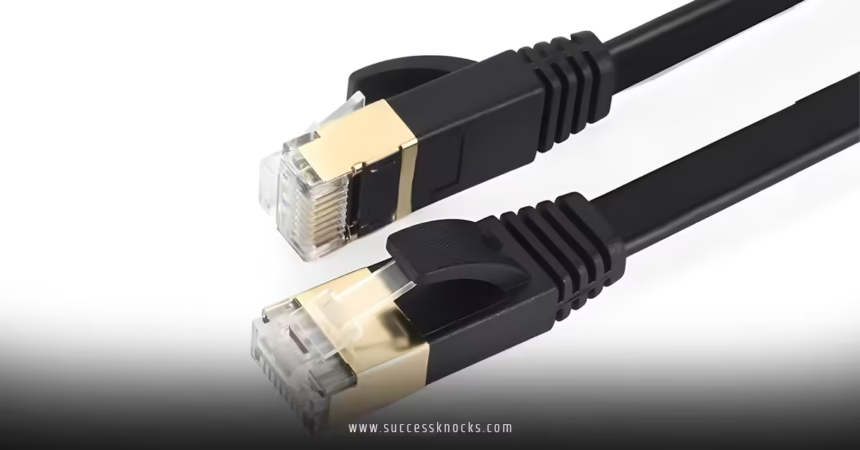
Best Ethernet Cable for 10Gbps in 2026 depends on your run length, environment, and how far you want to future-proof without wasting money.
In 2026, 10Gbps networks are no longer just for data centers or pros. More homes and small offices run multi-gig internet, NAS boxes, 8K streaming, or local backups that chew through bandwidth. But not every cable delivers reliable 10GBASE-T.
Quick reality check:
- Cat6 works for 10Gbps on short runs (up to ~55 meters) and costs the least.
- Cat6a is the sweet spot for most people — full 100-meter support at 10Gbps with better interference resistance.
- Higher categories like Cat7 or Cat8 add marginal gains at higher prices and complexity.
If you’re coming from slower setups, check our guide on [cat5e vs cat6] to see why stepping up makes sense once you hit multi-gig territory.
Here’s the no-fluff breakdown to help you pick the right cable without overpaying.
Why 10Gbps Needs the Right Cable
10Gbps (10GBASE-T) pushes a lot more data than 1Gbps. It demands higher frequency handling and tighter control over crosstalk — that electronic noise between wire pairs that corrupts signals.
Standard Ethernet rules cap most copper runs at 100 meters. But performance drops if the cable can’t keep up.
Cat5e? Forget it for reliable 10G — it tops out around 1Gbps comfortably.
Cat6 handles 10Gbps, but only up to about 55 meters under good conditions. Push farther and speeds fall or become unstable.
Cat6a (Augmented Cat6) doubles the bandwidth to 500 MHz and supports full 10Gbps across the entire 100-meter channel. That’s why installers call it the practical choice for permanent wiring.
Higher options like Cat7 add heavier shielding and 600 MHz bandwidth, but they often require special connectors and aren’t fully recognized in the same TIA standards that dominate US installations.
The kicker? Your whole chain matters — cable, switches, NICs, and terminations. One weak link and you won’t see true 10Gbps.
Cat6 vs Cat6a for 10Gbps: Head-to-Head
Let’s cut through the specs.
Cat6
- Bandwidth: 250 MHz
- 10Gbps distance: Up to 55 meters (sometimes less in noisy setups)
- 1Gbps distance: Full 100 meters
- Cost: Lower
- Flexibility: Easier to pull and terminate
- Best for: Short patch cables, small apartments, or runs under 40-50 meters
Cat6a
- Bandwidth: 500 MHz
- 10Gbps distance: Full 100 meters
- Better alien crosstalk rejection (noise from nearby cables)
- Slightly thicker and stiffer
- Cost: 20-50% more than Cat6
- Best for: In-wall runs, new builds, offices, or any setup where you might exceed 55 meters
In real-world 2026 tests and deployments, Cat6 often succeeds at 10Gbps for short home runs — say, from a switch in the closet to your desk. But for backbone cabling or longer distances, Cat6a gives you margin for heat, bundling, and future upgrades.
Cat7 and Cat8? They support even higher speeds (up to 40Gbps on Cat8 for very short runs), but for pure 10Gbps, they’re usually overkill unless you deal with extreme EMI or need the absolute highest headroom.
Comparison Table: Ethernet Cables for 10Gbps
| Cable Category | Max Bandwidth | 10Gbps Max Distance | 1Gbps Distance | Shielding Options | Typical Cost (100ft) | Best Use Case |
|---|---|---|---|---|---|---|
| Cat6 | 250 MHz | ~55 meters | 100 meters | UTP or STP | Lower | Short runs, budget setups |
| Cat6a | 500 MHz | 100 meters | 100 meters | UTP or STP | Medium | Most 10G home/office installs |
| Cat7 | 600 MHz | 100 meters | 100 meters | Usually shielded | Higher | High-interference environments |
| Cat8 | 2000 MHz | 30 meters | 100 meters | Shielded | Highest | Data centers, ultra-short runs |
This table shows why Cat6a wins for most balanced 10Gbps needs in 2026.
Real-World Recommendations: Brands and Types
For patch cables (short connections between devices and switches), Cable Matters 10Gbps Snagless Cat6 or their Cat6a versions get consistent praise. They’re reliable, UL-listed in many cases, and use pure copper.
For bulk in-wall or structured cabling, look at trueCABLE or Monoprice solid copper Cat6a. Avoid CCA (copper-clad aluminum) cables — they run hotter, perform worse, and fail sooner.
Shielded (STP/FTP) versions help in environments with power lines, motors, or lots of bundled cables. Most homes do fine with unshielded UTP if runs stay clean.
What I’d do: For a new home build or major remodel, pull Cat6a everywhere. It’s cheap insurance. For quick upgrades in an existing house with short runs, quality Cat6 patch cables often suffice.
Factors That Affect 10Gbps Performance
Distance is obvious, but other things bite you:
- Installation quality — Poor terminations, kinks, or tight bends kill speed.
- Temperature — Cables in hot attics derate faster.
- Bundling — Too many cables together increase crosstalk.
- PoE — Higher power delivery works better on thicker Cat6a conductors.
- Your equipment — You need 10G switches, 10G network cards, and compatible routers.
Test after install. Tools like iPerf or even simple file transfers between two 10G devices show real results.
Common Mistakes When Buying for 10Gbps
- Assuming any “Cat6” cable delivers full 10Gbps over long runs — it doesn’t reliably.
- Buying cheap no-name cables without pure copper conductors.
- Mixing categories in one link — the weakest cable sets the limit.
- Ignoring future needs — Wi-Fi 7 access points and multi-gig internet make Cat6a look smart quickly.
- Forgetting to test — many think they have 10G until they actually measure.
Fix: Buy from reputable sellers, check the cable jacket printing for exact category and “CMR” or “CM” rating for in-wall use, and use a basic cable tester.
Step-by-Step Action Plan to Get 10Gbps Running
- Assess your needs — Measure cable run distances. List devices that will use 10G (NAS, PCs, switches).
- Choose the category — Short runs (<50m)? Cat6 is fine. Longer or permanent? Go Cat6a.
- Pick pure copper, not CCA — Look for “bare copper” or “solid copper” on the spec.
- Buy quality — Cable Matters, Monoprice, or trueCABLE for good balance of price and performance.
- Plan the install — Use proper tools for termination. Leave slack at both ends.
- Upgrade endpoints — Get 10G PCIe cards or built-in 10G ports on your devices.
- Test end-to-end — Run speed tests and monitor for errors.
Follow this and you’ll avoid the common frustration of “I bought 10G gear but it’s crawling.”
Key Takeaways
- For reliable 10Gbps, Cat6a is the best Ethernet cable for most 2026 setups because it delivers full speed over 100 meters.
- Cat6 works well for short distances and saves money if your runs stay under 55 meters.
- Higher categories like Cat7 or Cat8 are rarely needed for standard 10Gbps use.
- Always use pure copper cables and test your installation.
- Pair the right cable with 10G-compatible switches and NICs for real performance.
- In-wall or long runs? Choose Cat6a during any renovation — it’s worth the small extra cost.
- Check your current [cat5e vs cat6] setup first before jumping to 10G.
Conclusion
The best Ethernet cable for 10Gbps in 2026 is usually Cat6a for balanced performance and future-proofing, or solid Cat6 if your runs are short and your budget is tight.
Don’t chase the highest category just for marketing numbers. Match the cable to your actual distances and environment, install it properly, and test it.
Next step? Measure your longest run today, then pick Cat6 or Cat6a accordingly. Your network will thank you with rock-solid speeds.
FAQs
1. Which Ethernet cable is best for 10Gbps?
Cat6a is the best balance of performance, cost, and compatibility.
2. Can Cat6 handle 10Gbps?
Yes, but only for short distances (under ~55m).
3. Is Cat7 worth it in 2026?
Only if you need extra shielding; otherwise Cat6a is enough.
4. Do I need shielded cables (STP)?
Not usually—only in high-interference environments.
5. What matters more: cable or router?
Both—your entire network (router, switch, NIC) must support 10Gbps.


