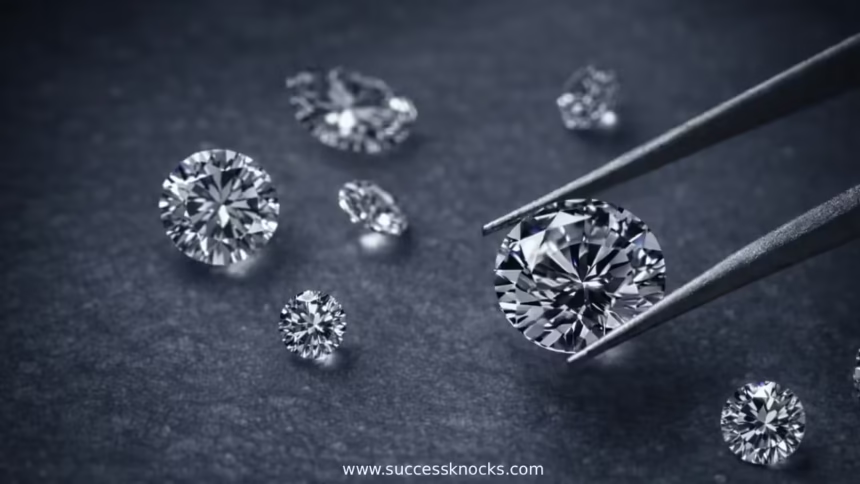
Diamond vs moissanite isn’t just about price—it’s about understanding what each stone brings to the table and finding the perfect match for your priorities, budget, and lifestyle.
Here’s what you need to know upfront:
- Diamonds are natural carbon crystals formed deep in the Earth over billions of years
- Moissanite is silicon carbide, originally discovered in meteorites but now lab-created
- Price difference: Moissanite costs 85-90% less than diamonds of similar size
- Visual appeal: Both stones are brilliant, but moissanite has more “rainbow fire”
- Durability: Diamonds rate 10 on Mohs scale; moissanite rates 9.25
What Makes Each Stone Unique?
Diamonds: The Traditional Choice
Diamonds form under extreme pressure about 100 miles beneath Earth’s surface. The process takes 1-3 billion years. No kidding.
This natural formation creates the hardest substance known to humans. But here’s the thing—that hardness comes with a price tag that makes your wallet weep.
The diamond industry has spent over a century building the “diamonds are forever” narrative. Marketing works. According to the Gemological Institute of America, diamonds remain the most popular choice for engagement rings in the United States.
Moissanite: The Smart Alternative
Moissanite was first discovered in 1893 by French scientist Henri Moissan in an Arizona meteor crater. He initially thought he’d found diamonds. Plot twist: he hadn’t.
Today’s moissanite is lab-created using silicon and carbon. The process takes weeks, not eons. This controlled environment actually produces stones with fewer inclusions than most natural diamonds.
The kicker? Moissanite has a higher refractive index than diamond, meaning more sparkle and fire.
Diamond vs Moissanite: Side-by-Side Comparison
| Feature | Diamond | Moissanite |
|---|---|---|
| Hardness | 10 (Mohs scale) | 9.25 (Mohs scale) |
| Brilliance | High | Very High |
| Fire | Moderate | High |
| Cost (1 carat) | $3,000-$15,000+ | $300-$600 |
| Origin | Natural (mined) | Lab-created |
| Environmental Impact | High | Low |
| Resale Value | Moderate | Limited |
| Durability | Excellent | Excellent |
The Real Talk About Sparkle and Fire
You’ve probably heard that “diamonds sparkle more.” That’s partially true, but incomplete.
Brilliance refers to white light reflection. Diamonds excel here because of their precise faceting and refractive properties.
Fire means colored light dispersion—those rainbow flashes you see when light hits the stone. Moissanite actually wins this category. Its refractive index of 2.65-2.69 beats diamond’s 2.42.
Think of it this way: diamonds give you elegant white sparkle, while moissanite throws a disco party.
Price Reality Check
Let’s be honest about money. A 1-carat, high-quality diamond easily runs $5,000-$10,000. The same size moissanite? Around $400-$600.
That’s not a typo.
This price gap exists because:
- Diamonds require extensive mining operations
- Marketing budgets for diamonds are massive
- Supply is controlled by major mining companies
- Consumer perception still favors “natural” over “lab-created”
But here’s what most people don’t realize: telling the difference requires gemological equipment. Your friends won’t know unless you tell them.
Durability: Will Your Stone Last Forever?
Both stones handle daily wear beautifully. The hardness difference between 9.25 and 10 is negligible for practical purposes.
Moissanite resists:
- Scratching from normal activities
- Chipping from accidental impacts
- Heat damage during jewelry repairs
- Chemical exposure from cleaning products
Diamonds have the edge in absolute hardness, but moissanite won’t disappoint you. I’ve seen moissanite rings from the early 2000s that still look brand new.
The Ethics Question
Diamond mining has environmental and social baggage. Even “conflict-free” diamonds require massive earth displacement. According to the Environmental Protection Agency, mining one carat of diamond moves approximately 1,750 tons of earth.
Moissanite production happens in controlled lab environments with minimal environmental impact. No communities are displaced. No ecosystems are destroyed.
For socially conscious buyers, this isn’t even close.
Common Myths Debunked
Myth: “Moissanite looks fake” Reality: Modern moissanite is virtually indistinguishable from diamond to the naked eye.
Myth: “Diamonds hold their value better” Reality: Most diamonds lose 50% of retail value immediately after purchase.
Myth: “Moissanite gets cloudy over time” Reality: This was true for early moissanite (pre-2015). Modern stones maintain clarity indefinitely.
Myth: “Only diamonds are suitable for engagement rings” Reality: Moissanite’s hardness makes it perfectly suitable for daily wear.
Step-by-Step Selection Process
1. Define Your Priorities
- Budget constraints
- Size preferences
- Ethical considerations
- Resale importance
2. Compare Stones in Person
Visit jewelers who carry both options. See them side by side under different lighting conditions.
3. Consider the Setting
Both stones work with identical settings. Your choice won’t limit design options.
4. Think Long-Term
Will you care about origin in 10 years? Will your budget concerns change?
5. Make the Decision
Choose based on your values, not external pressure.
Common Mistakes and How to Avoid Them
Mistake: Buying based solely on price Fix: Consider long-term satisfaction and personal values
Mistake: Assuming bigger is always better Fix: Focus on overall beauty and proportion to your hand
Mistake: Ignoring certification Fix: Ensure your moissanite comes with authenticity certification
Mistake: Comparing poor-quality moissanite to high-end diamonds Fix: Compare similar quality grades for fair assessment
Mistake: Making decisions under pressure Fix: Take time to research and visit multiple retailers
Key Takeaways
- Value proposition: Moissanite delivers 95% of diamond’s visual appeal at 10% of the cost
- Durability: Both stones handle daily wear without issues
- Ethics: Lab-created moissanite has minimal environmental impact
- Appearance: Differences are subtle and require trained eyes to detect
- Investment: Neither should be considered financial investments
- Personal choice: Your values matter more than others’ opinions
- Quality varies: Buy from reputable sources regardless of stone choice
- Setting flexibility: Both stones work with identical jewelry designs
The Bottom Line
Diamond vs moissanite ultimately comes down to what you value most. If tradition, natural origin, and maximum resale value matter most, diamonds win. If you want exceptional beauty, ethical production, and smart financial choices, moissanite takes the crown.
The “right” choice is the one that aligns with your priorities and makes you happy when you look at your hand.
Your stone should reflect your values, not someone else’s expectations.
Frequently Asked Questions
Q: Can jewelers tell the difference between diamond vs moissanite?
A: Trained gemologists can distinguish them using specialized equipment, but visual identification alone is extremely difficult even for professionals.
Q: Will moissanite pass a diamond tester?
A: Basic diamond testers often register moissanite as diamond because they test thermal conductivity. Advanced testers that check electrical conductivity will correctly identify moissanite.
Q: How long does moissanite last compared to diamonds?
A: Both stones are permanent. Moissanite’s 9.25 hardness rating means it will maintain its beauty and structural integrity for generations with proper care.
Q: Is moissanite considered a “fake diamond”?
A: No. Moissanite is its own distinct gemstone with unique properties. It’s not attempting to be a diamond—it’s offering an alternative with different characteristics.
Q: What’s the best way to clean diamond vs moissanite jewelry?
A: Both stones clean identically: warm soapy water and a soft brush work perfectly. Ultrasonic cleaners are safe for both, assuming the setting is secure.