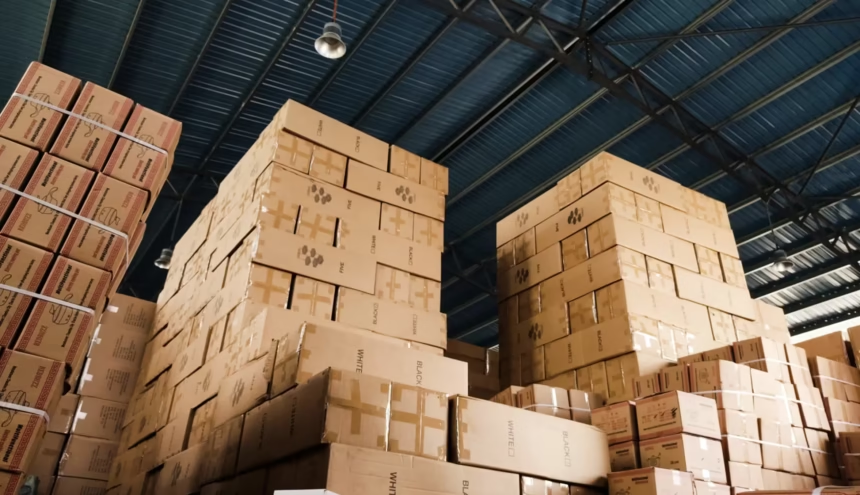
In warehouse and manufacturing environments, regardless of how successful it appears on the surface, there are going to have several friction points and bottlenecks that lie beneath activities that impact daily operations. These can be small inefficiencies, outdated habits, or repeated errors that drain your money, time and energy. They don’t always appear obvious; instead, they show up as missed deadlines, duplicated work, or teams constantly putting out fires.
Taking time to look at your internal processes isn’t about tearing everything down or starting all over again. It is about taking a real and honest look at your internal processes, how work actually gets done day-to-day, identifying what might be slowing things down, where the bottlenecks are and where you can make intentional changes that can reduce resistance and create momentum.
To help you on your journey to growing your business and understanding where time is being lost on the floor, in the office and in between, here are some top tips to help you make practical adjustments to keep things moving.
See what is going on behind the tasks
Operational issues often occur because of something going on in the background. This can be something small, like a gap between the reality of the work versus the documented protocols. On paper, things look logical and clear. However, many businesses find that in practice, they don’t work or they are outdated. This leads to employees adapting, building workarounds or improvising so that the work can be done and things can keep moving.
That’s why assumptions aren’t helpful when you want to improve your business operations; instead, you need to look at tasks and observe the way they work. Don’t rely on charts or data, it is vital that you spend time understanding how tasks flow from one to another. Where are people waiting for resources, approval, or clarification? Where are the most delays happening day-to-day?
You might find that there are multiple smaller inefficiencies that have compounded over time that can be changed, rather than one big obvious one. Quick fixes to shift priorities, work when there are unexpected shortages or last minute orders become inefficient.
Layout and movement matter more than you think
In a warehouse or manufacturing space, physical movement is a major factor in efficiency. Poor layout design can cause big health and safety risks, leave things hard to find and add hours of unnecessary travel time each day.
If workers are constantly trying to locate items, walking long distances, navigating cluttered aisles or waiting to use equipment that someone else is using, overall productivity is going to suffer. Not just on the floor, but the same applies to production lines. For example, if materials aren’t positioned logically in relation to each stage of assembly.
It doesn’t have to be a huge overhaul. Even just small layout changes, like changing access routes, reorganizing high-demand items and repositioning operations, can make a difference.
Equipment becomes a bottleneck
Machinery and handling equipment are at the heart of most warehouse and manufacturing operations. But if the equipment is difficult to access, limited, poorly managed or inconsistent, it can impact the rest of the workflow.
For example, if you find that during busy periods, your staff are delayed because they are regularly waiting for lifting equipment, tasks can fall behind. Not only can this lead to tasks being stacked up, but the quality of work can drop when it is later rushed to meet deadlines, and staff can become frustrated and unhappy. However, if you invest in equipment that sits idle for too long, that isn’t going to be cost-effective either.
This is where a more flexible approach to resourcing equipment can make a positive impact on your internal processes. Many warehouses are turning to options like fork lift hire as part of a broader strategy around outsourcing and equipment management. Instead of committing to permanent equipment, they can scale their equipment based on business needs and demand. This can help with adapting capacity during peak periods and reducing it when things quiet down.
This kind of flexibility can help your business to run efficiently and maintain flow when your operational needs are aligned.
Stock management and information flow
Inventory is another common source of inefficiency. Misplaced items, inaccurate stock levels, and delays in updating systems can disrupt both production and order fulfilment.
The issue is often less about the system itself and more about how consistently it’s used. Errors are going to be inevitable if your processes rely too heavily on manual checks, or if stock movements are recorded properly or in real time.
You don’t always need to heavily invest in new technology to improve this area of your business. You can review your existing processes, see what can be tightened and ensure that everyone follows the same steps. See where manual and repetitive work can be reduced, and where information can be made accessible to staff who need it.
Decisions can be more accurate and made faster when stock data is reliable.
Unclear roles and responsibilities
In business operational environments, disruption can occur quickly when responsibilities are unclear. Things can quickly fall through the cracks if it is not clear who is responsible for particular tasks, whether it is approving orders, unloading deliveries or maintaining equipment. Tasks can be duplicated, or worse, they can be overlooked entirely.
Make sure that clear roles are defined across your business so that operations can run smoothly. Coordination across teams can improve significantly when everyone knows what they are accountable for. This will show even more so during peak times or shift changes.
By improving layout, managing equipment more flexibly, clarifying roles and removing unnecessary steps, businesses can create operations that flow smoothly from end to end. This provides you with a more scalable way of working that is controlled and predictable, rather than just a faster output. This is what will move the needle in your business and make a significant impact.