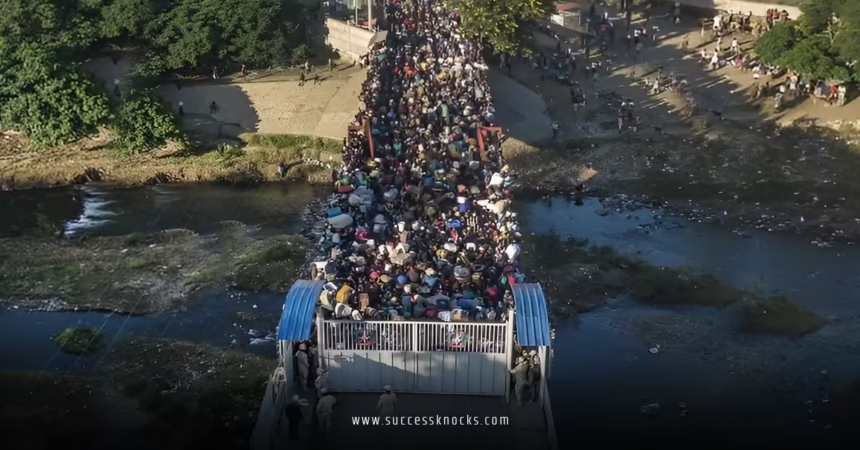
Dominican Republic Haiti border policy has become the frontline of the Caribbean’s most pressing humanitarian crisis, as the nation grapples with unprecedented migration flows while balancing security concerns, economic pressures, and international scrutiny. This 240-mile frontier now represents one of the world’s most militarized borders between developing nations, fundamentally reshaping regional geopolitics.
The Dominican government’s approach reflects a stark reality: managing over 500,000 Haitian nationals within its borders while maintaining domestic stability and economic growth. Here’s what’s driving current policies and their far-reaching implications:
• Border infrastructure: $100 million investment in walls, sensors, and checkpoints since 2022 • Deportation acceleration: Over 250,000 returns to Haiti in 2025 alone, tripling previous rates • Economic integration tensions: Haitian workers fill 80% of construction jobs while facing increasing restrictions • International pressure: UN and human rights groups condemn mass deportations amid Haiti’s collapse • Regional ripple effects: DR policies directly influence Haiti migration crisis Caribbean patterns across the hemisphere
Let’s examine how these policies evolved and what they mean for regional stability.
Historical Context: From Open Borders to Fortress Mentality
The Transformation of Cross-Border Relations
For decades, the Dominican Republic Haiti border policy operated on practical necessity rather than strict enforcement. Haitian workers crossed daily for agricultural and construction jobs, while Dominicans traveled west for cheaper goods and services.
The 2010 earthquake changed everything. Suddenly, the DR faced not gradual economic migration but humanitarian crisis on an unprecedented scale. Over 200,000 Haitians fled to the DR in the earthquake’s immediate aftermath, straining resources and sparking the first serious discussions about border control.
Constitutional changes hardened positions. The DR’s 2013 Constitutional Court ruling retroactively stripped citizenship from people of Haitian descent born in the country since 1929, affecting an estimated 200,000 individuals. This decision sent shockwaves through the international community and fundamentally altered the migration dynamic.
Economic Interdependence Meets Political Reality
Here’s what most analyses miss: the DR economy depends heavily on Haitian labor, creating a policy contradiction that persists today. Construction, agriculture, and domestic work sectors would face immediate crisis without Haitian workers, yet public pressure demands stricter border enforcement.
The numbers tell the story:
- Haitian workers contribute an estimated $2.3 billion annually to DR GDP
- Remittances to Haiti from the DR exceed $1.8 billion yearly
- Cross-border trade reaches $1.2 billion despite restrictions
Yet polling consistently shows 70%+ of Dominicans support stricter immigration controls, creating an impossible political dynamic for any administration.
Current Border Policy Framework
Physical Infrastructure and Technology
The Dominican Republic Haiti border policy now relies on increasingly sophisticated barriers that would have been unthinkable a decade ago.
Border wall construction accelerates. The government has completed 164 miles of concrete and steel barriers, with plans for full border coverage by 2027. These aren’t simple fences—we’re talking about 12-foot concrete walls topped with razor wire and equipped with motion sensors.
Checkpoint modernization continues. The DR has invested heavily in biometric systems, document verification technology, and communication networks that allow real-time coordination between border posts.
| Infrastructure Element | Investment (USD) | Status | Effectiveness Rating |
|---|---|---|---|
| Physical barriers | $67 million | 68% complete | High for organized crossings |
| Sensor networks | $23 million | 45% complete | Medium due to terrain |
| Checkpoint upgrades | $18 million | 90% complete | High for documentation |
| Patrol vehicles/equipment | $12 million | Complete | Medium coverage gaps |
Legal and Administrative Changes
Regularization programs create mixed results. The National Plan for Regularization (PNRE) attempted to provide legal status for long-term residents, but bureaucratic complexity and documentation requirements meant only 288,000 of an estimated 500,000 eligible applicants successfully registered.
Work permit systems tighten. New regulations require employers to demonstrate that no Dominican workers are available before hiring Haitians, creating bureaucratic barriers that push employment underground rather than eliminating it.
Enforcement Escalation
Deportation operations intensify dramatically. What were once sporadic sweeps have become systematic daily operations targeting markets, construction sites, and residential areas with significant Haitian populations.
The human cost is staggering: families separated, children born in the DR deported to a Haiti they’ve never known, and workers losing years of savings when forced to flee quickly.
The Security Dimension: Beyond Immigration
Drug Trafficking and Border Control
Dominican Republic Haiti border policy increasingly focuses on narcotics interdiction as Colombian and Venezuelan cartels exploit Haiti’s governance vacuum. Border agents report that traditional migration crossing points have become drug smuggling corridors.
Cartel presence complicates everything. When armed groups control territory on both sides of the border, immigration enforcement becomes secondary to basic security concerns. DR forces now coordinate with U.S. DEA and Colombian authorities on operations that would have been purely domestic five years ago.
Gang Violence Spillover
Haiti’s gang crisis directly impacts DR security calculations. The G9 alliance’s territorial control extends to border areas, creating situations where DR forces face armed confrontations during routine patrols.
Cross-border kidnapping increases. DR citizens living near the border face heightened risks, with gangs conducting operations across the frontier before retreating to Haitian territory where Dominican forces cannot pursue.
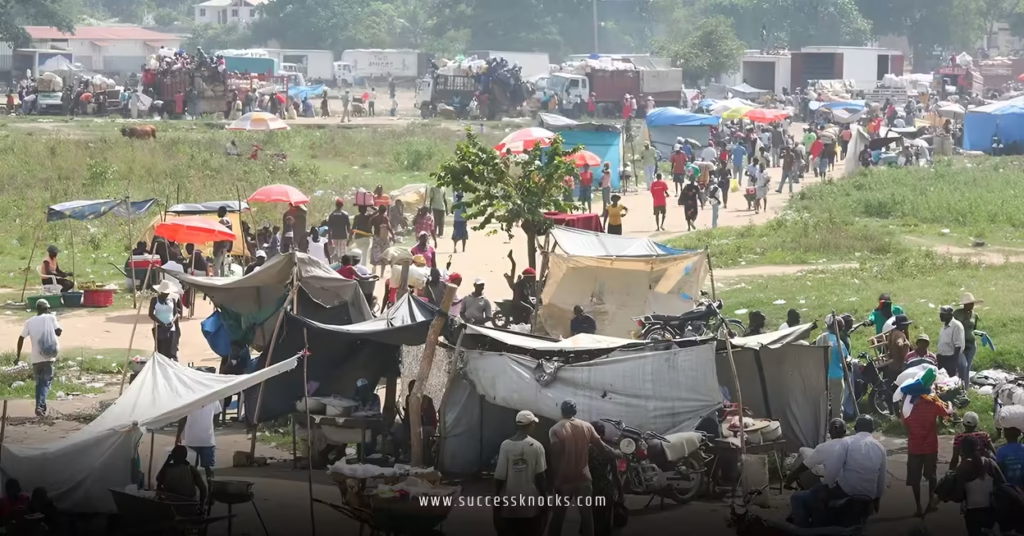
Economic Impact and Labor Market Dynamics
Construction Sector Dependence
The Dominican Republic’s construction boom—driven by tourism infrastructure and residential development—relies almost entirely on Haitian labor. Industry estimates suggest 200,000+ Haitians work in construction, often for wages 30-50% below what Dominican workers demand.
Deportation creates labor shortages. Construction companies report project delays and increased costs as enforcement operations remove experienced workers mid-project. Some firms now factor deportation risk into project timelines and budgets.
Agricultural Implications
Sugar plantations and produce farms face similar challenges. The DR’s agricultural exports, worth over $2.2 billion annually, depend on seasonal Haitian workers who accept wages and conditions that domestic workers reject.
Mechanization can’t replace everything. While some farms invest in machinery to reduce labor dependence, crops like coffee and cacao still require manual harvesting that Dominican workers increasingly avoid.
Underground Economy Growth
Stricter Dominican Republic Haiti border policy paradoxically increases illegal employment. Workers who previously crossed legally for seasonal work now stay longer irregularly, while employers avoid official hiring to escape documentation requirements.
This underground economy offers fewer protections for workers while reducing tax revenue and regulatory oversight for the government.
International Pressure and Human Rights Concerns
UN and NGO Criticism
International organizations consistently criticize Dominican Republic Haiti border policy as violating non-refoulement principles—the prohibition against returning people to face persecution or serious harm.
Mass deportations to collapsed state condemned. With gangs controlling 60% of Port-au-Prince, returning migrants to Haiti increasingly means delivering them to life-threatening situations. Human Rights Watch and Amnesty International document cases of deportees murdered or kidnapped shortly after return.
U.S. Policy Coordination Challenges
The Biden administration faces a delicate balance: supporting a democratic ally’s sovereignty while addressing humanitarian concerns that affect U.S. interests through the broader Haiti migration crisis Caribbean.
Congressional pressure builds. U.S. legislators from districts with significant Haitian-American populations increasingly criticize DR policies, creating diplomatic tensions between traditional partners.
Regional Implications and Spillover Effects
Caribbean Migration Patterns
Dominican Republic Haiti border policy directly influences migration flows throughout the Caribbean. When overland routes close, desperate Haitians turn to dangerous sea crossings toward the Bahamas, Turks and Caicos, and directly to Florida.
Coast Guard interdictions correlate with DR enforcement. U.S. Coast Guard data shows that increased DR deportations precede spikes in boat departures by 2-3 weeks, suggesting direct causation between border policies and maritime migration attempts.
CARICOM Relations
Caribbean Community (CARICOM) members view DR policies with growing concern, fearing that fortress-like approaches could spread regionwide and undermine traditional Caribbean cooperation principles.
Tourism industry impacts. Several Caribbean nations worry that harsh immigration enforcement damages the region’s humanitarian reputation, potentially affecting tourism from markets that value social responsibility.
Policy Alternatives and Reform Proposals
Circular Migration Programs
Seasonal worker visas could formalize existing patterns. Rather than preventing movement, structured programs would allow legal temporary migration while ensuring workers return to Haiti during off-seasons.
Benefits include:
- Reduced irregular crossings
- Worker protections through legal status
- Tax revenue from formal employment
- Maintained labor supply for key sectors
Enhanced Border Management
Smart border technology offers alternatives to walls. Biometric systems, mobile checkpoints, and data sharing with international partners could provide security while facilitating legitimate movement.
Joint border posts with international oversight could address both countries’ needs while ensuring human rights compliance.
Regional Cooperation Frameworks
CARICOM integration of DR border policies would create consistent regional approaches rather than pushing problems to neighboring countries.
Trilateral programs involving the U.S. could provide funding and technical assistance while addressing American concerns about irregular migration flows.
Common Policy Mistakes and Corrections
Overemphasis on Enforcement Alone
Mistake: Believing walls and deportations alone will solve migration pressure Reality: Economic and security factors driving migration require comprehensive approaches addressing root causes
Ignoring Economic Integration
Mistake: Treating Haitian workers as purely a burden Reality: Proper regulation and integration could maximize economic benefits while ensuring fair wages and conditions
Reactive Rather Than Strategic Planning
Mistake: Responding to migration crises after they develop Reality: Predictable seasonal and economic patterns allow for proactive policy design
Insufficient International Coordination
Mistake: Treating border management as a purely bilateral issue Reality: Regional and international cooperation is essential for sustainable solutions
Future Scenarios and Strategic Planning
Demographic Projections
Haiti’s population continues growing faster than economic opportunities, suggesting sustained migration pressure regardless of political improvements. The DR must plan for managing these flows over decades, not years.
Climate change accelerates displacement. Rising sea levels and increased storm intensity will drive additional migration from both rural and coastal Haitian communities.
Political Evolution Possibilities
Potential Haiti stabilization scenarios would reduce forced migration while maintaining economic migration patterns. DR policies must be flexible enough to adapt to changing conditions without abandoning border security.
Regional integration opportunities could emerge if Caribbean nations develop comprehensive migration frameworks that share responsibilities fairly.
Key Takeaways
• Dominican Republic Haiti border policy reflects the challenge of managing humanitarian crisis alongside legitimate security and economic concerns • Current enforcement-heavy approaches reduce irregular crossings while creating labor shortages and human rights violations • Economic interdependence makes complete border closure impossible despite political pressure for restrictions • International criticism focuses on deportations to Haiti amid state collapse and gang violence • Regional migration patterns shift based on DR policies, affecting the broader Haiti migration crisis Caribbean • Circular migration programs offer potential compromise between enforcement and economic needs • Climate change and demographic trends suggest sustained migration pressure requiring long-term policy frameworks • Coordination with international partners is essential for addressing root causes while managing immediate flows
Strategic Recommendations for Sustainable Policy
The current Dominican Republic Haiti border policy trajectory is unsustainable—neither achieving security goals nor addressing humanitarian obligations effectively. What’s needed is a fundamental reframing that acknowledges economic realities while ensuring orderly migration management.
Short-term adjustments should focus on reducing the worst humanitarian abuses while maintaining border security through smarter rather than harsher enforcement.
Long-term success requires regional cooperation that addresses both DR concerns and broader Caribbean stability. The alternative—continued crisis management and emergency responses—serves no one’s interests and costs everyone more.
The Dominican Republic didn’t create the Haiti crisis, but its border policies will significantly influence whether regional responses succeed or fail. Getting this balance right matters far beyond the island of Hispaniola.
Frequently Asked Questions
Q: How much does Dominican Republic Haiti border policy enforcement cost annually?
A: The DR government budgets approximately $180 million yearly for border security operations, including personnel, infrastructure maintenance, and deportation logistics—representing nearly 2% of the national budget.
Q: What percentage of Haitians in the DR are there legally versus irregularly?
A: Estimates suggest roughly 40% of Haitians in the DR have some form of legal documentation, though this includes expired permits and contested statuses. The Dominican Republic Haiti border policy aims to increase this percentage through regularization programs.
Q: How do DR border policies affect trade between the two countries?
A: Formal trade has declined 30% since enhanced enforcement began, but informal cross-border commerce continues at similar levels, suggesting policy is redirecting rather than eliminating economic exchange.
Q: What happens to Dominican citizens of Haitian descent under current policies?
A: The 2013 constitutional changes and subsequent laws have created a complex legal status for an estimated 200,000 people, with many facing documentation challenges despite Dominican birth.
Q: How does international aid factor into Dominican border policy decisions?
A: The DR receives limited international funding for migration management compared to the policy costs, creating domestic political pressure to prioritize national interests over international humanitarian expectations.