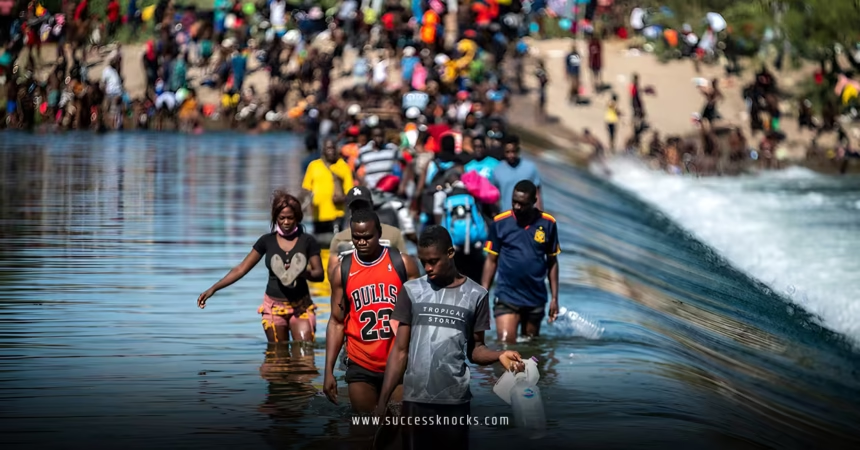
Haiti migration crisis Caribbean has escalated into one of the most pressing humanitarian challenges facing the Western Hemisphere in 2026. This complex emergency involves hundreds of thousands of Haitians fleeing unprecedented violence, economic collapse, and political instability, creating ripple effects across Caribbean nations and reaching U.S. borders with increasing frequency.
Here’s what you need to know about this crisis:
• Scale: Over 700,000 Haitians have been internally displaced, with tens of thousands attempting dangerous sea crossings monthly • Root causes: Gang violence controls 60% of Port-au-Prince, inflation exceeds 50%, and basic services have virtually collapsed • Regional impact: Caribbean nations struggle with limited resources to handle influxes while maintaining regional stability • U.S. implications: Coast Guard interdictions have tripled since 2023, straining immigration systems and sparking policy debates
Let’s break down what’s really happening and why it matters for everyone involved.
What’s Driving the Haiti Migration Crisis Caribbean?
The Perfect Storm of Collapse
Haiti isn’t just experiencing one problem—it’s drowning in them simultaneously. The assassination of President Jovenel Moïse in 2021 triggered a cascade of failures that continue accelerating today.
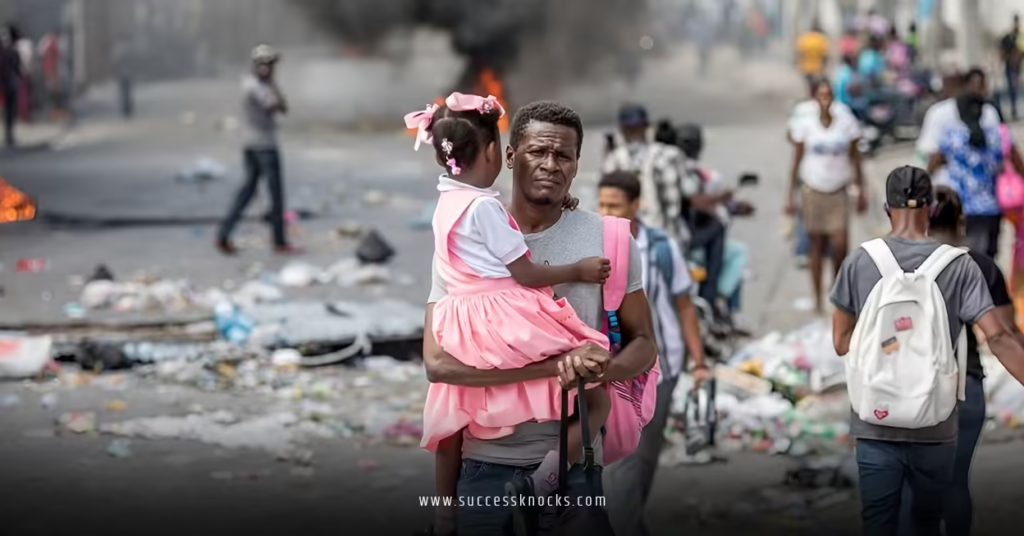
Gang violence reaches new extremes. The G9 alliance, led by former police officer Jimmy “Barbecue” Chérizier, now controls more territory than the legitimate government. We’re talking about armed groups that treat neighborhoods like feudal territories, collecting taxes and controlling movement.
Economic freefall continues. The Haitian gourde has lost over 70% of its value since 2021. Basic food costs consume 75% of average household income. When people can’t afford rice and beans—their staple foods—you know the situation is desperate.
Climate disasters compound everything. Hurricane Matthew in 2016 killed over 500 people and destroyed 90% of some regions. Each subsequent storm finds a country less capable of recovery.
Why Traditional Solutions Aren’t Working
Here’s the kicker: previous international interventions have actually made things worse in some cases. The UN peacekeeping mission (MINUSTAH) ended in 2017 after scandals including a cholera outbreak that killed over 10,000 people.
Current assistance efforts face a fundamental problem: how do you deliver aid when gangs control the ports and roads?
The Caribbean Response: Between Compassion and Capacity
Overwhelmed Island Nations
The Dominican Republic shares a 240-mile border with Haiti and has become the primary destination for land-based migration. But here’s what most people don’t understand: the DR itself is a developing nation with limited infrastructure.
Border dynamics have changed dramatically. What was once relatively open movement for trade and family visits has become heavily militarized. The DR has built border walls and increased deportations, creating tension with international human rights groups.
Other Caribbean nations face their own challenges:
| Country | Challenge | Response |
|---|---|---|
| Bahamas | Boat arrivals strain detention facilities | Increased maritime patrols |
| Jamaica | Transit point for U.S.-bound migrants | Enhanced coast guard cooperation |
| Turks and Caicos | Remote islands used as landing points | Joint operations with U.S. |
Regional Cooperation Efforts
The Caribbean Community (CARICOM) has attempted coordinated responses, but member states disagree on approaches. Some favor humanitarian protection; others prioritize border security.
The reality? These small island developing states simply lack the resources to handle mass migration while maintaining their own economic stability.
U.S. Policy Challenges and Responses
Coast Guard Operations Intensify
U.S. Coast Guard interdictions tell the story clearly. In fiscal year 2023, they stopped over 8,000 Haitians at sea—a number that’s continued climbing. These aren’t just statistics; each interdiction represents families desperate enough to risk death on overloaded boats.
The wet foot, dry foot problem. Unlike Cuban migrants who previously enjoyed special status, Haitians face immediate deportation if caught at sea. This policy creates a perverse incentive for more dangerous attempted landings on remote beaches.
Immigration Court Backlogs
Those who do reach U.S. soil face immigration courts already overwhelmed by cases. The average wait time for asylum hearings now exceeds four years, during which migrants live in legal limbo.
Temporary Protected Status (TPS) provides limited relief. The Biden administration extended TPS for Haitians already in the U.S., but this doesn’t address new arrivals or the root causes driving migration.
Common Mistakes in Understanding This Crisis
Oversimplifying the Causes
Mistake: Blaming migration solely on poverty Reality: Haiti has always been poor, but current migration levels are driven by unprecedented violence and state collapse
Ignoring Regional Perspectives
Mistake: Viewing this as primarily a U.S. immigration issue Reality: Caribbean nations bear the immediate burden and shape migration flows through their policies
Expecting Quick Fixes
Mistake: Believing aid alone will solve the crisis Reality: Gang control and institutional collapse make traditional development assistance nearly impossible
Underestimating Scale
Mistake: Treating this as a temporary spike Reality: Demographic and environmental factors suggest sustained high migration pressure for years
Action Plan: What Different Stakeholders Can Do
For Policymakers
- Expand legal migration pathways beyond asylum to reduce dangerous sea crossings
- Increase multilateral coordination between U.S., Caribbean, and international partners
- Address root causes through targeted anti-gang operations and institutional rebuilding
- Invest in Caribbean partner capacity for humane migration management
For Caribbean Nations
- Develop regional migration compacts that share responsibility fairly
- Strengthen coast guard capabilities through international partnerships
- Create temporary work programs that provide legal status while protecting domestic workers
- Improve refugee processing to distinguish between economic migrants and protection seekers
For International Community
- Fund humanitarian operations in Haiti and receiving countries
- Support anti-gang initiatives led by Haitian civil society
- Provide technical assistance for border management and refugee protection
- Address climate vulnerability through adaptation funding
Long-Term Implications and Trends
The Haiti migration crisis Caribbean isn’t going anywhere soon. Population growth, climate change, and entrenched governance failures create a perfect storm for sustained outflows.
Demographic pressure builds. Haiti’s population has doubled since 1980, with 60% under age 25. Even if conditions improved dramatically, employment creation couldn’t keep pace with new job seekers.
Climate change accelerates displacement. Rising sea levels threaten coastal communities while increased storm intensity damages recovery efforts. Haiti lost 7% of its GDP to natural disasters in an average year during the 2010s.
Regional migration patterns evolve. As traditional routes become militarized, migrants adapt by using new pathways, often through countries with weaker enforcement capacity.
Key Takeaways
• The Haiti migration crisis Caribbean represents state failure, not just poverty, requiring security responses alongside humanitarian aid • Caribbean nations need international support to manage flows humanely while protecting their own stability • Current U.S. policies create incentives for dangerous sea crossings while failing to address root causes • Gang violence control over 60% of Haiti’s capital makes traditional development assistance nearly impossible • Climate change will continue driving displacement even if political conditions improve • Regional cooperation offers the best hope for managing migration flows fairly • Legal migration pathways must expand to reduce reliance on dangerous irregular routes • Long-term solutions require addressing governance, security, and economic fundamentals simultaneously
The Path Forward
The Haiti migration crisis Caribbean demands a fundamental rethink of how we approach state failure in our interconnected world. Band-aid solutions won’t work when the patient is hemorrhaging from multiple wounds.
What’s needed is sustained commitment to regional cooperation, expanded legal migration options, and honest acknowledgment that addressing root causes will take years, not months. The alternative—continued crisis management and emergency responses—helps no one and costs everyone more in the long run.
The next chapter of this crisis is being written now. The question isn’t whether it will affect the broader Caribbean and U.S.—it’s how we choose to respond.
Frequently Asked Questions
Q: How many Haitians are currently seeking refuge in Caribbean countries?
A: Exact numbers fluctuate, but estimates suggest over 100,000 Haitians have sought refuge across Caribbean nations since 2021, with the Dominican Republic hosting the largest population. The Haiti migration crisis Caribbean affects every island nation in the region.
Q: Why don’t Haitians qualify for refugee status like people fleeing other conflicts?
A: Many do qualify under international law, but processing capacity in Caribbean nations is limited, and U.S. policy has historically treated Haitian migrants as economic rather than protection seekers, despite clear evidence of persecution and violence.
Q: What role do smuggling networks play in Caribbean migration routes?
A: Criminal networks have adapted to exploit the Haiti migration crisis Caribbean, charging $2,000-$5,000 per person for boat passages and often abandoning passengers in dangerous conditions.
Q: How has COVID-19 affected migration patterns and responses?
A: The pandemic initially reduced movements due to border closures, but pent-up pressure and deteriorating conditions in Haiti led to surge increases in 2022-2023, straining already limited health and detention facilities.
Q: What makes this crisis different from previous waves of Haitian migration?
A: The current Haiti migration crisis Caribbean involves unprecedented levels of violence, complete state collapse, and climate disasters occurring simultaneously, creating sustained rather than episodic displacement patterns.