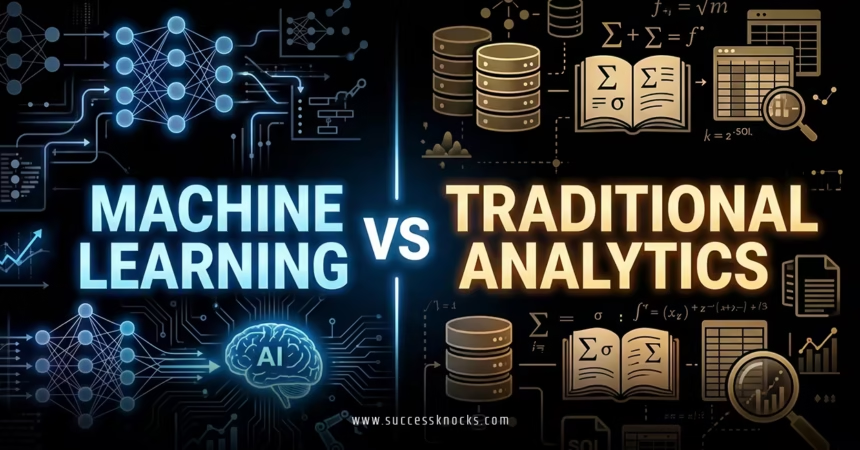
Machine Learning vs Traditional Analytics sparks heated debate in boardrooms and data teams alike. One delivers clear historical snapshots. The other predicts tomorrow and adapts on the fly.
Businesses stuck in the rearview mirror risk falling behind. Those blending both win.
- Core difference: Traditional analytics tells you what happened. Machine learning predicts what will happen and often suggests what to do.
- When each shines: Use traditional for simple reporting and explainable insights. Deploy ML for complex patterns, scale, and real-time decisions.
- 2026 reality: Hybrid wins. Strong data foundations power successful AI initiatives, with leaders investing up to 4x more in quality and governance.
- Practical takeaway: Start with traditional to understand your data, then layer ML where predictions drive ROI.
- The edge: ML handles unstructured data and learns continuously—something static reports simply can’t match.
The kicker? Neither is universally “better.” Smart teams know exactly when to use which.
How Machine Learning vs Traditional Analytics Stack Up
Think of traditional analytics as a detailed map of where you’ve been. Machine learning? It’s the GPS that reroutes in traffic, predicts arrival time, and even suggests the fastest pit stop.
Traditional methods rely on predefined rules, SQL queries, statistical tests, and human-crafted dashboards. They excel at descriptive and diagnostic work: sales by region last quarter, why churn spiked, variance analysis.
Machine learning algorithms learn patterns from data. They improve with more examples. This powers predictive and prescriptive analytics at scale.
Here’s the thing: ML doesn’t replace traditional analytics. It builds on it. Many organizations strengthen BI first before scaling ML.
| Aspect | Traditional Analytics | Machine Learning | Winner in 2026 Context |
|---|---|---|---|
| Primary Focus | What happened & why (descriptive/diagnostic) | What will happen & what to do (predictive/prescriptive) | ML for forward decisions |
| Data Types | Mostly structured | Structured + unstructured (text, images, etc.) | ML |
| Human Involvement | High (queries, interpretation) | Lower after training (but oversight critical) | Tie – humans always needed |
| Scalability | Limited by team and processing | Highly scalable with cloud/AutoML | ML |
| Interpretability | Excellent (clear rules) | Improving with XAI, but can be black-box | Traditional for regulated industries |
| Speed | Batch reports | Real-time or near real-time | ML |
| Best For | Reporting, compliance, simple trends | Forecasting, personalization, anomaly detection | Depends on the problem |
Key Strengths and Limitations
Traditional analytics delivers rock-solid reliability. You understand every step. Stakeholders trust the numbers because they’re transparent. It works beautifully with smaller datasets and requires less computing power.
Yet it struggles with complexity. Manual effort balloons as data grows. It rarely predicts future behavior accurately when variables interact in non-obvious ways.
Machine learning crushes complexity. It spots subtle patterns humans miss. Models retrain automatically and handle massive, messy datasets. European banks replacing statistical techniques with ML saw up to 10% sales increases and 20% churn drops.
The catch? ML demands quality data, ongoing monitoring, and explainability efforts—especially in 2026’s regulatory environment. Poor implementation wastes money fast.
Rhetorical question: Why build another static dashboard when your competitor uses models that adjust pricing dynamically and cut waste automatically?
When to Choose Machine Learning vs Traditional Analytics
Stick with traditional analytics when:
- You need clear explanations for executives or regulators
- Working with structured data and straightforward questions
- Budget or skills are limited
- Compliance and audit trails matter most
Go for machine learning when:
- Patterns are too complex for rules
- You have lots of data (especially unstructured)
- Predictions or automation deliver direct ROI
- Business conditions change rapidly
In my experience, most mid-sized companies over-invest in flashy ML before fixing basic reporting. Nail traditional foundations first. Then layer ML for high-impact use cases.
Step-by-Step: Building a Hybrid Approach
- Assess current state — Audit your BI setup. Fix data quality and governance gaps.
- Define business problems — Prioritize use cases by potential impact and feasibility.
- Start simple — Enhance existing reports with basic statistical models.
- Pilot ML — Pick one predictive project (demand forecasting, churn). Use AutoML to lower barriers.
- Integrate and monitor — Embed models into workflows. Track drift and business KPIs.
- Scale with MLOps — Automate retraining and governance.
What usually happens is teams skip step 1 and wonder why models fail in production.
Common Pitfalls and Fixes
- Treating ML as a silver bullet
Fix: Use it only where traditional falls short. Prove value with pilots. - Ignoring interpretability
Fix: Apply explainable AI techniques. Combine with traditional reporting for context. - Data quality neglect
Fix: Invest heavily in foundations—successful AI leaders do this 4x more. - Skill gaps
Fix: Train analysts on both. Leverage no-code/low-code platforms.
Linking It Back: Using Machine Learning for Business Analytics
Once you grasp Machine Learning vs Traditional Analytics, the next move becomes clear. Many teams transition by using machine learning for business analytics on specific high-ROI problems while keeping trusted BI dashboards for the basics. This hybrid model delivers the best of both worlds in 2026.
Check Gartner’s latest Data & Analytics predictions for enterprise benchmarks. Review McKinsey’s State of AI insights for adoption realities.
Key Takeaways
- Traditional analytics excels at understanding the past with clarity and trust.
- Machine learning drives predictions, automation, and competitive edge at scale.
- Hybrid approaches win—don’t choose sides, combine strengths.
- Data quality and governance remain non-negotiable foundations.
- Start with business problems, not technology hype.
- Monitor models continuously—static deployments die fast.
- Focus on ROI: measure impact on revenue, cost, and risk.
- Build team capabilities across both disciplines.
Mastering Machine Learning vs Traditional Analytics positions you to extract maximum value from data.
Ready to act? Map your top three business questions. Decide which tool fits each best. Run one small hybrid pilot this month. Results will guide your next moves.
FAQs
What’s the main difference between Machine Learning vs Traditional Analytics?
Traditional analytics focuses on historical reporting and human-driven insights using fixed rules. Machine learning learns patterns from data to predict future outcomes and automate decisions.
Can small businesses benefit from Machine Learning vs sticking to Traditional Analytics?
Yes. Start with traditional for core reporting, then add targeted ML via cloud services for forecasting or personalization. Many see quick wins without huge teams.
Which should I learn first—Machine Learning or Traditional Analytics?
Master traditional analytics and business domain knowledge first. It builds intuition and data literacy. Then layer machine learning skills for advanced applications.