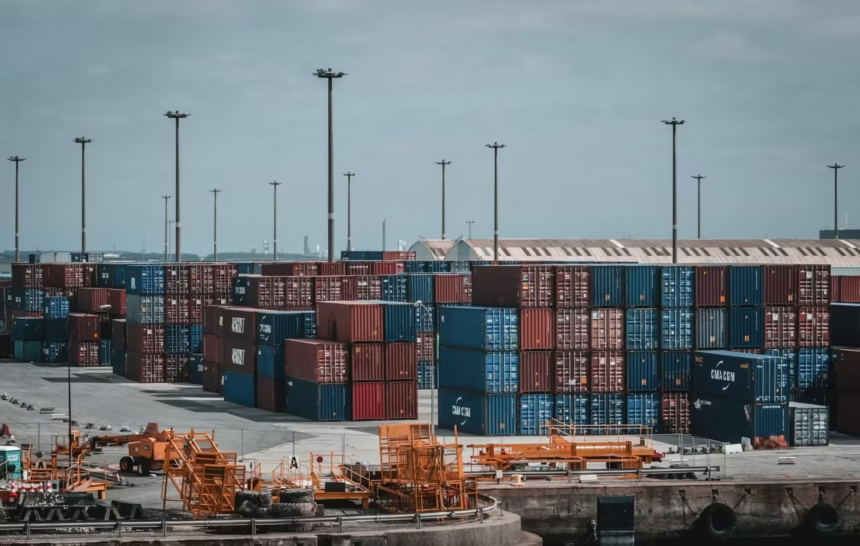
Every day a shipment sits in customs is a day your production line waits, your shelves stay empty, or your customers grow impatient. For businesses that depend on imported goods, whether raw materials, finished products, or specialist components, import delays aren’t just frustrating. They’re expensive.
And yet, the same businesses that invest heavily in supplier relationships, logistics contracts, and inventory management often leave customs clearance as an afterthought. That oversight is where a significant portion of avoidable delay originates.
Why Customs Delays Happen More Often Than They Should
Customs clearance is a regulated, document-intensive process, and errors or gaps at any stage create holdups that can cascade through the entire supply chain.
The most common causes of avoidable delay include:
- Incorrect or incomplete documentation — missing commercial invoices, incorrect tariff codes, or incomplete country-of-origin declarations
- Valuation discrepancies — declared values that don’t match supporting documents or that trigger audit flags
- Regulatory compliance gaps — goods subject to permits, licences, or specialist inspections that weren’t arranged in advance
- Classification errors — incorrect HS codes that attract different duty rates or inspection requirements than anticipated
- First-time importer issues — businesses importing a new product category or from a new country without understanding the specific requirements
Each of these is avoidable with the right expertise in place before the shipment arrives. Each one, left unaddressed, creates delays measured in days or weeks, with corresponding costs in storage, demurrage, and disrupted operations.
What Customs Brokerage Actually Does
A customs broker is a licensed professional who manages the clearance process on behalf of an importer or exporter. Their role is to ensure that goods move through customs as efficiently as possible, with documentation that’s accurate, classifications that are defensible, and compliance obligations that are met before the shipment arrives rather than scrambled for after it’s held.
In practice, this involves:
- Reviewing and preparing import documentation
- Classifying goods under the correct tariff codes
- Calculating applicable duties and taxes accurately
- Managing relationships with customs authorities
- Coordinating with freight forwarders, carriers, and inspection agencies
- Advising on trade agreements and duty optimisation opportunities
- Handling queries, audits, and disputes if they arise
For businesses importing regularly, a competent broker becomes a genuine operational partner, one whose expertise prevents the costly surprises that catch unprepared importers off guard.
The Cost of Getting Customs Wrong
It’s worth being specific about what’s at stake, because the costs extend well beyond the direct cost of a delay.
Demurrage and detention charges accumulate quickly when shipments are held at ports awaiting clearance. These fees are charged by carriers and terminal operators and can reach hundreds or thousands of dollars per day for large or containerised shipments.
Perishable goods losses are irreversible. For food, pharmaceutical, or time-sensitive products, a customs hold is not just a delay, it can render an entire shipment worthless.
Production disruption cascades through operations when imported components or materials don’t arrive on schedule. The cost of halted production lines, idle labour, and missed delivery commitments to customers typically dwarfs the direct cost of the customs issue itself.
Compliance penalties for repeated classification errors, valuation irregularities, or regulatory breaches can include fines, increased inspection rates, and in serious cases, loss of importing privileges.
Where Professional Brokerage Creates the Most Value
Not all imports carry the same complexity or risk. But there are specific situations where professional customs brokerage pays for itself most clearly:
- High-volume, regular importers — where clearance efficiency compounds across dozens or hundreds of shipments annually
- Complex product categories — goods subject to specialist permits, quotas, anti-dumping duties, or multi-agency inspection requirements
- First-time imports of new product lines — where classification and compliance requirements aren’t yet known
- Time-sensitive shipments — where delay has disproportionate operational or commercial consequences
- Cross-border e-commerce — where high volumes of lower-value shipments require systematic clearance processes
In these situations, the expertise and relationships a professional broker brings can mean faster clearance, fewer delays, lower duty exposure, and stronger compliance confidence.
This is where established specialists matter. Livingston customs brokerage solutions combine regulatory expertise, technology integration, and customs authority relationships to keep complex import operations running efficiently.
Technology’s Role in Modern Customs Clearance
Customs brokerage has evolved significantly with technology. The most capable brokers today operate through integrated platforms that connect directly with customs authority systems, enable real-time shipment tracking, and provide importers with visibility into clearance status at every stage.
For businesses managing import programmes at scale, this technology integration means:
- Automated pre-arrival filing that positions shipments for release as soon as they arrive
- Digital document management that reduces errors and speeds document review
- Real-time alerts when shipments are held or queries raised
- Data analytics that identify patterns in clearance performance and compliance risk
- Integration with ERP and inventory management systems for seamless supply chain visibility
The combination of expert human knowledge and capable technology is what separates high-performing brokerage operations from basic clearance services. It’s what importers should be evaluating when they choose who to trust with this critical part of their supply chain.
Building Customs Compliance Into Your Import Strategy
The businesses that experience the fewest customs problems aren’t necessarily the ones with the simplest product mix. They’re the ones that treat customs compliance as a strategic capability rather than a transactional service.
That means:
- Investing in accurate classification upfront rather than correcting errors under pressure
- Understanding the specific regulatory requirements for each product and market before importing
- Maintaining complete, accurate documentation as a standard operating practice
- Building relationships with customs authorities through consistent compliance rather than reactive engagement
- Reviewing and optimising duty positions regularly as trade agreements and tariff schedules evolve
A good customs broker is a partner in building this capability, not just an agent who files paperwork. The distinction matters significantly in the long run.
Conclusion
Import delays are rarely random. They’re almost always the product of documentation gaps, classification errors, compliance oversights, or inadequate preparation for the regulatory requirements of a specific shipment.
Professional customs brokerage addresses each of these root causes systematically. For businesses that depend on imported goods, and the operational and commercial outcomes that depend on those goods arriving on time, it’s an investment that pays for itself many times over.
The question isn’t whether you can afford professional brokerage support. It’s whether you can afford the alternative.