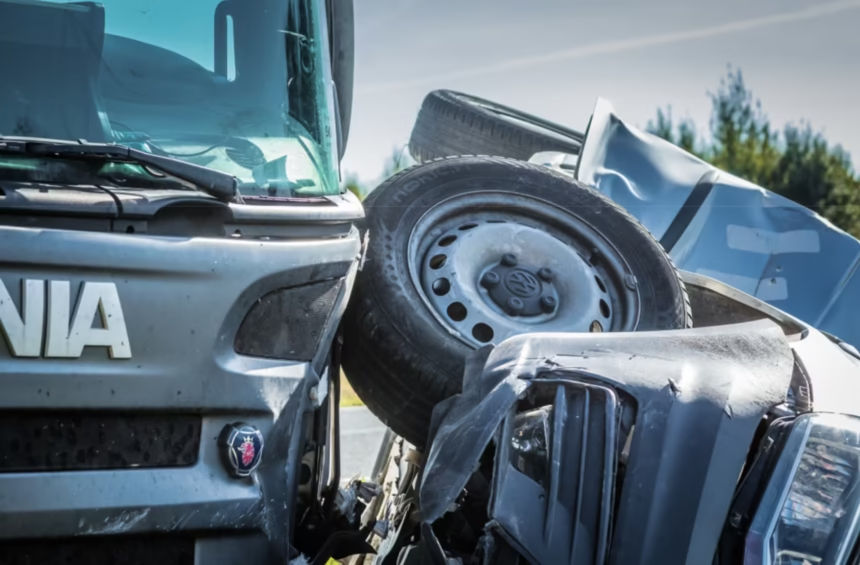
A truck accident leaves behind more than visible damage; it creates a puzzle of responsibility that is not always easy to read at first glance. Roads are clear, vehicles are removed, but the question of who is accountable often stays open longer than expected.
This is where legal help for truck accident victims becomes an important part of understanding how fault is evaluated and how claims are built step by step.
Behind every crash involving a commercial truck, there is a chain of decisions, actions, and conditions that must be carefully reviewed. This blog explains how liability is determined and what shapes the outcome of such cases.
Why Liability Matters in Truck Accident Cases
Liability is the foundation of every truck accident claim because it decides who is responsible for the harm caused. Unlike smaller vehicle accidents, truck crashes often involve more than one party, which makes the process more detailed and layered.
A driver may be involved, but responsibility can also extend to the trucking company, maintenance teams, or even cargo handlers, depending on the situation. The goal is not just to identify what happened but to understand why it happened and who had the responsibility to prevent it.
This step becomes essential because compensation and accountability both depend on how clearly liability is established.
Key Factors That Help Determine Fault
Before assigning responsibility, investigators look at several important details that help reconstruct the event. These factors are not considered in isolation but as part of a larger picture.
Driving Behavior
Speeding, distracted driving, fatigue, or ignoring road rules can all influence liability in a major way.
Vehicle Condition
Faulty brakes, tyre issues, or poor maintenance can shift responsibility toward the company or maintenance provider.
Road and Weather Conditions
Sometimes external factors like weather or road design play a role, which must also be reviewed carefully.
Compliance with Safety Rules
Commercial trucks must follow strict regulations, and failure to follow them can directly affect liability.
Each of these elements helps build clarity around how the accident occurred and why it was not preventable under normal conditions.
How Evidence Shapes Responsibility
Evidence is the backbone of every truck accident investigation. Without it, liability becomes difficult to prove with clarity. In many cases, multiple forms of evidence are reviewed together to form a complete picture.
Common types of evidence include:
- Driver logs and rest records.
- Truck maintenance history.
- Black box or electronic data.
- Surveillance or dash camera footage.
- Police reports and accident reconstruction details.
- Witness accounts from the scene.
Each piece helps connect actions to outcomes and supports or challenges claims made by involved parties. The strength of a case often depends on how well this information is preserved and analysed.
Role of Multiple Parties in Liability Decisions
Truck accident cases rarely involve only one responsible party. Instead, liability is often shared or divided based on actions leading up to the crash.
The driver may be responsible for errors on the road, but the trucking company might also share responsibility if it failed to train the driver properly or ignored safety rules. In other situations, third parties involved in loading cargo or maintaining the vehicle may also contribute to the incident.
This shared responsibility makes the evaluation process more detailed because each party’s role must be examined separately before reaching a conclusion.
How Legal Evaluation Works in Truck Accident Claims
Once evidence is collected, the legal process begins to evaluate how all elements connect. This is where truck accident lawsuit proceedings often become structured and formal, especially when liability is disputed between multiple parties.
During evaluation, investigators and legal teams focus on three main questions:
- What exactly caused the accident?
- Who had control over the factors that led to it?
- Whether any safety rules or responsibilities were ignored.
The answers to these questions help establish a clear direction for the case. Each detail is reviewed carefully to ensure that responsibility is assigned based on facts rather than assumptions.
Common Challenges in Proving Liability
Truck accident claims often face challenges because of the complexity involved. Evidence may not always be immediately available, and some information may be controlled by trucking companies or insurers.
Another challenge is conflicting versions of events. Drivers, witnesses, and companies may all provide different accounts, which requires careful review to identify consistency and accuracy.
Delays in collecting evidence can also weaken parts of a case, especially when key data is not preserved early. These challenges highlight why timing and documentation play an important role in determining liability.
Why Liability Determination Impacts Compensation
The way liability is assigned directly affects the outcome of a claim. If one party is clearly found responsible, compensation discussions become more straightforward. However, if responsibility is shared or disputed, the process becomes more complex and may take longer to resolve.
Insurance coverage also depends on liability findings, which means financial recovery is closely tied to how clearly fault is established. Every detail reviewed during the investigation contributes to shaping this outcome.
Understanding the Bigger Picture of Responsibility
Truck accident cases are not only about identifying who made a mistake but about understanding how a chain of decisions led to a preventable outcome. Every detail, from driver actions to company policies, plays a role in shaping responsibility.
When legal help for truck accident victims is involved, the focus often shifts toward organizing facts, preserving evidence, and building a clear explanation of how the incident occurred. This structured approach ensures that liability is not assumed but carefully determined through verified information.