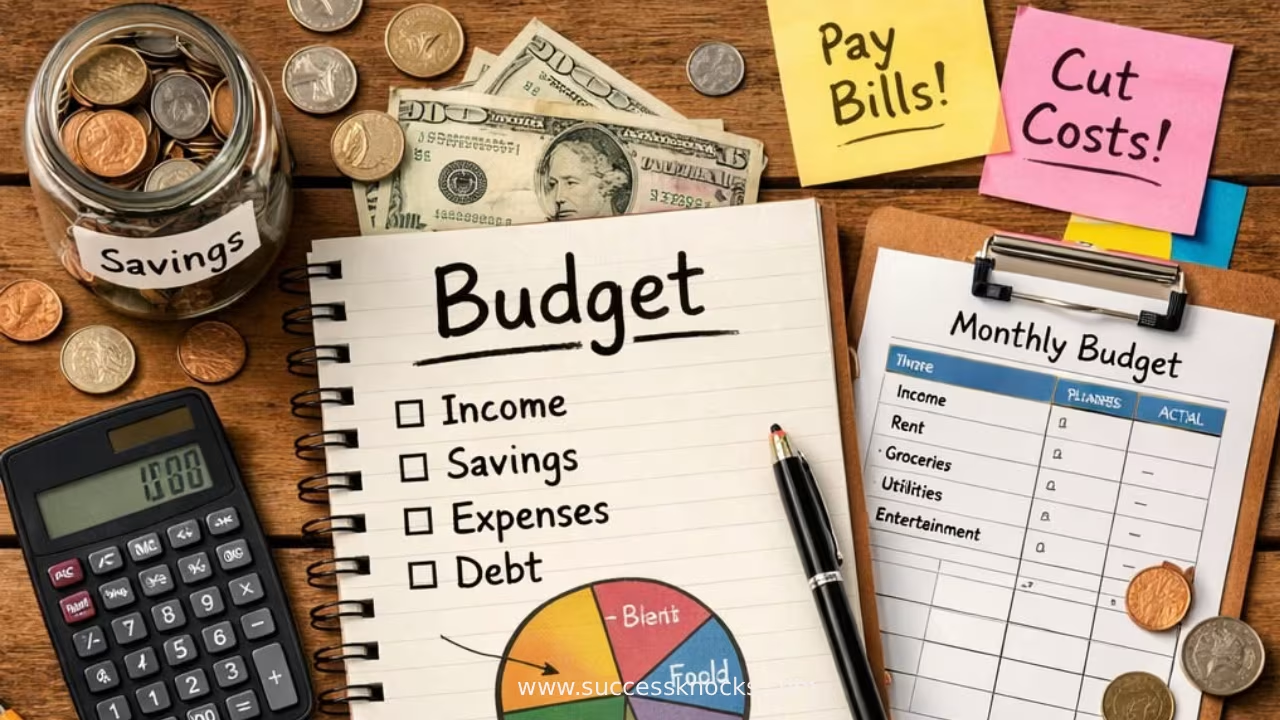
UK household budgeting tips for 2026 matter more right now than they have in years — and the numbers back that up. With the average UK household spending £3,106 per month (roughly £717 per week) just to cover the basics, according to ClearScore’s 2026 analysis of ONS Living Costs data, and 36% of adults expecting to be worse off this year than last, getting your financial house in order is no longer optional. It’s survival strategy.
The good news? Over half of UK adults — 51% — now have a formal budget for 2026, up from 46% in 2025, per YouGov’s 2026 Financial Outlook report. People are waking up. The question is: are they doing it right?
What You Need to Know at a Glance
- Average UK household monthly spend is £3,106 in 2026, inflation-adjusted using ONS Living Costs data (ClearScore/NimbleFins, July 2026).
- 66% of monthly income goes to committed spending — bills, mortgage/rent, and essentials — per MoneySuperMarket’s Household Money Index (July 2026).
- 51% of UK adults now budget, the highest rate on record, driven primarily by the need to cover essentials (YouGov, 2026).
- Only 9% of budgeters use a dedicated app — most rely on spreadsheets or nothing at all, leaving serious money on the table.
- Consumer frugality and spending cutbacks across the UK in 2026 have made structured budgeting the sharpest tool available for households trying to protect disposable income.
Why UK Household Budgeting in 2026 Is a Different Beast
This isn’t your parents’ budgeting advice. “Spend less than you earn” used to be enough. It isn’t anymore.
UK Household Budgeting Tips 2026 Two years of compounded inflation, volatile energy prices, and rising mortgage costs have fundamentally reset what a household budget looks like. The MoneySuperMarket Household Money Index for July 2026 puts committed spending at 66% of monthly income — meaning the average UK household has roughly £755 of true disposable income left each month after fixed costs. That’s the budget you’re actually working with. Not your salary. £755.
What’s the practical implication? Your discretionary decisions — where you eat, what you subscribe to, when you shop — happen inside a much narrower window than most people realise. That makes every intentional budgeting choice disproportionately powerful. Small changes compound fast in a tight margin.
The UK Household Budget Breakdown: Where the Money Actually Goes
Before you optimise anything, you need to know the baseline. Here’s the current average weekly household spending picture, based on ONS Living Costs and Food Survey data adjusted for inflation through May 2026 (sourced via ClearScore and NimbleFins analysis):
| Category | Average Weekly Spend | % of Total Budget | Optimisable? |
|---|---|---|---|
| Housing (net), fuel & power | £118.40 | 18% | ⚠️ Partially (switch tariffs) |
| Transport | ~£95 | ~14% | ✅ Yes (WFH, car-sharing, rail cards) |
| Food & non-alcoholic drinks | ~£85 | ~12% | ✅ High impact (meal planning, own-brands) |
| Recreation & culture | ~£78 | ~11% | ✅ Yes (subscriptions audit, free events) |
| Restaurants & hotels | ~£55 | ~8% | ✅ Yes (frequency reduction) |
| Clothing & footwear | ~£28 | ~4% | ✅ Yes (pre-owned, seasonal buying) |
| Miscellaneous goods & services | ~£45 | ~6% | ⚠️ Partially |
| Other categories combined | ~£113 | ~16% | Varies |
Sources: ONS Living Costs and Food Survey (FYE 2025), adjusted for inflation to May 2026 via ClearScore/NimbleFins; MoneySuperMarket HMI July 2026.
The big three — housing, transport, and food — eat up roughly 44% of total spend before you’ve bought a single luxury item. Attack those categories first. Chipping away at Netflix before you’ve compared your energy tariff is like bailing a bathtub with a teaspoon.
UK Household Budgeting Tips 2026: 4 Methods That Actually Work
UK Household Budgeting Tips 2026 There’s no universally perfect budgeting system. There’s only the one you’ll actually stick to. Here are the four approaches worth knowing, ranked by complexity.
1. The 50/30/20 Rule — Best for Beginners
Split your after-tax income into three buckets:
- 50% → Needs (rent/mortgage, bills, food, transport)
- 30% → Wants (eating out, subscriptions, leisure)
- 20% → Savings and debt repayment
Simple. No transaction-by-transaction obsession. Just a monthly sense-check that your broad ratios are holding.
The caveat in 2026: With committed spending already at 66% of income for the average household (MoneySuperMarket), the 50% “needs” bucket is already blown before you start. If that’s you, this method needs recalibrating — start with 65/15/20 and work toward the ideal over 6–12 months as you reduce fixed costs.
2. Zero-Based Budgeting — Best for Precision
Every pound of income gets assigned a job before the month starts. Income minus all allocations = zero. You’re not spending everything — you’re giving savings and debt repayment a formal “job” just like rent.
Why it works: It forces you to confront spending categories you’d otherwise ignore. Most people who do this for the first time are surprised by how many categories they forgot to plan for.
The time investment: Expect 30–60 minutes to set up, then 30–60 minutes at month-end to review. That’s 2 hours a month. Worth it.
3. The Digital Envelope Method — Best for Variable Spenders
Old concept, new execution. Instead of cash in physical envelopes, you use named pots or sub-accounts inside banking apps — Monzo Pots, Starling Spaces, Revolut Vaults. Assign a monthly amount to each category. When the pot’s empty, that category’s done.
What I’d do: Automate the pot transfers the day after your pay lands. Remove the friction and the system basically runs itself. This is the single most effective structural hack for people who know their budget but keep blowing it.
4. Pay Yourself First — Best for Savers Who Struggle to Save
UK Household Budgeting Tips 2026 Before you spend a single penny, transfer a fixed amount to savings. Non-negotiable. Everything else is built around what’s left.
Start at 10% if you’re currently saving nothing. Build toward 15–20% over 6–12 months. The right number isn’t what’s ideal — it’s whatever you can sustain reliably for two years straight.
Choosing the Right System for Your Situation
| Your Situation | Best Method | Why |
|---|---|---|
| First-time budgeter, overwhelmed | 50/30/20 | Simple, low maintenance, quick wins |
| Know where money goes, want control | Digital Envelope (Pots) | Limits overspend category by category |
| Variable income (freelance, shifts) | Zero-Based | Forces monthly recalibration |
| Savings keep disappearing | Pay Yourself First | Removes savings from the spending decision |
| Experienced, wants maximum control | Hybrid (all four combined) | Each method covers the other’s weaknesses |
Step-by-Step Action Plan: Build Your 2026 UK Household Budget from Scratch
This is for beginners who want a real process, not theory.
Step 1: Calculate Your True Monthly Take-Home
Not your salary. Your after-tax, after-pension-contribution income. This is the only number that matters for budgeting purposes. If it varies month-to-month, use the lowest three-month average.
Step 2: Pull 90 Days of Bank and Card Statements
Three months of transactions, categorised. Yes, it’s tedious the first time. Do it anyway. What you think you spend on food and what you actually spend on food are rarely the same number. In my experience, people underestimate discretionary spend by 20–30%.
Step 3: Identify Your Fixed Committed Costs
Rent or mortgage, council tax, energy, water, broadband, insurance, minimum debt payments. List them with their exact monthly amounts. This is your non-negotiable floor.
Step 4: Calculate Your Real Disposable Income
Take-home minus committed costs. This is your actual working budget. If it’s under £500 per month, you have a fixed-cost problem — not a coffee problem. Address the big numbers first.
Step 5: Assign Every Remaining Pound a Category
Groceries, transport (variable), clothing, entertainment, eating out, subscriptions, personal care. Build from your 90-day actuals, not aspirational numbers. Budgets built on optimistic projections collapse in week two.
Step 6: Build a Sinking Fund for Irregular Costs
Car insurance, MOT, Christmas, birthdays, boiler service — these arrive every year and still blindside people. Add up your annual one-offs, divide by 12, and set aside that amount monthly. This single habit kills more budget derailments than any other fix.
Step 7: Automate Everything You Possibly Can
Savings transfer on payday. Pot allocations on payday +1. Direct debits for bills. The less your budget depends on daily willpower, the more reliably it runs.
Common Household Budgeting Mistakes in 2026 — And the Exact Fix
Mistake #1: Building a Budget Based on Aspirations, Not Actuals
Most first budgets are based on what people wish they spent. They’re fiction. Fix: use three months of real transactions as your baseline, then optimise from there.
Mistake #2: Forgetting to Budget for Irregular Costs
No line item for birthdays, car repairs, or the annual insurance renewal. Then December arrives and the whole plan implodes. Fix: sinking funds (see Step 6 above). Non-negotiable.
Mistake #3: Attacking Small Expenses While Ignoring Big Ones
Cancelling a £7.99 streaming service while your energy tariff hasn’t been reviewed in two years is backwards maths. Fix: rank your spending categories by size, attack the top three first. A better energy deal alone can save £200–£400 per year.
Mistake #4: No Buffer for Overspend
Budget the exact amount, spend slightly over in one category, feel like a failure, abandon the whole system. Fix: build a 5–10% buffer into your discretionary categories. Rigid budgets break. Flexible ones stick.
Mistake #5: Treating Budgeting as a One-Time Setup
A budget set in January and never revisited is already wrong by March — prices change, income shifts, unexpected costs arrive. Fix: a 20-minute monthly review. That’s it. Treat it like a standing appointment.
Mistake #6: Not Connecting Your Budget to the Wider Context
Individual household financial stress doesn’t exist in a vacuum. The wave of consumer frugality and spending cutbacks reshaping the UK in 2026 is being driven by structural forces — sustained inflation, housing costs, and wage stagnation — that no single budget spreadsheet can fully offset. Understanding the macro picture helps you make better micro decisions.
The Tools Worth Using Right Now
Only 9% of UK budgeters use a dedicated app (YouGov, 2026). That’s a missed opportunity. The best tools available to UK households in 2026:
- Spreadsheets (Excel/Google Sheets): Still the most popular (39% of budgeters). Flexible, fully customisable, and free.
- Monzo / Starling / Revolut: Built-in pot systems make the envelope method almost automatic.
- Emma / Money Dashboard / Plum: Aggregate all your accounts in one view and auto-categorise transactions — enormously useful for the Step 2 audit.
- Your bank’s own tools: 8% of budgeters use their bank’s financial management tools — underutilised and usually free.
The right tool is the one you’ll open weekly. Fancy apps you check once and forget are worse than a sticky note on the fridge.
Key Takeaways
- The average UK household spends £3,106 per month in 2026 — know your own number before anything else (ONS/ClearScore, 2026).
- Committed spending absorbs 66% of monthly income for the average UK household — your real disposable budget is far smaller than your salary suggests (MoneySuperMarket HMI, July 2026).
- 51% of UK adults now budget, up from 46% in 2025 — the behaviour shift is happening, but most people are still using basic tools (YouGov, 2026).
- The 50/30/20 rule needs adjusting for current UK conditions — start with a 65/15/20 split if your fixed costs are already above 50%.
- Sinking funds are the single most underused budgeting tactic — they prevent irregular costs from derailing an otherwise solid plan.
- Automate your savings transfer on payday — every day that passes before the transfer is a day the money can be spent on something else.
- Attack big expenses first: energy tariffs, insurance, mortgage/rent. Micro-cuts on small items produce micro-results.
- Monthly reviews — just 20 minutes — are what separate budgets that work from budgets that get abandoned by February.
The bottom line is straightforward: a household budget in 2026 isn’t about restriction. It’s about visibility. Once you know exactly where £3,106 a month goes, you get to decide what stays and what goes — instead of wondering where it all went. Start with the 90-day spending audit this week. Everything else builds from there.
FAQs
Q1: What is a realistic household budget for the average UK family in 2026?
Based on ONS Living Costs data adjusted for inflation through May 2026, the average UK household spends approximately £3,106 per month across 2.3 people. That’s around £717 per week covering housing, food, transport, and all other categories. If you rent rather than own, or have a mortgage above the national average, your actual committed spend will be higher than the baseline. Use this figure as a reference point, not a target — your own three-month average is the only number that matters for your budget.
Q2: Which budgeting method works best for beginners in the UK in 2026?
The 50/30/20 rule is the most beginner-friendly UK household budgeting approach in 2026 — low maintenance, easy to understand, and requires no app or special setup. That said, given that average committed spending has already reached 66% of take-home pay for many UK households, beginners should adjust the split to reflect their real fixed-cost baseline rather than forcing numbers that don’t fit their actual situation.
Q3: How do UK household budgeting tips in 2026 connect to the broader consumer spending trend?
They’re directly linked. The broader pattern of consumer frugality and spending cutbacks across the UK in 2026 — where 45% of consumers describe themselves as actively more frugal and eight in ten plan short-term cutbacks (PwC/Deloitte) — is creating both the need and the motivation for household budgeting. Structural cost-of-living pressures are the macro driver; a robust personal budget is the micro response. People who have a formal budget are far better positioned to navigate those pressures without financial stress accumulating silently in the background.