FP&A best practices are the habits, systems, and decision rules that help finance teams plan smarter, forecast with more confidence, and spend less time wrestling messy data. If you want a keyword tie-in for internal SEO, this article can also support your content cluster around Finance and Business Analytics Conference September 2026.
- FP&A works best when data is clean, centralized, and owned.
- Rolling forecasts beat static annual plans when the business moves fast.
- Driver-based planning is usually more useful than line-by-line guesswork.
- Scenario modeling helps finance teams answer the question everyone actually asks: “What happens if this changes?”
- The best FP&A teams do more than report numbers; they help shape decisions[1][6][8].
Finance teams do not win by making prettier spreadsheets. They win by making better calls. That’s the real job.
FP&A best practices explained without the fluff
FP&A stands for financial planning and analysis. In plain English, it’s the part of finance that turns numbers into decisions.
The best FP&A teams do three things well:
- They collect the right data
- They model likely outcomes
- They help leaders act before problems get expensive
That sounds simple. It isn’t. Most teams still struggle with disconnected systems, manual reporting, and forecasts that go stale before the quarter ends[1][7][10].
Why FP&A best practices matter now
Finance has shifted from backward-looking reporting to forward-looking decision support. Teams are expected to explain variance, model risk, and guide resource allocation, not just close the books[3][8][13].
And yes, the tools matter. But process matters more. A fancy model built on bad assumptions is just a more expensive mistake.
The core FP&A best practices that matter most
1. Build one source of truth
If your actuals live in one system, your forecast in another, and your headcount plan in a third, you are setting yourself up for reconciliation pain. The strongest FP&A teams standardize data and make ownership clear[1][7][12].
That means:
- One trusted data environment
- Clear input owners
- Defined refresh cadence
- Auditability from source to report
2. Use rolling forecasts
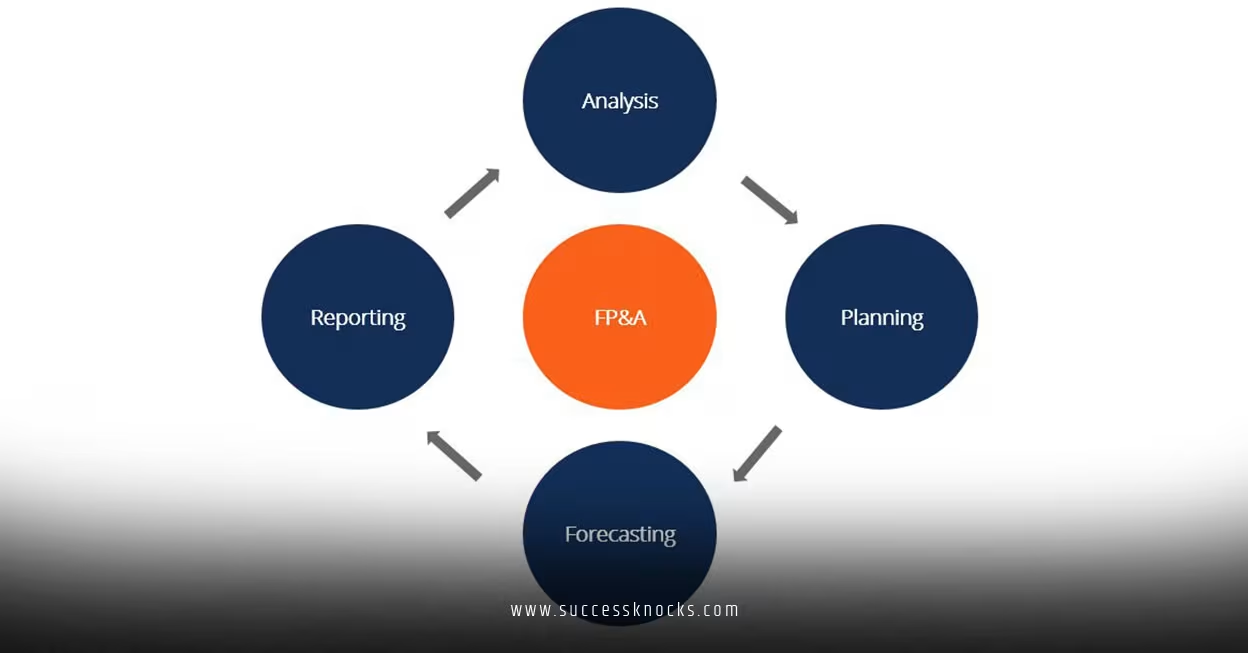
Annual budgets are fine for planning. They are weak for agility. A rolling forecast keeps the planning window moving, so you are always looking ahead with current assumptions[1][6][7].
What usually happens is this: the business changes, but the plan does not. Rolling forecasts fix that gap.
3. Plan around business drivers
Do not forecast every line item with the same level of detail. Focus on the drivers that move the business: headcount, pipeline, conversion rates, churn, COGS, utilization, and cash timing[1][6][8][13].
That is where real signal lives.
4. Run scenario models before the market does it for you
Scenario planning is not a luxury. It is a basic survival skill. Strong FP&A teams test base, upside, and downside cases before leadership makes a big move[2][3][11].
Ask:
- What happens if hiring slows?
- What if conversion drops?
- What if a customer delays payment?
- What if pricing changes?
That is how finance becomes useful under pressure.
5. Automate repetitive reporting
If someone is manually rebuilding the same report every week, that is a process problem wearing a finance hat. Automate the ugly stuff first, then use the saved time for analysis and business partnership[1][7][10].
6. Focus on insights, not just reports
A dashboard is not insight. A variance table is not insight either. Insight answers why something happened and what to do next[8][12][13].
That is the difference between being a reporting function and being a decision function.
7. Partner early with the business
The best FP&A people do not wait until the end of the month to ask questions. They get into the conversation early, when the decision is still flexible[5][8][13].
That’s where influence lives.
8. Keep the model simple enough to use
Complexity is seductive. It looks smart. But when a model becomes too hard to explain, it becomes too hard to trust[4][11].
Simple models are not weak. They are scalable.
FP&A best practices and how they support better decision-making
| Practice | What it improves | Typical business impact |
|---|---|---|
| Unified data | Accuracy and trust | Fewer reconciliation issues |
| Rolling forecasts | Planning agility | Faster response to change |
| Driver-based planning | Model relevance | Better forecasting confidence |
| Scenario modeling | Risk awareness | Better contingency planning |
| Automation | Speed and efficiency | More time for analysis |
| Business partnering | Decision quality | Stronger cross-functional execution |
Step-by-step action plan for beginners
If you are new to FP&A, do not try to fix everything at once. That’s how teams end up with chaos and a dashboard nobody trusts.
1. Start with the data map
List every source feeding your forecast and reporting. Actuals. CRM. Payroll. Headcount plan. Budget inputs. Then identify who owns each one[1][12].
2. Clean up the top five drivers
Pick the five metrics that move your forecast most. For many teams, that will be revenue, headcount, pipeline, churn, and COGS[1][6][13].
3. Build a simple rolling forecast
Do not start with twelve months of perfect complexity. Start with a working forecast that updates on a regular cadence and improves over time[1][7][11].
4. Add one scenario at a time
Build one base case, one downside case, and one upside case around a real business decision. Hiring. Pricing. Expansion. Something real.
5. Automate one annoying report
Choose the report that wastes the most time. Fix that first. Quick win. Big morale boost.
6. Turn analysis into action
If your team spots a variance, do not just explain it. Recommend a response. That is where FP&A starts earning its keep[8][13].
What the best FP&A teams do differently
The strongest teams do not obsess over perfect models. They obsess over useful ones.
They:
- Move fast on changing assumptions
- Keep models tied to decisions
- Use technology to remove grunt work
- Work closely with operations, sales, and leadership
- Prioritize insights that change behavior[5][7][8]
That is the whole trick. Not glamorous. Very effective.
Common mistakes and how to fix them
- Mistake: Treating FP&A like bookkeeping
Fix: Shift the team’s focus from recording history to shaping decisions. - Mistake: Forecasting every account with equal detail
Fix: Use drivers and materiality. Focus on what actually moves the business. - Mistake: Relying on manual copy-paste work
Fix: Automate data pulls and recurring reporting first. - Mistake: Ignoring scenario planning
Fix: Build a base/downside/upside structure around major decisions. - Mistake: Working in a silo
Fix: Bring in department leaders early and ask better questions before the numbers lock. - Mistake: Overcomplicating the model
Fix: Keep the logic understandable enough that another analyst can inherit it without a decoder ring.
How this connects to Finance and Business Analytics Conference September 2026
If you are building an FP&A skill set, conference learning can be a smart shortcut. A strong conference gives you exposure to new planning methods, analytics workflows, and the kinds of tools finance teams are using now.
That matters because FP&A is increasingly connected to analytics, reporting automation, and business decision support. The conference angle is especially useful if you want to compare real-world approaches, hear from practitioners, and pressure-test your own process against what other teams are doing.
Search-wise, that makes the internal keyword link do real work. It connects a practical how-to article with a broader event-interest page, which is exactly how a clean topical cluster should behave.
Key takeaways
- FP&A best practices help finance teams move from reporting to real decision support.
- One source of truth is the foundation. Without it, everything downstream gets shaky.
- Rolling forecasts are more useful than static annual plans when the business changes fast.
- Driver-based planning makes forecasts smarter and easier to defend.
- Scenario modeling should be standard, not optional.
- Automation gives FP&A teams back time for analysis.
- The best teams partner early with the business instead of reacting late.
- Simplicity usually beats complexity in planning models.
FP&A works best when it is built around decisions, not just spreadsheets. Tighten the data, simplify the model, and focus on the few drivers that matter most. That is how you make finance genuinely useful.
FAQs
What are the most important FP&A best practices for beginners?
Start with clean data, a small set of business drivers, a simple rolling forecast, and one automated report. Those four moves create momentum fast.
How do FP&A best practices improve forecasting?
They improve forecasting by reducing manual errors, centering the plan on business drivers, and making it easier to update assumptions as conditions change.
How does FP&A connect to Finance and Business Analytics Conference September 2026?
A conference focused on finance and analytics can expose you to FP&A workflows, planning tools, and decision-making frameworks that support better forecasting and analysis.