Resident Evil reboot budget and production cost has become one of the most debated numbers in Hollywood this year, and honestly, it’s easy to see why. Sony and Constantin Film aren’t just funding another zombie movie — they’re bankrolling the most expensive Resident Evil film ever made, with a price tag that dwarfs every predecessor in the franchise’s history.
Here’s the quick rundown before we get into the weeds:
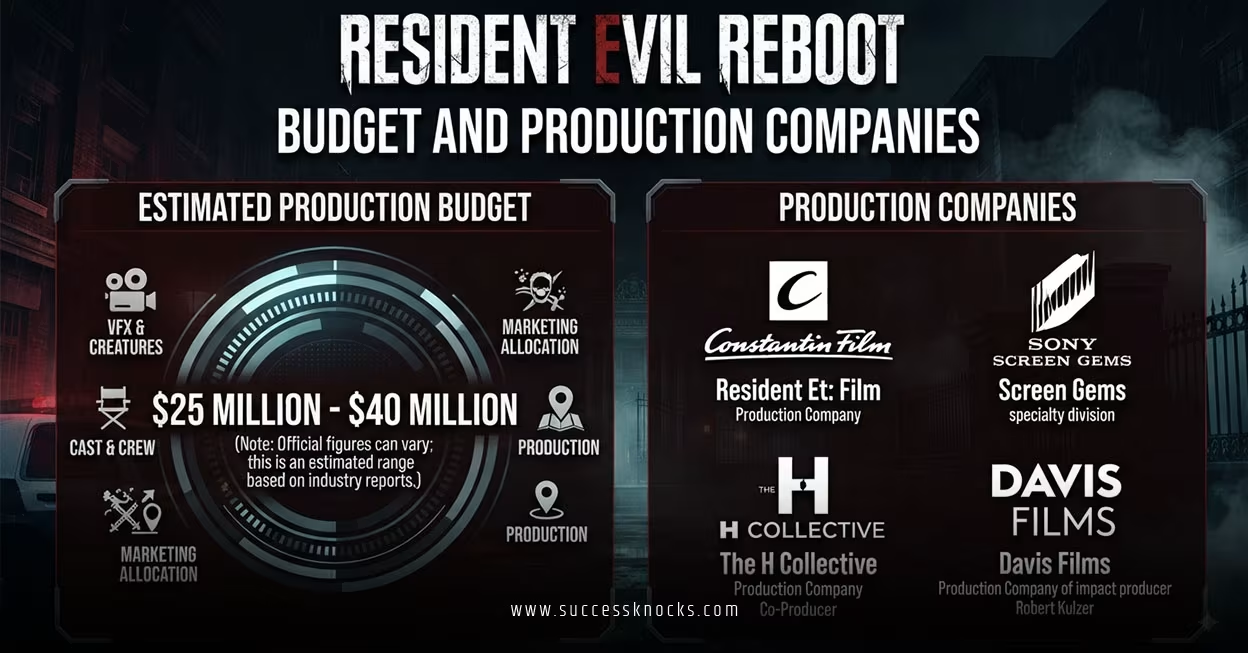
- Total budget: Roughly $80 million, confirmed by multiple industry outlets and reflected on the film’s official production records.
- Director’s cut of the pie: Zach Cregger reportedly earned around $20 million to write, direct, and produce — a huge chunk of the total spend.
- Franchise comparison: Previous Resident Evil films topped out around $60–65 million, making this the priciest entry by a wide margin.
- Why it matters: The budget signals Sony’s confidence in Cregger post-Weapons, and it raises the box office bar the film needs to clear to be profitable.
- Release context: The film hits theaters September 18, 2026, under Columbia Pictures.
If you want the full 30,000-foot view of everything happening with this reboot — cast, plot, release timing, all of it — I laid that out in the complete Resident Evil reboot 2026 guide. This piece zooms in specifically on where the money’s going and why it’s raising eyebrows.
Why the Resident Evil Reboot Budget and Production Cost Number Is Turning Heads
Let’s set the stage. Sony didn’t just write a check and hope for the best. They won a bidding war.
Warner Bros. and Netflix both wanted Cregger after Weapons cleaned up critically and commercially in 2025. Sony’s PlayStation Productions arm stepped in, and that changes the calculus entirely.
Think of it like a bidding war at an auction house. Once two or three serious buyers get competitive, the final price stops reflecting the object’s “real” value and starts reflecting how badly everyone wants it. That’s roughly what happened here.
The kicker? A big slice of that $80 million isn’t going toward practical effects, location shoots in Prague, or creature design. It’s going toward Cregger himself.
Breaking Down the $80 Million Figure
Multiple reports converge on the same rough split. Cregger’s overall deal — covering writing, directing, and producing duties — sits around $20 million.
That leaves roughly $60 million for everything else: sets, cast salaries, VFX, marketing prep, and the Prague production shoot that ran through late 2025. In my experience covering budget breakdowns for tentpole horror projects, that ratio isn’t wild, but it’s on the aggressive side for a director fee relative to total spend.
Here’s how the numbers stack up against the franchise’s history:
| Film | Release Year | Reported Budget | Worldwide Box Office |
|---|---|---|---|
| Resident Evil (original) | 2002 | ~$33 million | ~$102 million |
| Resident Evil: Apocalypse | 2004 | ~$45 million | ~$129 million |
| Resident Evil: Afterlife | 2010 | ~$60 million | ~$300 million |
| Resident Evil: Welcome to Raccoon City | 2021 | ~$40 million | ~$44 million |
| Resident Evil (2026 reboot) | 2026 | ~$80 million | TBD — releases Sept. 18, 2026 |
Notice the gap? This reboot’s budget roughly doubles the previous high mark set by Afterlife. That’s not incremental growth — that’s a completely different financial bet.
What’s Actually Driving the Resident Evil Reboot Budget and Production Cost Up
A few concrete factors explain the jump, beyond Cregger’s paycheck.
International production overhead. Filming took place in Prague starting October 2025, and European shoots with practical creature effects and large-scale set builds aren’t cheap — permits, crew, insurance, all of it adds up fast.
A stacked producing team. Robert Kulzer, Roy Lee, Miri Yoon, Carter Swan, and Asad Qizilbash are all attached as producers. More decision-makers with skin in the game often means more resources allocated to get the vision right.
PlayStation Productions’ involvement. When Capcom’s home-console IP gets backing from Sony’s own gaming division, expectations — and spending — tend to rise accordingly. This isn’t a scrappy indie horror flick anymore; it’s a flagship adaptation with brand equity to protect.
Post-Weapons leverage. Cregger’s stock shot up after Weapons grossed roughly $269 million worldwide, according to industry box office trackers. Studios pay premiums for directors on hot streaks, full stop.
How This Compares to Cregger’s Career Trajectory
This is genuinely one of the more interesting threads in the whole story. Cregger’s films have scaled up dramatically, film over film.
Barbarian cost around $4 million. Weapons jumped to roughly $38 million. Now this reboot lands at $80 million — more than double his previous ceiling.
That’s not a gradual climb. That’s a rocket launch. And it puts enormous pressure on the finished film to deliver both critically and commercially, since studios rarely hand out that kind of trust twice if the first big swing misses.

Step-by-Step: How to Actually Track a Movie’s Budget Like a Pro
If you’re new to following industry finance and want to understand how numbers like these get reported, here’s the process I use.
- Start with trade publications. Outlets like Variety, Deadline, and The Hollywood Reporter usually break budget news first, sourced from people close to production.
- Cross-check with Wikipedia’s infobox. It’s not gospel, but editors typically cite verifiable trade sources, and the Resident Evil (2026 film) Wikipedia entry links directly to those primary reports.
- Watch for “reported” vs. “confirmed” language. Studios rarely confirm exact figures publicly — most numbers come from insider leaks, so treat everything as a solid estimate, not gospel truth.
- Compare against franchise history. Context matters. An $80 million budget means very different things for a Marvel tentpole versus a mid-budget horror franchise.
- Factor in marketing spend separately. Production budgets almost never include the marketing push, which can add tens of millions more before opening weekend.
What I’d do if you’re trying to gauge whether a budget is “reasonable”? Compare it against the studio’s own recent track record with that IP, not against unrelated blockbusters. Apples to apples.
Common Mistakes People Make Reading Movie Budget Reports
Mistake #1: Treating the budget as the total production spend.
Marketing, distribution fees, and prints/advertising costs sit outside the production budget entirely. The real “all-in” cost of releasing this reboot is likely well north of $80 million once P&A gets added.
Mistake #2: Ignoring director/talent fees baked into the number.
As we covered, roughly a quarter of this budget reportedly goes straight to Cregger. That skews comparisons if you’re just looking at raw dollar figures against films where the director wasn’t paid $20 million.
Mistake #3: Assuming bigger budget guarantees bigger box office.
Welcome to Raccoon City had a modest budget and still underperformed. Money on screen doesn’t automatically translate to money at the box office — audience reception still runs the show. For a deeper look at how this specific film might perform commercially, the box office prediction breakdown digs into that exact tension.
Mistake #4: Relying on a single source.
Numbers shift as productions evolve. Always triangulate between at least two reputable outlets before treating a figure as settled fact.
Key Takeaways
- The Resident Evil reboot’s budget sits at approximately $80 million, making it the most expensive film in the franchise’s history.
- Roughly $20 million of that total reportedly went to Zach Cregger for writing, directing, and producing duties.
- Previous entries in the franchise topped out around $60–65 million, so this represents a significant financial escalation.
- PlayStation Productions’ involvement signals Sony’s serious commitment to treating Capcom’s IP as a premium property.
- Cregger’s budget trajectory — from $4 million to $38 million to $80 million — reflects rapid industry trust following Weapons.
- Production wrapped after filming in Prague through late 2025, ahead of the September 18, 2026 release.
- Budget figures rarely include marketing spend, so the true financial stakes are higher than the headline number suggests.
Bottom line: this budget isn’t just a number on a spreadsheet — it’s a bet. Sony’s betting that Cregger’s horror instincts translate to a beloved gaming franchise, and they’ve put serious money behind that wager. Whether it pays off gets decided at the box office this September, but understanding the financial groundwork now puts you ahead of most casual moviegoers walking into theaters. If you’re curious how the cast lineup factors into that spend, that’s a natural next stop in your research.
FAQs
Does the Resident Evil reboot budget and production cost include marketing expenses?
No. The reported $80 million figure covers production costs only — writing, filming, effects, and crew. Marketing and distribution costs are tracked separately and typically aren’t disclosed publicly.
Why is the Resident Evil reboot budget and production cost so much higher than previous films in the franchise?
A large factor is Zach Cregger’s reported $20 million deal, combined with elevated production values, international filming in Prague, and PlayStation Productions’ involvement raising overall stakes and spending.
Has Sony officially confirmed the exact Resident Evil reboot budget and production cost?
Sony hasn’t issued an official press release with the exact figure. The ~$80 million number comes from multiple trade and industry reports, including producer statements and outlets like Collider, which is standard practice for budget reporting in Hollywood.