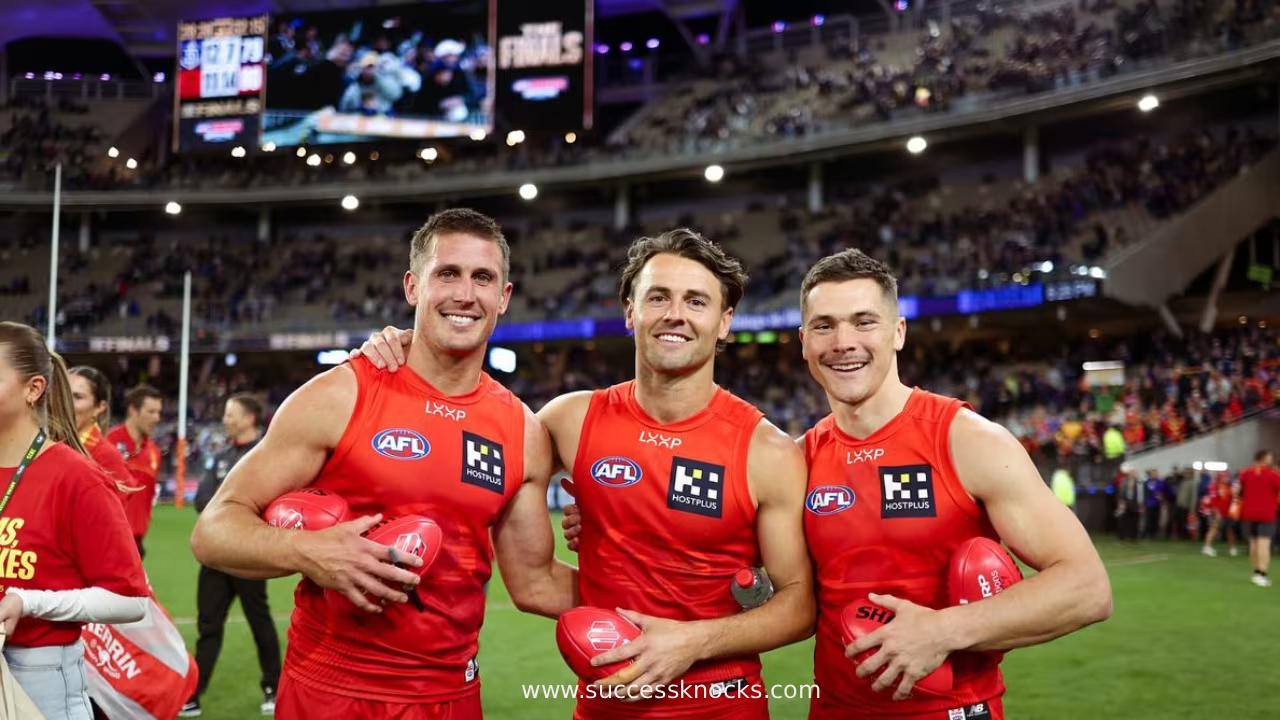
Gold Coast Suns midfield structure 2026 is the most talked-about tactical puzzle in the AFL — and not for good reasons. On paper, it’s the most formidable centre square rotation in the competition. In practice, the Suns have gone from fourth-best clearance differential in 2025 (+3.3) to the absolute worst in 2026 (-7.2) [1]. That’s not a slump. That’s structural collapse.
Here’s the snapshot before we dig in:
- The Suns’ “Fab Four” midfield — Noah Anderson, Matt Rowell, Touk Miller, and Christian Petracca — has underdelivered at every key contested metric in 2026.
- Gold Coast ranks 15th in clearances per game and 18th in clearance differential across 21 rounds [2].
- Matt Rowell’s clearances have dropped from 8.2 to 6.3 per game. His contested possessions have fallen from 14 to 12 [1].
- Touk Miller has been pushed from midfield to half-forward, dropping from 15 centre bounce attendances in 2025 to just 10 this season [1].
- The arrival of Petracca hasn’t complemented the existing structure — it’s disrupted it.
What went wrong? How did one of the most exciting midfield additions in recent AFL history turn into what SEN’s David King called “the drab four”? Let’s break it down properly.
Gold Coast Suns Midfield Structure 2026: Meet the “Fab Four”
Before we diagnose what’s broken, it’s worth understanding what Damien Hardwick actually built — or tried to build.
Heading into 2026, the Gold Coast midfield looked like this:
Noah Anderson — Club captain, 2025 Brownlow Medallist, the engine. A 30-plus disposal machine with elite contested work. Now averaging 110.3 fantasy points across the season with a recent surge (5-week average of 124.6), suggesting he’s finally hitting form [3].
Matt Rowell — Reigning Brownlow Medallist, hard-nosed contested midfielder. His numbers have dropped across the board: overall disposals from 26.3 to 24.2, contested possessions from 14 to 12, and clearances from 8.2 to 6.3 per game [1]. The Rowell slide is one of the most underreported stories of 2026.
Touk Miller — Two-time All-Australian. The defensive midfielder who makes the rest of the group function. Since Petracca arrived, Miller has been pushed to half-forward, reducing his on-ball impact dramatically. His centre bounce attendances dropped from 15 in 2025 to just 10 in 2026, though they’ve climbed recently [1].
Christian Petracca — Norm Smith Medallist, recruited from Melbourne in the off-season. The marquee signing that was supposed to elevate the group. Instead, his positional deployment has created a logjam on-ball. For the full breakdown of his role problems, read our deep-dive on Christian Petracca midfield vs forward 2026.
Four elite names. One fractured structure.
The Clearance Crisis: By the Numbers
This is where it gets damning. Clearances aren’t everything in AFL football — but they’re a direct measure of midfield dominance. Win clearances, you win territory. Win territory, you win games.
| Metric | Gold Coast 2025 | Gold Coast 2026 | Change | 2026 League Rank |
|---|---|---|---|---|
| Clearance Differential | +3.3 | -7.2 | ↓ 10.5 | 18th (last) |
| Clearances Per Game | ~37.0 | 33.8 | ↓ 3.2 | 15th |
| Contested Possessions Per Game | ~138.0 | 128.0 | ↓ 10.0 | 11th |
| Tackles Per Game | ~62.0 | 53.8 | ↓ 8.2 | 15th |
| Centre Clearances Per Game | ~14.0 | 12.0 | ↓ 2.0 | 12th |
| Stoppage Clearances Per Game | ~24.0 | 21.7 | ↓ 2.3 | 15th |
Sources: AFL.com.au, Legz.com.au, Footywire.com [1] [2] [4]
That’s a near-complete red column. Across every contested midfield metric, Gold Coast is worse in 2026 than they were in 2025 — despite adding Petracca, one of the most elite midfielders of his generation.
The Suns were “outhunted” by Sydney in Gather Round — the Swans won contested possessions by 16 and tackles by a staggering 45 [1]. Six days earlier, Melbourne thrashed them in clearances (+11), contested possessions (+22), and tackles (+5) [1].
Why Four Elite Midfielders Aren’t Clicking
Here’s the thing about elite midfield talent: more doesn’t automatically mean better. You need complementary roles, not duplicated ones.
The Gold Coast midfield structure problem in 2026 is that Hardwick is trying to rotate four high-usage, on-ball middleweights through a centre square that functionally fits two or three at maximum. Someone has to go elsewhere. And that decision — who goes where — has been the source of almost every structural problem this season.
Dermott Brereton put it plainly: “He lands in a midfield that already has a captain in the midfield, a Brownlow Medallist in the midfield, the longest-serving club legend in the midfield, and an aspiring star who’s starting to get more midfield minutes” [4].
That’s five bodies jostling for three or four meaningful positions. The result? Role compression. Reduced impact. Statistical decline across the board.
The Touk Miller Problem Nobody’s Talking About Enough
Miller is arguably the most underappreciated casualty of this restructure.
In 2025, he was the defensive backbone of a midfield that posted a +3.3 clearance differential. His two-way running — SEN‘s Adam Simpson described him as “arguably the best two-way runner in the competition alongside Fremantle’s Andrew Brayshaw” — was what gave the group defensive shape while Anderson, Rowell, and Humphrey applied offensive pressure [1].
Push Miller to half-forward, and you strip that defensive cover from the centre square. Suddenly Anderson and Rowell are operating without their safety net. Clearances suffer. Tackles suffer. The entire chain of possession becomes fragile.
Now, with Petracca banished to the forward line, Miller has been pushed back on-ball again — and his numbers have responded. But it shouldn’t have taken a 10-game losing streak and a public coaching admission to get there.
Noah Anderson: The One Bright Light
Give credit where it’s due. Anderson has been the standout performer in a struggling midfield, and his recent form suggests the captain is finding another gear.
His 5-week fantasy average of 124.6 and 3-week average of 121.0 are among the best in the competition [3]. His contested work has returned to near-elite levels. He’s carrying more of the load than any one player should have to — but he’s doing it.
The contrast between Anderson’s recent ascent and Rowell’s decline is stark. Anderson has embraced the chaos and found a way to dominate anyway. Rowell hasn’t found that gear yet.
Gold Coast Suns Midfield Structure 2026: Step-by-Step Fix
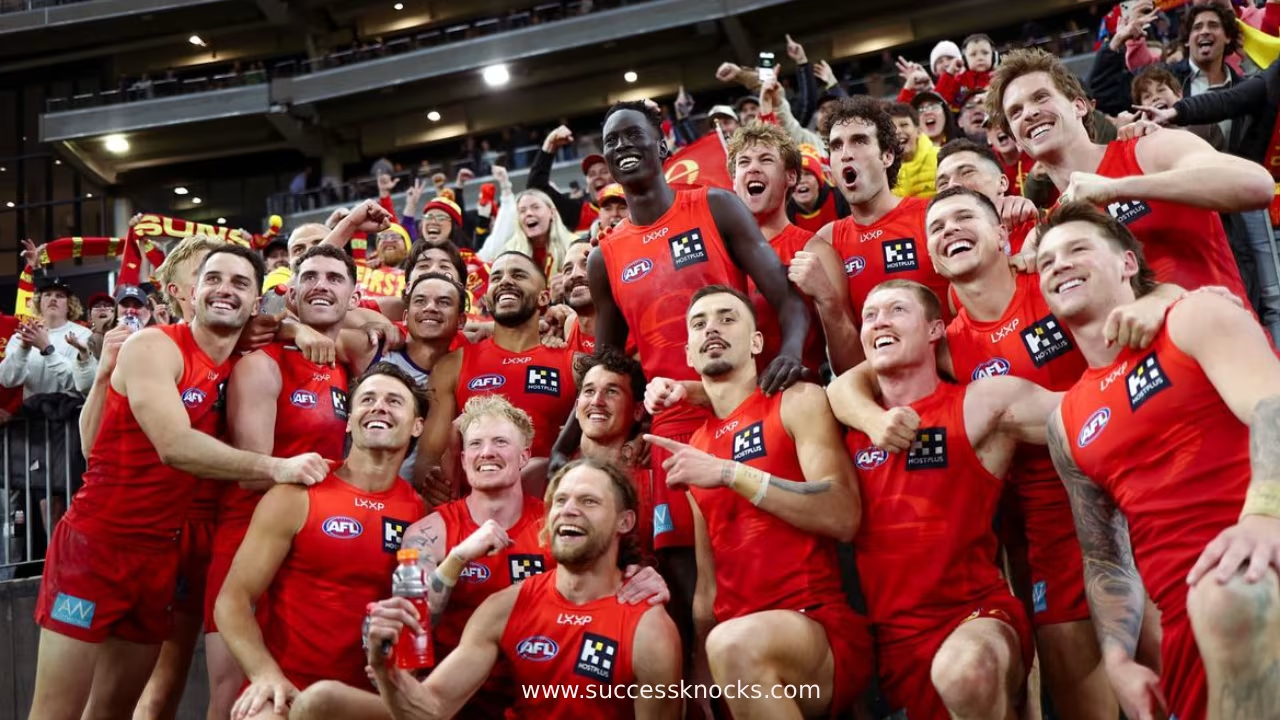
Hardwick needs a structural reset, not a personnel overhaul. The talent is there. The system isn’t.
Step 1: Lock in Anderson as the primary on-ball midfielder. No rotation disrupts his centre bounce attendance. He’s the best performer. Build around him.
Step 2: Return Petracca to a 70-30 midfield-forward split immediately. His forward experiment has failed. The data confirms it. Hardwick has admitted it. Act on it.
Step 3: Use Miller as the defensive midfielder anchor. His best football comes when he’s on-ball with a clear defensive brief — chase, pressure, smother. Stop pushing him to half-forward when the structure struggles.
Step 4: Build Rowell’s role around stoppages specifically. Rowell’s elite contested work at stoppages is his defining skill. If his overall number is down, narrow his role and let him dominate the specific moments he’s built for.
Step 5: Give Bailey Humphrey earned midfield minutes. He’s not a passenger. He’s a developing star who needs consistent on-ball time — not just scraps when someone rotates off. Define his role clearly.
Step 6: Stop trying to play all four at maximum capacity simultaneously. Rotation is about timing, not just frequency. Stagger them strategically, not reactively.
Common Mistakes Hardwick Is Making Right Now
Mistake: Treating the midfield as interchangeable parts.
Fix: Each midfielder has a defined strength. Anderson is the all-rounder. Rowell is the stoppage bull. Miller is the defensive runner. Petracca is the explosive ball-winner. Build a system that uses each role, not one that asks all four to do the same thing.
Mistake: Reacting to injuries and form by reshuffling the entire structure.
Fix: Establish a base structure — Anderson and Rowell on-ball, Miller defensive mid, Petracca 70-30 — and adjust around it, not from scratch.
Mistake: Moving Miller to half-forward every time there’s a structural problem.
Fix: Miller’s defensive value in the centre square is quantifiable. Losing it directly correlates with the clearance collapse. Stop treating his position as the buffer variable.
Mistake: Prioritising defensive balance over Petracca’s strengths.
Fix: As outlined in the Christian Petracca midfield vs forward 2026 analysis, pushing Petracca forward to give Miller a defensive midfield role created the problem, not solved it.
Mistake: Waiting too long to acknowledge structural failure.
Fix: The clearance numbers were a warning sign at Round 6. The public admission came at Round 22. That’s 16 rounds of compounding damage.
What the Rest of the Competition Is Doing Differently
Brisbane. Carlton. Geelong. They all run elite midfield rotations and dominate clearance counts because their roles are defined and consistent. Nobody guesses. Nobody gets bumped based on form fluctuation.
Brisbane’s midfield — Neale, Ah Chee, Zorko, Dunkley — works because each player has a specific, non-duplicating job. Neale goes hard at stoppages. Ah Chee provides run and carry. Zorko cleans up and pressures. Dunkley tackles and wins ground balls.
Gold Coast’s four could do the same. They have the calibre. They don’t yet have the clarity.
Key Takeaways
- Gold Coast Suns midfield structure 2026 has deteriorated from fourth-best clearance differential in 2025 to dead last in 2026 — a drop of 10.5 points.
- The “Fab Four” of Anderson, Rowell, Miller, and Petracca has created role congestion, not midfield dominance.
- Matt Rowell’s clearances have dropped from 8.2 to 6.3 per game; his contested possessions from 14 to 12.
- Touk Miller’s centre bounce attendances fell from 15 in 2025 to 10 in 2026 after being pushed to half-forward.
- Noah Anderson is the standout — his 5-week fantasy average of 124.6 is among the competition’s best.
- Returning Petracca to a 70-30 midfield-forward split and reinstating Miller’s defensive midfield role is the most logical structural fix.
- Gold Coast ranks 15th in clearances, 15th in tackles, and 18th in clearance differential across 21 rounds of 2026.
- The fix is structural, not personnel-based — the talent exists, the defined roles do not.
The Gold Coast midfield isn’t broken because the players aren’t good enough. It’s broken because four elite midfielders have been asked to share space without clear, differentiated roles. Define the roles. Commit to the structure. Stop reacting. The Suns have the pieces for a genuine premiership contender midfield — they just need someone to sort out where each piece actually belongs.
FAQs
Why has Gold Coast’s clearance differential dropped so dramatically in 2026 despite adding Petracca?
Adding Petracca disrupted the established roles of Miller, Rowell, and Anderson rather than complementing them. Miller was pushed to half-forward, reducing defensive midfield cover. Petracca was then deployed in the forward line to compensate — stripping the group of his on-ball impact entirely. The result was a clearance differential swing from +3.3 in 2025 to -7.2 in 2026, the worst in the competition [1].
Is Noah Anderson still performing in Gold Coast’s struggling midfield?
Yes — Anderson is the clear standout. His 5-week AFL fantasy average of 124.6 and 3-week average of 121.0 are elite-level numbers, suggesting the captain has lifted his output even as the team’s collective midfield metrics declined [3]. He’s been carrying a disproportionate share of the on-ball load in 2026.
How should Gold Coast Suns midfield structure 2026 look to maximise all four key players?
The optimal structure uses Anderson as the primary on-ball midfielder, Rowell as a stoppage specialist, Miller as the defensive midfield anchor, and Petracca in a 70-30 midfield-forward split. This mirrors the structure that made each player elite at their respective clubs, and avoids the role duplication that has compressed their individual output throughout 2026.