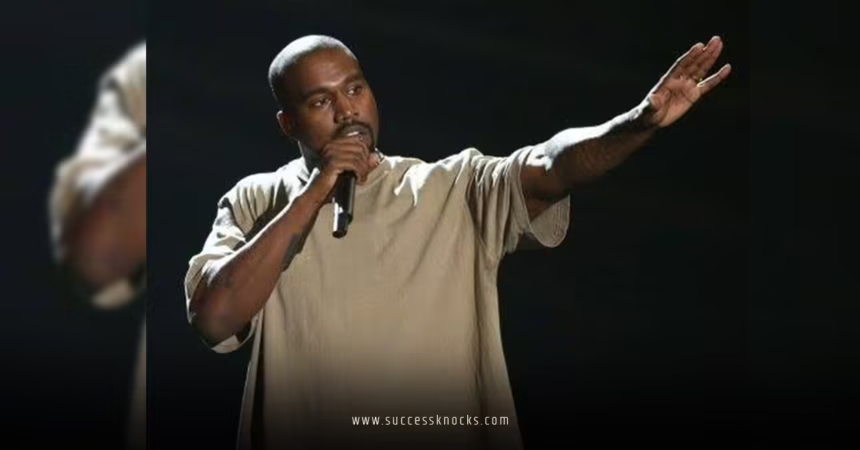
Kanye West diss track response stories have become their own genre of internet drama. Every time Ye drops a bar aimed at an old friend, a former collaborator, or an ex-in-law, the internet holds its breath waiting to see who claps back — and who stays silent.
Here’s the thing: not every diss gets answered. Some artists fire back within hours. Others let it simmer for months, then drop a track that flips the whole narrative. Understanding why people respond the way they do tells you more about the hip-hop feud economy than the original diss ever could.
Quick Overview — What This Article Covers:
- How major figures (Iggy Azalea, Ty Dolla $ign, Dave Blunts, Bhad Bhabie’s camp) actually responded to Kanye’s 2025-2026 diss tracks
- The difference between a public statement response and a musical response
- A breakdown of response timelines and formats
- A step-by-step framework for tracking any diss-track fallout as a beginner
- Common mistakes fans and casual observers make when reading these feuds
If you want the full backstory on the tracks themselves, I broke down the entire situation in the complete Kanye West diss track guide, which covers the songs, timeline, and context in one place.
Why Kanye West Diss Track Responses Look Different From Other Rap Beefs
Most rap beefs follow a predictable rhythm. Diss drops, response drops, round two, cool-down period. Ye breaks that mold constantly.
His targets in 2025 alone included Kendrick Lamar, Tyler, The Creator, Ty Dolla $ign, Playboi Carti, Travis Scott, and even Iggy Azalea’s son — all in a single social media tirade, according to reporting from Billboard. That’s not a diss track. That’s a blast radius.
What usually happens next is telling. Some targets go musical. Some go straight to a press statement. A few just go quiet and let the internet do the talking.
The Musical Response Path
This is the classic move — you get disses, you record bars back. Dave Blunts, who co-produced material with West in early 2025, later released “Tired of Being Groomed,” alleging Ye manipulated him into writing antisemitic lyrics. That’s a Kanye West diss track response delivered entirely through song, and it landed with real weight because it came from an insider.
The Public Statement Path
Iggy Azalea didn’t drop a track. She posted directly on X, asking Ye to leave her son out of his lyrical analogies, framing her response “kindly and as a mother.” No beat, no bars — just a direct, human plea that arguably did more damage to Ye’s narrative than a diss song would have.
A Side-by-Side Look at Response Types
Not every response format carries the same weight or reaches the same audience. Here’s how the major approaches stack up.
| Response Type | Example | Speed | Public Impact | Best Used When |
|---|---|---|---|---|
| Musical diss track | Dave Blunts’ “Tired of Being Groomed” | Weeks to months | High — becomes part of the permanent record | You have real allegations or bars worth dropping |
| Social media statement | Iggy Azalea’s X post | Hours | Medium-High — spreads fast, humanizes the target | Protecting family, correcting a false claim |
| Public denial / clarification | Ye denying the AI-generated Bhad Bhabie verse | Hours to a day | Medium — damage control | Misattribution or AI voice controversy |
| Formal open letter | Ye’s Wall Street Journal apology (Jan 2026) | Months | Very High — reframes an entire public image | Widespread backlash requiring accountability |
| Silence / no response | Several 2025 targets never addressed Ye’s tirade | N/A | Low-visibility, but often the smartest PR move | The diss lacks staying power or credibility |
In my experience watching these cycles play out, silence is underrated. Responding gives a diss oxygen. Sometimes the smartest move an artist can make is simply not feeding it.
Step-by-Step: How to Track a Kanye West Diss Track Response as a Beginner
If you’re new to following this stuff and don’t want to get lost in the noise, here’s the framework I’d use.
- Identify the original claim. Before you can judge a response, know exactly what was said and where — a tweet, a leaked verse, an interview.
- Check the timestamp gap. A response dropped within hours usually means it’s emotional and reactive. One that comes weeks later is typically more calculated.
- Separate the format from the substance. A diss track sounds dramatic, but a two-line statement can carry more factual weight. Judge the content, not the packaging.
- Cross-reference with verified outlets. Screenshots get faked constantly. Confirm claims through outlets like Billboard or Rolling Stone before treating them as fact.
- Watch for the follow-up. The real story often isn’t the first response — it’s the second wave, when other artists or family members weigh in.
- Note what gets deleted or retracted. Ye has a pattern of posting, then removing, then re-explaining. That pattern itself is part of the story.
For deeper lyric-level analysis of what actually triggered these responses, the lyrics breakdown piece in this cluster digs into specific verses line by line.

Common Mistakes & How to Fix Them
Mistake #1: Treating every quote-tweet as an official response.
Fix: Wait for a statement from the artist or their verified account, not a fan page repost. AI-generated audio has already caused real confusion here — Ye himself had to publicly deny a Bhad Bhabie-related verse that wasn’t his.
Mistake #2: Assuming silence means guilt.
Fix: Silence is often strategic, not an admission. Plenty of artists Ye named in 2025 never responded and came out looking better for it.
Mistake #3: Confusing a business dispute with a personal diss.
Fix: Some of these “beefs” are contract or royalty disputes dressed up as lyrical warfare. Read past the headline before assuming it’s purely personal.
Mistake #4: Ignoring the mental health context.
Fix: Ye’s public letter in January 2026 tied his conduct to a bipolar disorder diagnosis he’d previously resisted accepting, according to the BBC’s reporting. That context doesn’t excuse the content, but it does change how you should read the pattern of outbursts and retractions.
Mistake #5: Forgetting that responses evolve.
Fix: A response today isn’t the final word. Track updates — Ye’s own posture shifted dramatically between early 2025 and his 2026 apology.
The Kicker: Responses Shape the Legacy More Than the Diss Does
Here’s what I’ve noticed after years of watching rap feuds unfold: the diss track gets the headline, but the response writes the history book. A sharp, credible comeback — like Dave Blunts naming specific allegations — outlives the original track in cultural memory. A weak or panicked response, on the other hand, fades fast.
Think of a diss track like a match being struck. It’s loud, it’s bright, it grabs attention instantly. The response is the wind — it either fans that flame into something that burns for months, or it snuffs it out before anyone even remembers what the fight was about.
Isn’t that the real reason people obsess over these back-and-forths? It’s not really about the bars. It’s about who controls the narrative when the smoke clears.
If you’re curious about how fans reacted in real time across social platforms, that’s covered separately in the fan reaction breakdown, which tracks the online response wave.
Key Takeaways
- A Kanye West diss track response can come as a song, a social post, a formal letter, or complete silence — format doesn’t equal importance.
- Musical responses (like Dave Blunts’ track) tend to have the longest cultural shelf life because they become part of the permanent record.
- Public statements, like Iggy Azalea’s, often land harder emotionally because they’re direct and unpolished.
- Silence from a target is frequently a deliberate PR strategy, not an admission of guilt.
- Always verify viral clips and AI-generated audio before treating them as a genuine response — this has already caused real confusion in Ye’s feuds.
- Ye’s January 2026 Wall Street Journal apology reframed months of controversy and tied his behavior to a bipolar disorder diagnosis.
- Context matters more than volume — a quiet correction can outweigh a loud comeback track.
Bottom line: don’t judge these feuds by decibel level. Judge them by what actually holds up once the dust settles. If you’re building out your understanding of the full saga, start with the pillar guide and work outward from there — it’ll save you from chasing half the internet’s misinformation.
FAQs
Is every Kanye West diss track response a musical track?
No. Some of the most notable Kanye West diss track responses have come as plain social media statements or formal letters rather than songs — Iggy Azalea’s X post and Ye’s own 2026 Wall Street Journal apology are both examples of non-musical responses that generated major coverage.
Why do some artists never issue a Kanye West diss track response at all?
Staying silent is often a calculated move. Responding can give a diss more attention and legitimacy than it would otherwise get, so several artists named by Ye in 2025 chose not to engage publicly at all.
How can I tell if a viral Kanye West diss track response clip is real?
Cross-check it against a verified account or a reputable outlet before trusting it. AI-generated voice clips have already caused real confusion in this space — Ye had to publicly clarify that a viral verse attributed to him was AI-generated, not something he actually recorded.