

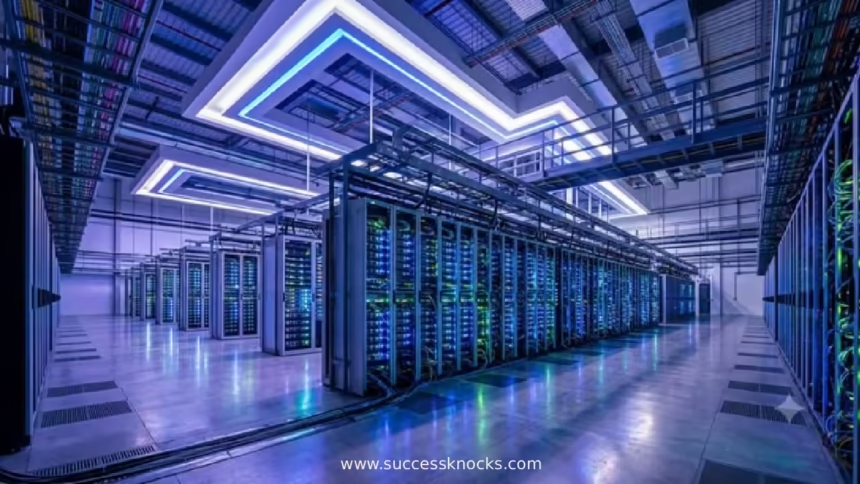
Biggest data center projects announced in 2026 are rewriting the rules of American infrastructure, and honestly, the scale is hard to wrap your head around. We’re not talking about a warehouse full of servers anymore. We’re talking about multi-gigawatt campuses that rival small power plants, backed by hundreds of billions in capital from the biggest names in tech.
Here’s the quick version before we go deep.
Quick Summary — What’s Actually Happening:
- Hyperscalers (Amazon, Microsoft, Google, Meta) are on pace to spend nearly $700 billion combined on data centers in 2026 alone.
- The Stargate initiative (OpenAI, Oracle, SoftBank) is building out multiple gigawatt-scale sites across Texas, New Mexico, and beyond.
- Texas has become the undisputed epicenter, hosting several of the largest projects by raw capacity.
- Power availability — not land, not money — is now the single biggest bottleneck slowing these builds down.
- Most of these projects are tied directly to AI compute demand, not traditional cloud storage.
If you want the bigger picture on how we got here, I broke down the full economics of this trend in the data center investment boom of 2026, which covers the money side in more detail.
Why 2026 Became the Year of Mega-Projects
Something shifted. Data centers used to be a quiet, unglamorous part of tech infrastructure — nobody wrote headlines about a colocation facility in Ashburn, Virginia.
Then AI training demand exploded. Suddenly, chipmakers, cloud providers, and government officials were all talking about gigawatts like it was a normal unit of business planning. It isn’t. A single gigawatt can power roughly 750,000 homes, according to the U.S. Department of Energy’s own grid planning estimates.
That context matters. When a company announces a 5 GW campus, they’re essentially proposing to build the electrical footprint of a mid-sized city — just to run chatbots and model training runs. Wild, right?
The Biggest Data Center Projects Announced in 2026, Ranked
Biggest Data Center Projects Announced in 2026 Here’s where things get concrete. Below is a snapshot of the standout projects making headlines this year, based on capacity, investment size, and construction status.
| Project Name | Company / Developer | Location | Planned Capacity | Estimated Investment | Status |
|---|---|---|---|---|---|
| HyperGrid (Project Matador) | Fermi America | Amarillo, TX | Up to 11 GW | Tens of billions | Under construction |
| PORTS-Pike Technology Campus | OpenAI / SB Energy | Piketon, OH | 8 GW | $105B (Nvidia-backed) | Under construction |
| Meta Hyperion | Meta Platforms | Richland Parish, LA | Up to 5 GW | ~$27B | Under construction |
| Project Camellia | OpenAI | Effingham County, GA | 3.2 GW | $20B–$30B | Planned |
| Matrix Data Center Campus | MSB Global Services | Sulphur Springs, TX | 3 GW | $18.7B | Planned |
| Project Tembo | Cheyenne, WY | 2.7 GW | Undisclosed | Under construction | |
| Project Jupiter (Stargate) | STACK Infrastructure / BorderPlex | Santa Teresa, NM | 2.2–2.45 GW | Part of $165B Stargate build-out | Under construction |
Figures reflect publicly reported plans as of 2026 and are subject to change as projects move through permitting and construction phases.
Stargate’s Sprawl: The Biggest Data Center Projects Announced in 2026 Under One Banner
Stargate deserves its own mention, because it isn’t one project — it’s an umbrella covering many. OpenAI, Oracle, and SoftBank first unveiled the $500 billion initiative through a White House announcement, and it’s since spread across Texas, New Mexico, Ohio, and Michigan.
The Abilene, Texas campus was the flagship, breaking ground first with eight buildings and over 5 GW of planned capacity. From there, Stargate branched into smaller (still massive) satellite sites — Project Jupiter in New Mexico, Project Freebird in Milam County, and “The Barn” in Michigan among them.
Think of Stargate less like a single skyscraper and more like a highway system — one name, but dozens of on-ramps feeding into it across different states.
Fermi America’s HyperGrid: The Biggest Bet in Texas
If you’re ranking by raw capacity alone, Fermi America’s HyperGrid campus near Amarillo currently tops the list at up to 11 GW. That’s genuinely staggering — bigger than some entire regional power grids.
What makes this one different is the energy strategy behind it. Fermi America isn’t just requesting grid power; they’re pairing the campus with dedicated on-site generation, including plans tied to nuclear and natural gas capacity. That’s becoming the playbook for anyone building at this scale.
Why These Projects Matter for the Power Grid
Here’s the thing nobody tells beginners: the real constraint on these mega-projects isn’t financing. It’s electrons.
Utility companies simply can’t turn on 5 GW of new demand overnight. Georgia Power, for instance, structured a 25-year agreement specifically to support OpenAI’s Project Camellia — that’s how far out utilities are now planning around single customers.
The U.S. Energy Information Administration has already flagged data centers as a major driver behind rising electricity demand forecasts nationwide, a trend that’s expected to accelerate through the decade. If you want a deeper breakdown of why power — not permits — is the real gatekeeper here, I covered that in detail in how data center power constraints are actually reshaping site selection.
Step-by-Step: How Beginners Can Track These Announcements
New to following this space? Here’s the approach I’d take if I were starting from zero.
- Start with capacity, not headlines. Ignore press-release adjectives like “massive.” Look for the GW or MW figure — that’s the real signal of scale.
- Check the power source. Grid-tied, off-grid, or on-site generation changes the entire timeline and risk profile of a project.
- Track the anchor tenant. Most campuses are built for one primary customer (OpenAI, Meta, xAI). Know who’s actually renting the compute.
- Watch permitting stages. “Announced” and “under construction” are very different milestones — many projects stall between the two.
- Follow the utility filings. State public utility commission dockets often reveal real timelines before press coverage does.
Common Mistakes & How to Fix Them
Mistake #1: Treating every announcement as a done deal.
Plenty of these projects get delayed, downsized, or scrapped entirely once permitting and power negotiations hit reality. Fix: track construction milestones, not just press releases.
Mistake #2: Ignoring the power agreement details.
A campus without a signed power purchase agreement is basically a rendering with a name attached. Fix: look specifically for utility contracts or on-site generation plans before assuming a timeline is solid.
Mistake #3: Confusing total investment with construction cost.
Numbers like “$165 billion” often cover an entire multi-site initiative, not one building. Fix: separate campus-level cost estimates from umbrella-program totals, like Stargate’s combined figure.
Mistake #4: Assuming bigger always means better for local communities.
Gigawatt-scale campuses can strain water supplies and local grids. Fix: check local reporting and public utility hearings, not just corporate press kits, before drawing conclusions about community impact.
Key Takeaways
- The biggest data center projects announced in 2026 are almost entirely AI-driven, not traditional cloud storage builds.
- Texas hosts several of the largest sites by capacity, including Fermi America’s 11 GW HyperGrid campus.
- Stargate operates as a multi-site umbrella initiative rather than one physical location.
- Power availability, not capital, is the primary bottleneck slowing construction timelines nationwide.
- Utilities like Georgia Power are signing decades-long agreements to accommodate single mega-tenants.
- Hyperscaler capital spending is projected near $700 billion combined for 2026.
- Not every announced project reaches construction — permitting and grid capacity can stall or shrink plans significantly.
So where does that leave you? If you’re tracking this space — as an investor, a job seeker, or just someone curious about where American infrastructure dollars are flowing — the pattern is clear: follow the power contracts, not the press releases. That’s where the real story of the biggest data center projects announced in 2026 actually plays out.
FAQs
What is the single biggest data center project announced in 2026?
By raw planned capacity, Fermi America’s HyperGrid campus near Amarillo, Texas leads the pack at up to 11 GW, though Stargate’s combined multi-site footprint arguably represents a larger overall initiative.
Why are so many of the biggest data center projects announced in 2026 located in Texas?
Texas offers deregulated power markets, faster permitting, available land, and grid operators willing to negotiate large-load agreements — a combination that’s hard to match elsewhere.
Are all these announced data center projects guaranteed to be built?
No. Announcements often precede full permitting and power agreements by years, and some projects get scaled back or delayed once grid capacity and community pushback enter the picture.


