

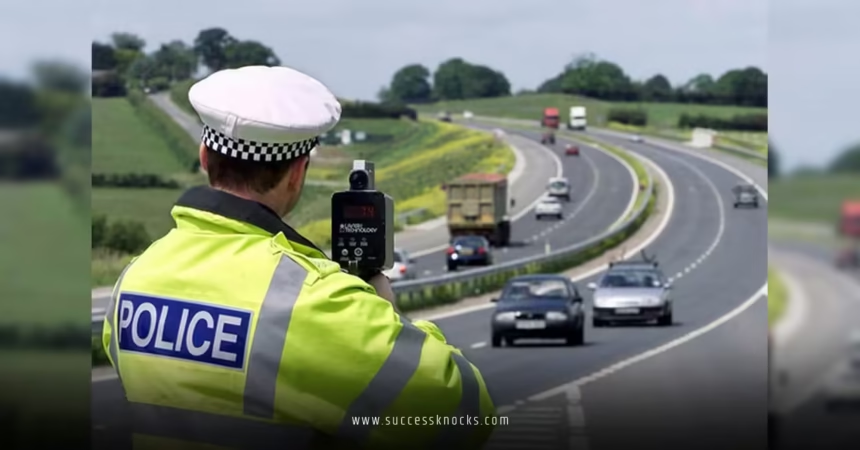
UK speeding fines and penalty points explained simply: get caught speeding, and you’re not just paying a fine — you’re loading points onto a licence that can only hold so much weight before it snaps. Ask Dawn French. Her six-month driving ban after a fourth speeding offence in Plymouth is the freshest, most public proof that this system doesn’t play favorites.
Here’s the deal in plain terms before we get into the mechanics.
- Fines are tiered by income and offence severity — not a flat number everyone pays.
- Points range from 3 to 6 depending on how far over the limit you were caught.
- 12 points within 3 years triggers an automatic disqualification consideration — this is the “totting up” rule.
- Points stay active for 3 years, but can affect your insurance for up to 5.
- First-time minor offenders can sometimes swap points for a speed awareness course instead.
This isn’t abstract law-nerd trivia. It’s the exact framework that just took down a national comedy icon, and it’s the same framework that’ll catch any UK driver who treats speed limits as suggestions.
How UK Speeding Fines and Penalty Points Actually Work
Let’s start with the fine structure, because most drivers get this wrong immediately.
UK speeding fines aren’t flat fees. They’re calculated as a percentage of your weekly income, split into three severity bands [1].
- Band A (lowest speed over limit): fine equals 25%–75% of weekly income.
- Band B (moderate excess): fine equals 75%–125% of weekly income.
- Band C (highest excess): fine equals 125%–175% of weekly income.
There’s a statutory cap, though — £1,000 for most roads, £2,500 on motorways. So no, you can’t get fined into oblivion even if you’re earning big.
Now, the points. This part matters more than the fine, honestly.
Why Penalty Points Cause More Damage Than the Fine Itself
Here’s the thing nobody tells beginner drivers: the fine is a one-time hit. Points are a slow bleed.
- 3 points: standard for most low-level speeding offences (like French’s 36mph-in-a-30 conviction).
- 4–6 points: reserved for more serious excess-speed cases, especially those that go to court rather than a fixed penalty notice.
- Points expire after 3 years for totting-up purposes, but they sit on your licence for insurance-checking purposes far longer.
Insurers see those points too. Expect premium increases of 20%–30% on average after a single speeding conviction, according to industry pricing data reported by comparison services [2]. That’s not a one-off fine — that’s a tax you pay every renewal for years.
UK Speeding Penalty Bands at a Glance
Numbers are easier to digest in a table. Here’s the breakdown by severity band.
| Speed Band | Example (30mph zone) | Typical Points | Fine Range | Court Referral Likely? |
|---|---|---|---|---|
| Band A | 31–35 mph | 3 points | 25%–75% of weekly income | Rarely |
| Band B | 36–40 mph | 4–6 points or short ban | 75%–125% of weekly income | Sometimes |
| Band C | 41mph+ | 6 points or disqualification | 125%–175% of weekly income | Often |
Interesting wrinkle here — Dawn French’s offence, 36mph in a 30mph zone, technically sat right at the Band B threshold. That’s not a wild, reckless speed. It’s the kind of thing thousands of UK drivers do weekly without thinking twice. The difference was her existing point total, not the offence severity.
Step-by-Step: What Happens After You’re Caught Speeding
If you’ve never been through this process, here’s exactly how it unfolds.
- You’re caught — by a fixed camera, mobile unit, or an officer with a radar gun.
- A Notice of Intended Prosecution (NIP) arrives by post within 14 days, usually.
- You respond, confirming who was driving.
- Options get presented: a Fixed Penalty Notice (fine + points), a speed awareness course (first-timers only, points-free in most cases), or a court summons for serious cases.
- Points post to your licence electronically via the DVLA — no more paper counterpart since 2015.
- DVLA tracks your rolling 3-year total. Hit 12, and you’re heading to a totting-up hearing.
- Magistrates decide the ban length, typically starting at 6 months for a first totting-up disqualification.
Simple on paper. Brutal in practice if you’re not tracking your own point total.

Common Mistakes Drivers Make With Speeding Fines and Points
I’ve seen the same errors trip up drivers again and again — beginners and seasoned commuters alike.
Mistake #1: Paying the fine and forgetting the points exist.
Fix: check your driving licence record on GOV.UK after every offence. Know your exact running total, not a rough guess.
Mistake #2: Assuming a speed awareness course is always available.
Fix: it’s typically only offered once every three years, and only for lower-band offences. Don’t bank on it as a repeat escape hatch.
Mistake #3: Not shopping insurance after a conviction.
Fix: get quotes from at least three providers post-conviction — premiums vary wildly, and loyalty rarely pays off here.
Mistake #4: Ignoring how close you are to the 12-point cliff edge.
Fix: this is exactly what caught up with Dawn French. If you’re sitting at 9 or 10 points, drive like there’s a magistrate in your back seat.
Mistake #5: Fighting a totting-up ban without solid grounds.
Fix: “exceptional hardship” arguments need real evidence — job loss, care responsibilities, provable consequences. A vague “I need my car” plea won’t cut it in front of a judge.
What I’d Tell a New Driver Sitting at 6 Points
If a friend called me up saying they’d just hit 6 points, I’d tell them straight: you’re halfway to a ban, and the second half goes faster than the first.
Why? Because most drivers who get one ticket weren’t paying attention the first time either. The habits that earned points once tend to repeat — same road, same rush, same “I’ll just push it a bit” mentality.
Think of your licence points like a credit score for your driving. Nobody checks it until they desperately need to, and by then, the damage is already sitting there in black and white.
Key Takeaways
- UK speeding fines scale with income and offence severity, split into Bands A, B, and C.
- Points range from 3 to 6 depending on how far over the limit you were caught.
- Hitting 12 points within a rolling 3-year window triggers automatic totting-up disqualification consideration.
- Dawn French’s six-month driving ban after her fourth speeding offence in Plymouth is a real-world case of exactly this rule in action.
- Speed awareness courses can help first-time offenders avoid points entirely, but they’re not unlimited.
- Insurance premiums typically rise 20%–30% after a single speeding conviction.
- Exceptional hardship pleas rarely succeed without solid, documented evidence.
Bottom line? Points aren’t background noise attached to a fine — they’re the actual threat. The fine stings once; the points follow you around for years, quietly stacking until one ordinary speeding offence turns into a six-month ban, just like it did in Plymouth in 2026. Check your licence record today, know your exact point total, and treat every speed limit sign like it’s the last warning you’ll get.
FAQs
How many points do you need before a UK driving ban kicks in?
12 points within a rolling 3-year period triggers a totting-up disqualification hearing, the same threshold that led to Dawn French’s driving ban after her fourth speeding offence.
Do speeding points ever disappear from your licence?
Yes — points expire for totting-up purposes after 3 years, though convictions can remain visible on your licence record for insurance purposes for up to 5 years.
Can you avoid points with a speed awareness course after multiple offences?
Usually not — courses are typically offered only to first-time or low-band offenders, and repeat offenders like those approaching a totting-up ban rarely qualify.


