AI agent vs. chatbot: what’s the real difference for your business — and why does it matter which one you pick? If you’ve been using these terms interchangeably, you’re not alone. But here’s the thing: choosing the wrong tool is like hiring a receptionist when you actually need a project manager. Same broad category, wildly different outcomes.
Before we get into the weeds, here’s what you need to know:
- Chatbots follow scripts. AI agents make decisions.
- Chatbots respond. AI agents act.
- The gap between the two is widening fast — especially in 2026.
- For small businesses, picking the right tool can mean the difference between saving 10 hours a week and wasting a software subscription.
- This isn’t about hype. It’s about fit for your specific workflow.
If you want the full picture on deploying AI tools at scale, the complete guide to AI agents for small business lays out the broader strategy — but start here to nail the fundamentals.
AI Agent vs. Chatbot: What’s the Real Difference for Your Business in Plain English
Let’s cut through the noise.
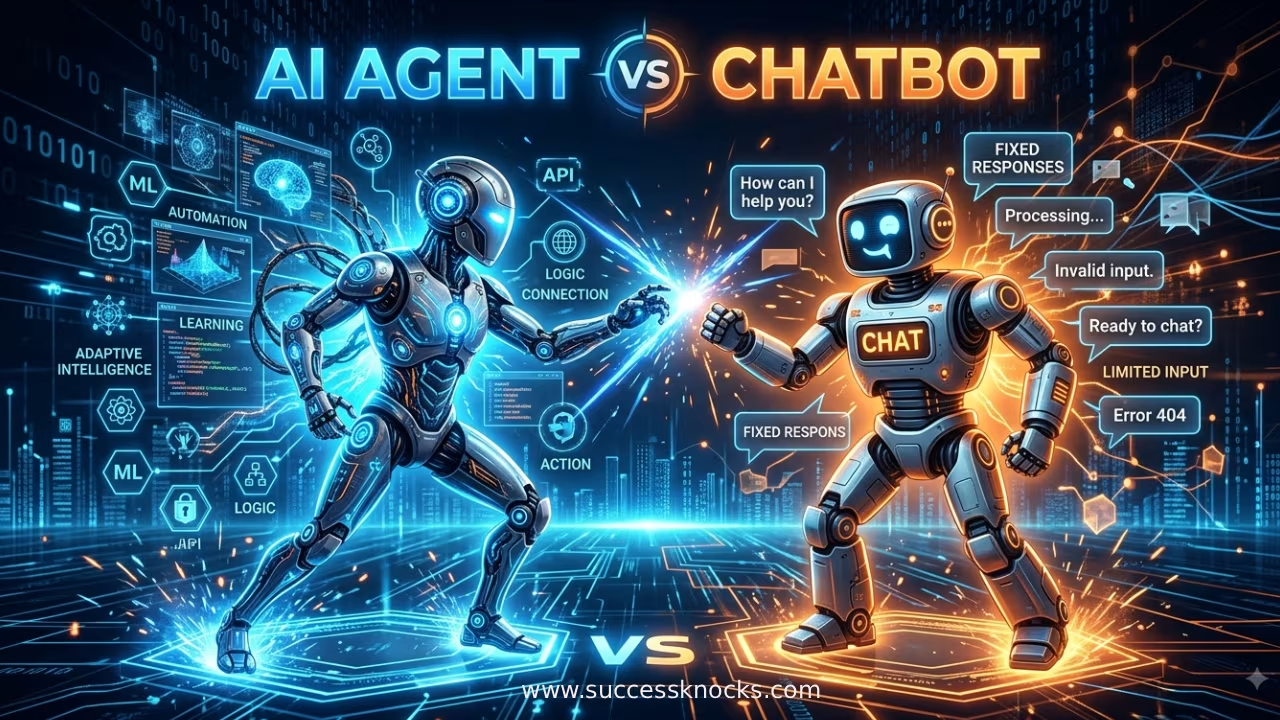
A chatbot is a conversational tool built on a decision tree or a language model that answers questions. It’s reactive. You type something, it responds. That’s the job. Classic chatbots — think the pop-up on a retail website — were literally just if/then logic: “If user says X, show message Y.” Modern chatbots powered by large language models (LLMs) are smoother and smarter, but they’re still fundamentally response machines.
An AI agent is different at the architecture level. It doesn’t just respond — it plans, executes, and iterates. Give it a goal (“book a meeting with anyone who filled out my contact form today”) and it figures out the steps, calls the right tools (calendar API, email, CRM), and loops until the job’s done. It acts with autonomy.
The kicker is this: both can hold a conversation. But only one of them can do the work afterward.
The Core Difference: Reactive vs. Autonomous
Think of it this way. A chatbot is a well-trained front desk staffer reading from a binder. An AI agent is a junior operations analyst who reads the binder, rewrites it if it’s wrong, emails the right department, and sends you a summary — without being asked.
| Feature | Traditional Chatbot | LLM-Powered Chatbot | AI Agent |
|---|---|---|---|
| Primary Function | Answer FAQs, route users | Conversational Q&A | Complete multi-step tasks |
| Memory | None (session only) | Limited context window | Persistent memory across sessions |
| Tool Use | None | Rare/limited | Core capability (APIs, databases, apps) |
| Decision-Making | Rule-based | Probabilistic responses | Goal-directed reasoning |
| Can Take Actions | No | No | Yes |
| Handles Ambiguity | Poorly | Better | Actively resolves it |
| Setup Complexity | Low | Low–Medium | Medium–High |
| Best For | Simple FAQs, routing | Conversational support | Workflows, automation, complex tasks |
| Example Tools (2026) | Tidio, Freshchat (basic) | ChatGPT plugins, Intercom Fin | AutoGPT, Relevance AI, Lindy |
Why This Distinction Actually Matters for Small Businesses
AI Agent vs. Chatbot: What’s the Real Difference for Your Business Here’s where most small business owners get burned. They deploy a chatbot expecting it to handle customer service end-to-end. It handles the easy stuff — “What are your hours?” — and then completely falls apart on anything that requires action. The customer gets frustrated. The owner thinks “AI doesn’t work for us.” The real issue? Wrong tool.
What usually happens is this: businesses with recurring, multi-step workflows — onboarding new clients, following up on quotes, processing simple orders — see the most dramatic ROI from AI agents. Businesses that just need to deflect common support tickets? A well-configured LLM chatbot is often enough.
The question isn’t “which is better?” It’s “which does my bottleneck actually need?”
AI Agent vs. Chatbot: What’s the Real Difference for Your Business When It Comes to Automation?
Automation is the deciding factor.
Chatbots automate conversations. AI agents automate outcomes.
If your goal is answering “Where’s my order?” at 2 a.m. — chatbot. If your goal is automatically processing that order inquiry, checking your inventory system, updating the customer record in your CRM, and sending a follow-up email three days later — that’s an agent’s job.
According to McKinsey’s research on generative AI’s economic potential, automating knowledge work tasks — including customer service workflows — could unlock significant productivity gains across industries. The distinction between simple Q&A automation and full task automation is exactly where those gains live.
Step-by-Step: How to Choose Between a Chatbot and an AI Agent
AI Agent vs. Chatbot: What’s the Real Difference for Your Business No framework-speak. Just a practical decision process.
Step 1: Write down the exact task you want to automate.
Be specific. Not “handle customer service” — more like “answer refund requests” or “qualify inbound leads.”
Step 2: Count the steps required to complete that task.
If it’s 1–2 steps (receive question → give answer), you need a chatbot. If it’s 3+ steps involving different tools or systems, you need an agent.
Step 3: Check whether your tools have APIs.
AI agents need to connect to your existing stack — your CRM, calendar, email, helpdesk. If your tools don’t have open APIs or native integrations, even a powerful agent is going to hit walls.
Step 4: Assess your tolerance for setup time.
Chatbots can go live in hours. Agents take days to weeks to configure properly. If you need something running by Friday, start with a chatbot.
Step 5: Define what “done” looks like.
Agents are goal-oriented. You need to define a clear success condition — otherwise you’re just automating confusion.
Step 6: Start small, measure, then scale.
Don’t automate your most complex workflow first. Pick a repetitive, low-stakes task, deploy an agent, track the outcomes for two to four weeks, then expand.
AI Agent vs. Chatbot: What’s the Real Difference for Your Business in Terms of Cost?
Price points vary significantly. Basic chatbot platforms (Tidio, ManyChat, Freshchat) typically run $0–$50/month for small business tiers. LLM-powered chatbots like Intercom Fin start around $99/month. AI agent platforms — Lindy, Relevance AI, or custom deployments — generally range from $49/month for simple templates to several hundred dollars monthly for full workflow automation.
The real cost, though, isn’t the subscription. It’s the time cost of setup and maintenance and the opportunity cost of picking the wrong tool. If you want a detailed breakdown before committing, the full cost breakdown for deploying an AI agent for customer service covers exactly what to budget for.
Common Mistakes — and How to Fix Them
Mistake 1: Deploying an agent when you needed a chatbot.
Fix it: If your use case is purely informational (FAQs, hours, pricing), a chatbot is cheaper, faster, and easier to maintain. Don’t overcomplicate it.
Mistake 2: Expecting a chatbot to take action.
Fix it: Stop configuring it to “handle” the task. Configure it to capture and route the task to a human or an agent that can act on it.
Mistake 3: Not defining the agent’s success condition.
Fix it: Before you build anything, write one sentence: “This agent succeeds when [specific outcome] happens.” Without that, you’ll spend weeks debugging the wrong thing.
Mistake 4: Connecting an agent to your production systems without testing.
Fix it: Always run your agent in a sandbox environment first. One misconfigured automation can spam your entire customer list or overwrite real records. According to OWASP’s LLM Application Security guidelines, excessive agency and improper tool permissions are among the top security risks in AI deployments.
Mistake 5: Treating the agent as “set and forget.”
Fix it: AI agents need monitoring. Goals shift, APIs break, edge cases appear. Build in a monthly review — 30 minutes minimum — to catch drift before it becomes a customer-facing problem.
Mistake 6: Ignoring the handoff.
Fix it: The best deployments know exactly when to escalate from AI to human. Define those thresholds upfront. A frustrated customer escalating to a real person is fine. A frustrated customer stuck in an agent loop is a churn event.
A Quick Word on Where This Is All Heading
In 2026, the line between chatbots and agents is blurring — fast. Platforms like Intercom, HubSpot, and Salesforce are embedding agent-like capabilities directly into their chatbot interfaces. What used to require custom engineering is becoming a toggle in a dashboard.
But the conceptual difference still holds. Understanding which model you need — reactive or autonomous — is the mental model that’ll save you from bad vendor pitches and misaligned expectations. The Stanford HAI research group has been tracking the evolution of AI agent architectures, and the consensus is clear: agentic systems are not incremental chatbot improvements — they represent a fundamentally different design philosophy.
Key Takeaways
- Chatbots are reactive — they answer questions. AI agents are autonomous — they complete tasks.
- If your use case involves 3+ steps, multiple tools, or requires action (not just response), you need an agent.
- Chatbots are faster and cheaper to deploy. Agents require more setup but unlock real workflow automation.
- Never connect an agent to live production systems without sandbox testing first.
- Cost isn’t just the subscription — factor in setup time, maintenance, and the cost of getting it wrong.
- Both tools can coexist. Many businesses use a chatbot as the front door and an agent as the back-end workflow engine.
- The “best” tool is the one that matches your specific bottleneck — not the one with the best marketing.
- Always define what “done” looks like before you build. Vague goals produce vague automations.
What Would I Do?
AI Agent vs. Chatbot: What’s the Real Difference for Your Business If I were a small business owner evaluating this today, here’s my honest call: start with an LLM-powered chatbot for customer-facing support — one that handles common questions well and escalates gracefully. Then, identify the one internal workflow that eats the most time (lead follow-up, scheduling, onboarding) and pilot one AI agent specifically for that task. Give it 30 days. Measure before-and-after time spent. Let the data tell you whether to expand.
Don’t automate everything at once. Don’t buy the most expensive agent platform because it looks impressive. Start with clarity, not complexity.
FAQs
Q1: Is there a scenario where a chatbot and an AI agent work together?
Yes — and it’s actually one of the most effective setups in 2026. A chatbot handles the customer-facing conversation (collects info, answers basic questions, sets expectations), while an AI agent works in the background to execute the actual task — updating records, sending emails, triggering workflows. The chatbot is the face; the agent is the engine.
Q2: For someone asking about AI agent vs. chatbot — what’s the real difference for your business at the very early stage — where should you start?
Start with a chatbot. Seriously. Most early-stage businesses don’t yet have the systematic, repeatable workflows that make agents worth the setup cost. Get your processes documented and consistent first. Once you can describe a workflow in precise steps, then you’re ready to hand it to an agent.
Q3: Can AI agents replace chatbots entirely?
Not cleanly — and not for every use case. Agents are overkill for pure Q&A scenarios, and they introduce more complexity and potential failure points than chatbots. Think of them as different instruments in the same toolkit. A hammer doesn’t replace a screwdriver; it just does a different job better.