Q1. With your extensive experience in the surety and reinsurance space, what inspired your journey into the insurance industry, and what continues to drive your leadership at Janus Assurance Re?
A. My journey into insurance began in 1994, when the State of North Carolina issued me a bail agent’s license. At the time I was the youngest professional bondsman in the state. That first exposure to suretyship, where the bondsman has genuine skin in the game on every single obligation, taught me more about risk evaluation than any classroom ever could. Having personal liability on every bond you write is a formidable, and occasionally painful teacher. When the bail market began to contract in the late 1990s under the weight of a shrinking market and a growing pool of bondsmen, I began exploring adjacent lines. Civil suretyship was the natural fit. Surety One, Inc. grew out of that pivot. Janus Assurance Re followed some years later as the logical next step, a captive facility that would give our group the underwriting capacity and reserving flexibility that we needed to support both clients and our carrier partners.
What drives me today is the same thing that drove me then, a fanatic focus on the voice of the customer. Our philosophy has always been that we never decline a submission if the obligation is bondable or insurable, and we can get our heads wrapped around the obligation. From my perspective, leadership is a two-lane street. It is about building an enduring enterprise, one that can be passed along to the next generation of the Poindexter Group Team, and ensuring that that future generation of Team members will support the charitable foundations that have been part of my mission from the beginning. Commerce and community are not separate enterprises in my view. They are the same enterprise.
Q2. Janus Assurance Re operates in specialized segments such as surety bonds and financial guarantees. How do you define the company’s unique value proposition in a highly competitive global insurance market?
A. Janus is not trying to be everything to everyone, and that is precisely the point. We are a specialty facility built around three competencies that generalist carriers may not be configured to deliver: deep knowledge of the nature of the obligations that we undertake, willingness to structure capacity for needs that fall outside the standard appetites, and a robust understanding of what our clients require to reach their goals. Surety is fundamentally a credit evaluation exercise dressed up as insurance. It shares more in common with banking than with traditional property and casualty lines. That reality demands underwriters who have a crystal clear understanding of what we are being asked to guarantee, exposure tails, and the way economic stress can correlate very real problems across an otherwise healthy and diversified book.
Our value proposition comes down to three things. First, domain depth. Our underwriting team carries credentials and tenure that compare favorably with any specialty facility in the market. Second, structural flexibility. Because Janus is ours, we can craft treaties, fronting arrangements, non-traditional layering, and other novel terms in ways that a publicly traded, admitted carrier simply cannot. Third, responsiveness. A mid-market contractor or a Latin American financial institution calling Janus gets an underwriter, not a voicemail tree, and in many cases gets terms the same day. In a market where incumbents often rely on inertia and privileged relationships, that combination is differentiating. We are VERY close to our end users.
Q3. As a thought leader, how do you see the role of captive insurance and reinsurance evolving in addressing modern financial and operational risks?
A. Captives have moved from being a tax-advantaged curiosity to being a core component of serious enterprise risk management. I expect that trajectory to continue. Traditional markets have become less reliable partners on complex, emerging, or idiosyncratic exposures. Cyber liability is the obvious example, but the same dynamic applies to financial guarantee business, reputational risk, supply chain interruption, and a growing list of operational risks that underwriters struggle to price. When the commercial market withdraws or prices irrationally, a captive gives the parent organization a tool to retain economics, build actuarial data, and maintain continuity of coverage.
Reinsurance, which we offer to captives, helps the captive model remain sustainable. A captive without a smart reinsurance program is just a deductible with a legal wrapper. The tradecraft lies in the treaty architecture, whatever matching (i.e.,quota share, surplus share, excess of loss, and facultative placements, etc.) to the underlying book make sense. I expect the next decade to bring more sophisticated captives, more regulatory scrutiny of them, increased demand on and for captive managers who genuinely understand the mechanics rather than simply purchasing coverages off the shelf. The explosive growth of A.I. and data centers I think will drive a lot of this growth.
Q4. Janus has transitioned across jurisdictions, including Bermuda and the Dominican Republic. What strategic advantages do such global structures offer in today’s regulatory and financial landscape?
A. Janus was originally constituted in Bermuda and was later redomiciled to the Dominican Republic, where it remains in compliance with the capital and surplus requirements of its domiciliary rules. Each jurisdiction offered advantages at different points in our evolution. Bermuda provided a mature, internationally respected framework that was well understood by reinsurance counterparties. The Dominican Republic, as our book shifted toward the Caribbean and Latin American markets we primarily serve, offered regulatory proximity and a closer relationship with the regulator, operational efficiency, and alignment with a client base we were building through Surety One’s presence in the Caribbean.
The broader strategic point is that domicile is a tool, not an identity. A well-run captive should be domiciled where its regulatory environment, tax treatment, capital requirements, and market proximity best serve its purpose at that stage of its life. Jurisdictions that prize substance over form, that have credible solvency regimes, and that permit the underwriting flexibility that specialty business demands are invaluable. Janus is not an admitted carrier in the United States, which may change at some point however Janus is in a very good place right now so I don’t foresee a U.S. presence in the short term. We provide capacity and reinsurance support to the licensed fronting and primary carriers with which we work and direct write specialty offshore commercial accounts. The current structure suits that mission.
Q5. Risk management is becoming increasingly complex across industries. How is Janus Assurance Re innovating its underwriting and risk assessment models to stay ahead of emerging challenges?
A. I am cautious about using the word “innovation” in underwriting. A great deal of what passes for innovation in our industry is unfortunately an automation of mistakes that careful human underwriters would never have made. Janus focuses on disciplined evolution. Our underwriting is grounded in proven tradecraft, that is standard financial analysis of the principal and having a clear understandingo of the nature of the obligations that we guarantee. Within the surety class, the three Cs; character, capacity, and capital, are still the bedrock of every bond capacity evaluation. We are not reinventing the wheel there. Around that core, we have layered more rigorous analytics, better exposure aggregation monitoring, and a continuously updated view of macroeconomic indicators that tend to correlate significant changes in risk to our book.
The areas where we have genuinely pushed forward are three. First, we have invested heavily in the technical credentialing of our line underwriters. Tradecraft built on an appropriate fundamental knowldege of the subject matter is the single best defense against suffering what we call a strategic surprise, an unforeseen high-impact event. Second, we have built out our cyber and professional liability capabilities, recognizing that our surety clients increasingly need these adjacencies and that cyber exposure is one of the defining underwriting challenges of our era. Third, and this is on the Re side, we have become far more deliberate about retention discipline on surplus share, adjusting our retained line to capital position and portfolio concentration rather than leaving it static. Cyber especially is too complex and too fast-moving today to rely on in-house countermeasures. The days of simple breach repair and notifications are over. So, we pair our underwriting with subject-matter specialists if the coverage that we are offering is anything more than just a token policy to meet a low compliance limits. Good underwriting is ninety percent humility and ten percent cleverness. We try to keep those proportions straight and we try not to miss an opportunity to learn.
Q6. The surety industry plays a critical role in supporting infrastructure and construction sectors. How do you see this segment evolving, and what role does Janus play in enabling sustainable growth?
A. Contract suretyship is arguably the most socially useful class of insurance there is. Surety bonds are the cornerstone of construction integrity. They ensure that projects are completed on time, that subcontractors and suppliers are paid, and that taxpayer dollars on public works are protected. The performance and payment bond system is a quiet but extraordinary piece of economic infrastructure, and in many jurisdictions it is the single mechanism standing between a failed contractor and a half-built school or hospital.
Where I see the segment evolving is toward greater sophistication in risk sharing. Public-private partnerships, mega-projects (especially data center projects), and cross-border infrastructure programs require bonding capacity that very few individual carriers can absorb on their own balance sheet. That is precisely where specialty reinsurers like Janus add value, by participating in pools of these oversized and complex risks to the benefit of all of their stakeholders. Our capacity contribution lets primary sureties write the obligations their clients actually need without overextending themselves. I also expect meaningful growth in bonding for sustainable and resilient infrastructure, for alternative energy projects, and for the kind of long-duration public works where the principal’s credit must be evaluated over a ten or fifteen year tail. My book, The Contractor’s Guide to Surety Bonds, was written in large part to help contractors understand that bonding is not a bureaucratic obstacle but a strategic lever, one that institutionalizes discipline and unlocks access to higher-value work. Sustainable growth in construction and sustainable growth in surety are, in practical terms, the same project.
Q7. With growing digital transformation in financial services, how is technology—such as data analytics and automation—reshaping the future of insurance and reinsurance?
A. Technology is reshaping our business in really significant ways, however, I want to be clear about both sides of that ledger. On the positive side, AI-driven work flows and analytics have made underwriting faster, enhanced judgment underwriting, made exposure aggregation more transparent, and portfolio monitoring close to real-time rather than monthly or quarterly. Automation has taken enormous friction out of the transactional end of the surety business, particularly for smaller commercial bonds where the cost of underwriting really exceeds the premium itself unless the volume is incredibly large. Same-day turnaround on a bond used to be extraordinary. It is now just assumed that an applicant can get what they want “right now”.
On the cautious side, technology is not a substitute for judgment in some of the classes that we write. Suretyship is a call on a human enterprise. The signals that matter most such as character, track record, management depth, the quality of a contractor’s supplier and sub relationships, and the truths about work in progress do not reduce neatly to a dataset. Further, technology cannot shake a hand, invite a contractor to a coffee nor be a true friend and collaborator when a shock claim appears or an unavoidable catastrophe befalls a contractor. The firms that will win over the next decade will be the ones that use technology to compress the rote work so their underwriters have more time for the judgment-intensive work and personal relationships. Janus is investing in broadly in its A.I. capability, data infrastructure, portfolio analytical capacity, and secure client-facing tools. We are also investing, just as deliberately, in our people’s technical credentials. An underwriter who understands both the data and the underlying obligation will always outperform the one who understands only one or the other.
Q8. As a recognized industry expert (noted for thought leadership in surety practices), how do you contribute to educating and guiding professionals and businesses in understanding complex risk instruments?
A. Education has been a through-line of my career, and it is genuinely the part of the the industry that I really enjoy. Suretyship especially is poorly understood even by many insurance professionals. The contractors, attorneys, CPAs, and project owners who encounter surety know even less. That knowledge gap has real consequences. It extends to contractors who bid work that a surety won’t bond, to obligees who misread the guarantees that they hold, and to brokers who place business incorrectly. Much of what I write and publish is directed to narrowing that gap.
Concretely, I try to contribute to the insurance knowledge pool in several ways. I write regularly on reinsurance, financial guarantee, surety underwriting, risk management generally and the legal frameworks surrounding the products that we offer. I authored The Contractor’s Guide to Surety Bonds in 2025, which is now available through Amazon and Barnes & Noble among other distributors, as a primer for construction professionals and the advisors who serve them. I contribute to industry publications and blog on LinkedIn in both English and Spanish. The multi-lingual redundancy matters because much of the growth in our sector is happening in Latin America. Within the Poindexter Group, I mentor our line underwriters , insist that they pursue the technical designations, the CPCU, AFSB, ASLI, ARe, CLPL, and pay the costs for all of it. You cannot ask your team to be students of the craft if you are not a student of it yourself. I think that even with thirty years in the business, being humble in front of one’s team and being clear that learning never stops even for “the boss” is appropriate role modeling.
Q9. Looking ahead, what key trends—such as regulatory shifts, alternative risk transfer, or global economic changes—do you believe will redefine the insurance and reinsurance industry over the next five years?
A. Several currents will matter more than the rest. Regulatory divergence will continue. Solvency regimes in Europe, the United States, Bermuda, and the Latin American jurisdictions are evolving on different timelines, and carriers that operate across borders will need to become genuinely fluent in each. That complexity will reward specialty players who have built their operating model around it, and it will burden generalists who assumed harmonization would do the work for them.
Alternative risk transfer will continue to grow, particularly in the form of captives, cell structures, and parametric products for risks the traditional market prices poorly. Climate-linked exposure, cyber, and political and trade risk will drive much of that demand. Economic cycles will also reassert themselves in surety specifically. We have enjoyed a relatively benign loss environment recently but we cannot expect that to be the norm. Especially in the surety class, suretyship is a credit business. Credit businesses eventually pay for extended periods of easy money. Underwriters who have never worked through a genuine construction-sector meltdown may get an education. Finally, I expect consolidation pressure in the distribution end of the industry to continue. The eight-hundred-pound gorilla in the room is of course A.I. The disintermediation of the traditional agent/broker model is the most grave threat to the participants in the traditional distribution channel in a century. At the carrier level, the firms that combine breadth and depth of knowledge, disciplined capital management, and a robust client orientation will come out of the next five to ten years stronger. The firms that relied on soft-market pricing and distribution inertia will not.
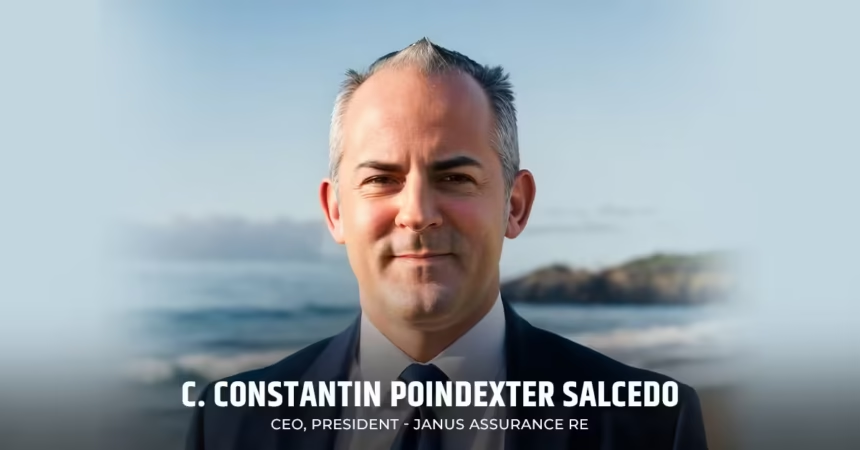
Q10. Please share a brief professional biography of C. Constantin Poindexter Salcedo, highlighting his career journey, expertise in surety and reinsurance, leadership philosophy, and his role in building Janus Assurance Re into a specialized global insurance entity.
A. C. Constantin Poindexter Salcedo is a credentialed thirty-year veteran of the insurance industry and an internationally recognized thought leader in suretyship and reinsurance. He serves as Chairman of Janus Assurance Re, Founder and former CEO of Surety One, Inc., and is a law partner at VSP Consultores Legales, S.A. Together these entities form the core of the Poindexter Surety Group, a specialty platform with operations spanning all fifty U.S. states, Puerto Rico, the U.S. Virgin Islands, Canada, and the Dominican Republic.
His technical credentials include the Chartered Property Casualty Underwriter (CPCU) designation, Associate in Fidelity and Surety Bonding (AFSB), Associate in Surplus Lines Insurance (ASLI), Associate in Reinsurance (ARe), Associate in Insurance (AINS), Associate in Insurance Services (AIS), and Cyber Professional Liability Practitioner (CPLP) designation awarded by the Professional Liability Underwriting Society. He has also earned the Reinsurance Association of America’s Re Scholar certificate, an honor held by only a small group of professionals worldwide. He holds degrees from North Carolina State University, a Juris Doctor from the University of Salamanca, Master’s Degree in Intelligence and graduate counterintelligence certificate from American Military University.
Mr. Poindexter is the author of The Contractor’s Guide to Surety Bonds: A Primer on Contract Surety Bonding for Construction Professionals, published in 2025, and is a frequent contributor to industry publications in both English and Spanish. His leadership philosophy rests on three principles: a fanatic focus on the voice of the customer, a conviction that underwriting excellence is built on a profound knowledge of the obligations that a company chooses to underwrite, and the belief that a business exists to serve something larger than itself. That last principle animates the substantial philanthropic commitments of the Poindexter Surety Group, managed by the Carlyle Poindexter Charitable Foundation. Mr. Poindexter’s foundation focuses on the treatment and cure of debilitating childhood illnesses and eradicating childhood hunger.